

I recently gave a keynote at the Future Leaders Summit in Hamburg this past week. Twenty-five minutes to make one argument: leadership is a clarity problem, not a skills problem.
Twenty-five minutes on stage is a compression engine. You cut stories short. You skim the research. You give people the headline and hope the punchline lands before the clock runs out.
This is the uncompressed version. The full stories. The deeper research. The mechanisms that make the argument actually stick — including everything I had to leave on the cutting room floor.

Here’s the argument I made, and the evidence behind it.
The Leadership Trap Nobody Warns You About
When I got my first real leadership role, I had the experience. I’d been doing the work for years. I knew the business.
Then people started reporting to me. And I had no idea who I was supposed to be.
Not the work — the work was fine. But the leadership part? I stayed up at night wondering if everyone could see that I was winging it. So I did what most new leaders do. I worked harder. Read every book. Tried to absorb every management framework I could find. Tried to imitate every leader I admired.
Carlo Ancelotti has won five Champions League titles, and is considered one of the most successful football managers in history. He wrote something in his book Quiet Leadership that left a huge impression on me: “Leadership can be learned but cannot be imitated. If your natural inclination is to be quiet, calm, and take care of others, it is unwise to try to be anyone else.”
Learned. Not imitated. That was the first time I had words for what I was feeling. I was trying to imitate leadership before I had defined it for myself.
Six months into that role, I walked into a difficult conversation with someone on my team. I had a coaching framework, a feedback model, and a delegation system from a workshop. Needless to say, it was an awkward conversation. I knew all these techniques, but they didn’t fit for the conversation that I was having. Who was I supposed to be at that point? Was I the empathetic listener? The tough-love coach? The peer? The boss?
I probably had five frameworks. But zero foundation.
Charlotte Otter calls this out directly in We Need New Leaders: “We have a flawed leadership archetype that mistakes confidence for competence.” And the philosopher René Girard takes it even further — his theory of mimetic desire says we don’t just imitate other people’s behavior. We imitate what they want. We copy their goals, their style, their version of success, before we’ve ever asked if it actually fits who we are.
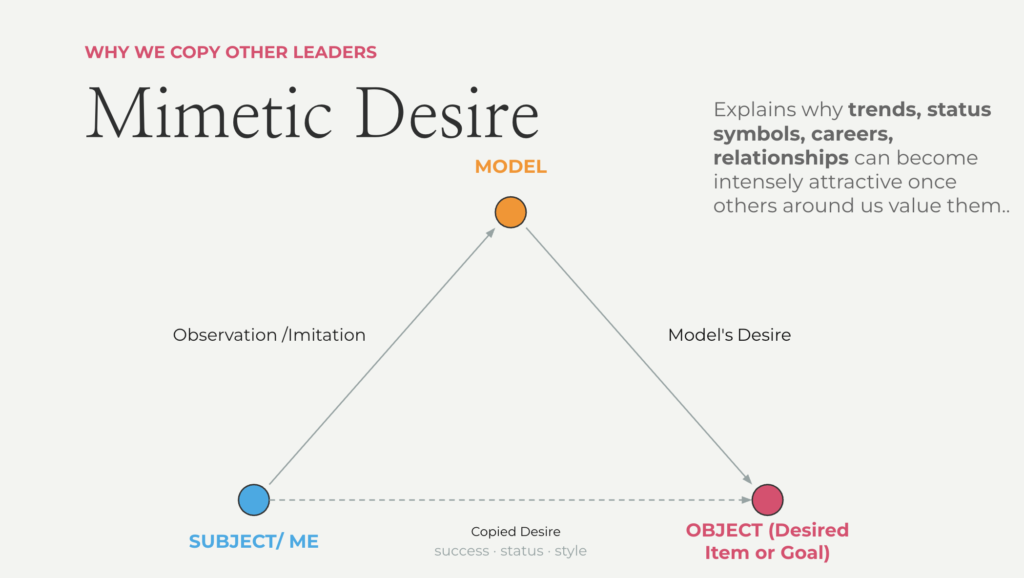
That’s exactly the trap that we want to avoid. When your leadership is built on imitation, no matter what you do, everything is going to make you feel like an imposter, like an actor trying to give an Oscar-worthy performance every day. And what we label as “burnout” is often something more specific. It’s the exhaustion of performing a version of leadership that was never ours to begin with.
The thing is, this is more common than you could imagine. Korn Ferry’s 2024 Workforce Global Insights survey of 10,000 professionals found that 71% of CEOs reported experiencing symptoms of impostor syndrome. These aren’t junior employees. These are the people who are running the largest companies in the world. And it gets worse as you climb — 65% of senior executives reported the same, compared with just 33% of early-career professionals.
That’s a clarity gap, not a skills gap. And it has a structural fix.
The Psychology Experiment That Redefines Self-Leadership
In 1980, psychologists Robert Kleck and Angelo Strenta ran a study at Dartmouth College. They recruited 24 female undergraduates and told them the experiment was about how people react to someone with a physical stigma.
A professional makeup artist applied a realistic, healed scar to each participant’s right cheek and let them look at it in the mirror. It was convincing.
Then, right before each participant left for a one-on-one conversation with a stranger, the researcher said he needed to apply moisturizer to “set” the makeup. What he actually did was remove the scar entirely.
They didn’t know.
They walked into that conversation believing they were disfigured. They weren’t. And afterward, they reported that the other person was hostile. That they were staring at the scar. That they seemed tense and uncomfortable.
None of it was true. The scar was gone. The stranger had interacted with them normally.
Their belief about themselves created the entire experience.
That study was published in the Journal of Personality and Social Psychology — and a 1984 follow-up by Strenta and Kleck showed that even outside observers, when they believed someone had a stigma, scrutinized that person’s interactions more closely. Our expectations don’t just color our experience; they shape it. They shape how deeply we look for evidence that confirms them.
Here’s why this matters for leadership.
There was a plastic surgeon in the 1960s named Maxwell Maltz who noticed the same pattern from the other direction. He would correct a patient’s physical flaw — fix the nose, remove the scar — and many of them didn’t change at all. They still felt unattractive. They still behaved as if the flaw existed.
Because the real architecture wasn’t physical. It was their self-image.
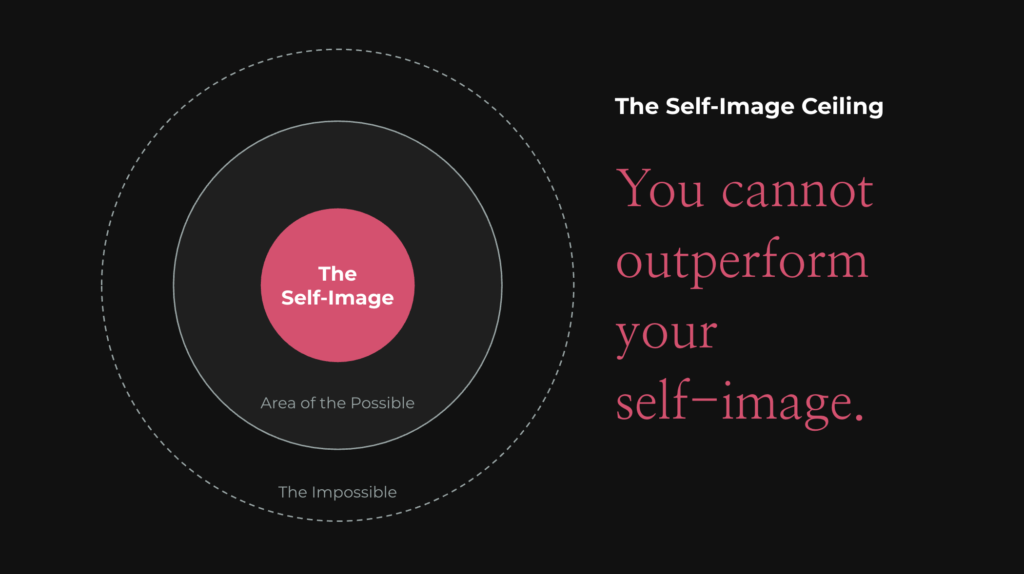
Maltz wrote: “Expand the self-image and you expand the area of the possible.”
Translation: you cannot outperform your self-image.
If your internal picture says “I’m not really a leader,” then every title, every promotion, every win feels like a costume you’re wearing. Your nervous system isn’t receiving signals that say you belong here. It’s receiving signals that say you’ve fooled them so far.
And now we have neuroscience to back this up. A 2016 study published in Psychological Science by Dutcher and colleagues found that when people affirm important personal values — the kind of identity work I’m describing — the ventral striatum, a core reward center in the brain, activates. Self-affirmation is intrinsically rewarding. Your brain literally wants you to do this work.
A complementary study from Chavez and Heatherton (2015) went further: people with higher self-esteem showed stronger structural and functional connectivity between the brain’s self-processing regions and its reward circuits. Higher self-esteem isn’t just a feeling. It’s wired into the neural infrastructure. Your brain rewards a clear, strong self-image — and it penalizes an unclear one by routing more energy toward threat detection and self-protection.
James Clear wrote about the behavioral side of this in Atomic Habits: “The biggest barrier to positive change at any level — individual, team, society — is identity conflict.” His whole system is built on identity first, behavior second. Good leadership habits make rational sense. But if they conflict with who you believe you are, you’ll fail to sustain them.
And Maltz, decades earlier, had already identified the mechanism: “The self-image is changed, not by intellect alone, but by ‘experiencing.’”
You can’t think your way to a new identity. You have to build your way there.
Three Steps to Lead Yourself First: Define, Prove, Ground
The framework I teach is Clarity → Growth → Impact. And the order matters.
Most people want Impact first. They want to be seen as a great leader. So they jump to the Growth layer — the tactics, the frameworks, the performance techniques — without ever doing the Clarity work.
Growth without clarity becomes imitation. You’re following the tactics and frameworks. Impact without clarity is really just performance. It’s the made-for-LinkedIn world without the expertise.
Here’s how to start where almost nobody starts.
Step 1: Define Yourself
When I was 13, I captained our national youth football team in Antigua. My first game as captain, we lost 7–1.
Afterward, the coach pulled me aside. “You need to be louder. Shout at them. Tell them where to go. Lead them.”
So next game, I did exactly that. I shouted. I directed. I was on every player, every minute. By the end, I had no voice left. But we had won.
And here’s what I remember most: it didn’t feel like me. The shouting. The commanding. That wasn’t my nature. I could feel the disconnect even at 13 — between the leader I was being told to be and the leader I actually was.
That feeling that I felt is the identity question trying to surface. And most of us spend decades ignoring it, imitating whatever leadership style we’re told works instead of finding the one that’s actually ours.
So here’s the practical question: Who am I as a leader — independent of my title?
Carl Jung has a quote that goes: “The world will ask you who you are, and if you don’t know, the world will tell you.”
Finish this sentence: When I’m at my best as a leader, people can expect me to…
Write down three or four things that are actually true about how you operate at your best. Not your LinkedIn bio. Your lived version. Maybe it’s “stay calm in a crisis, be direct and fair, and make decisions when others hesitate.” Maybe it’s “hold the vision when everyone else is tired.” Whatever it is — write down what’s real.
Step 2: Prove Yourself
Most people try to talk themselves into confidence. That doesn’t work. Action is what actually builds confidence. Confidence built on compliments will eventually disappear. Confidence built on evidence is more likely to compound.
Go back and find three moments in your career where you led well. Not perfectly. There is no such thing as perfect leadership. For each one, ask three questions: What was the situation? What did I actually do? What does that reveal about how I lead?
Maybe you owned a mistake instead of blaming your team. That tells you that you lead with ownership. Or maybe you were the most junior person in a room and asked the hard question that nobody else wanted to ask. That’s courage and truth-telling.
Cataloging this evidence is how you rewire your self-image with data from your own life. Maltz was clear: the self-image changes through experience, not solely through intellect. The proof exercise is about deliberately creating that experience.
And here’s the compounding effect. When Dave Brailsford took over British Cycling, they had won exactly one Olympic gold medal in 76 years. His approach was absurdly simple: find every element that goes into riding a bike and improve each one by 1%.
They tested massage gels to improve muscle recovery and taught riders proper hand-washing to reduce sick days. They painted the inside of the team truck matte white so they could spot tiny specks of dust that might contaminate bike mechanisms. They optimized pillows, racing suits, nutrition, and travel routines.
At the 2008 Beijing Olympics, British cyclists won 7 of 10 available gold medals. At London 2012: 7 track golds, 9 Olympic records, 7 world records. And then three of the first four Tour de France titles.
That’s what evidence-based improvement looks like. A hundred small proof points that compound. Your leadership evidence works the same way. You’re aiming for small, consistent data points that gradually rebuild your self-image from the inside.
Step 3: Ground Yourself
Identity and evidence are powerful, but they still need an anchor. So we’re going for the things that make us who we are. Step three aims to identify your values and beliefs, and turn them into principles.
Finish this sentence three times: As a leader, I believe…
“As a leader, I believe people do their best work when it’s safe to tell the truth — especially bad news.”
“As a leader, I believe standards are a form of respect.”
“As a leader, I believe my job is to stay calm when everyone else is losing it.”
If you wouldn’t hold onto it when it costs you something, it’s not a principle yet. It’s a slogan. Viktor Frankl captured this in Man’s Search for Meaning: “Man is pushed by drives but pulled by values.” Your principles are the pull — the things that hold you steady when the pressure is on.
Let’s look at this in the real world. When Howard Schultz returned to Starbucks in 2008 he defined what clarity under pressure looked like.
Howard Schultz had three non-negotiables for Starbucks:
- take care of people
- protect quality
- serve the customer
In 2008, Starbucks was in crisis. Revenue hit $10.3 billion but net income had been cut in half — from $673 million in 2007 to $315 million. Schultz had returned as CEO in January after the stock had dropped 42% the previous year. In his book Onward, he describes the internal battles he dealt with. The board pushed him to franchise, cut employee healthcare, reduce quality to save margins.
He refused those suggestions every time.
On February 26, 2008, Schultz made a decision that analysts called “insane”: he closed all 7,100 U.S. stores for 3.5 hours to retrain every barista on espresso fundamentals. Estimated cost: $6 million in lost revenue that day. He then shut down 600 underperforming U.S. locations and 61 in Australia.
By 2010, Starbucks posted $945 million in net income — a company record. He tripled profits in two years. (I wrote about the deeper Schultz identity story — including his Brooklyn childhood and the principle that drove every decision — in an earlier edition of this newsletter.)
Schultz wasn’t confident during that crisis. He was clear. And clarity made the decisions possible.
Another great example is Alan Mulally at Ford.
He brought the same principle to Ford. When he arrived in September 2006, Ford was projecting a $17 billion loss. He implemented weekly Business Plan Reviews, with every metric color-coded green, yellow, or red. For weeks, everything came back green — despite the catastrophic losses.
Then Mark Fields showed a red. The room went silent. Everyone expected consequences.
Mulally started clapping. “Mark, that is great visibility. What can we do to help?”
That single moment changed the culture. Truth-telling became a status move instead of a career risk. Ford went from a $17 billion loss to $6.6 billion in profit by 2010 — the only U.S. automaker to avoid a government bailout.
TalentSmart’s research across more than 500,000 professionals found that emotional intelligence accounts for roughly 58% of job performance in leadership roles. Self-awareness — knowing who you are, what triggers you, how you show up — is literally the first component of EQ. Mulally didn’t fix Ford with a strategy deck. He fixed it by making self-awareness and honesty the operating culture. That starts with the leader going first.
Why Self-Leadership Matters More in the Age of AI
Everything in this article has always been true. But AI is making it urgent.
For years, if someone asked “Who are you?”, most of us answered with a job title. I’m a marketing director. I’m a founder. I’m an engineer. When the work changes — and the World Economic Forum’s 2025 Future of Jobs Report estimates that 39% of workers’ core skills will change by 2030 — that answer stops working.
But that re-skilling conversation misses the fact that the skills rising fastest include leadership, resilience, curiosity, and social influence. All of those are identity skills or self-leadership skills. The stable center when everything around it shifts.
Microsoft’s latest Work Trend Index says 82% of leaders plan to use “digital labor” — AI agents — to expand capacity. Every employee becomes an “agent boss.” But you can’t direct AI agents toward an outcome you haven’t defined. If your strategy is unclear, the agents will happily execute an unclear strategy at scale.
We’ve seen this before. CRMs didn’t fix bad sales processes. Project management software didn’t fix unclear priorities. AI agents won’t fix unclear thinkers.
Rich Roll put the question simply: “Who am I becoming?” Everything you do — every delegation, every decision about what to automate and what to keep — is answering that question in real time. The leaders who thrive in the next phase of new work won’t have the longest list of tools. They’ll have the strongest internal architecture.
The Leadership Upgrade
Let me bring this back to where the keynote started.
That feeling — being in the room, not sure you belong, wondering if anyone can see through you — that feeling isn’t a sign you’re not ready. It’s a signal that you haven’t defined your foundation yet.
Most people respond by working harder. More hours. More books. More frameworks.
You cannot outperform a self-image you’ve never examined. You can only upgrade it.
So here’s what I’d ask you to do. Find 30 minutes this week. Alone. No phone.
Answer one question: Who am I as a leader — independent of my title?
Write it down. A page. Half a page. What you believe. How you operate. What you won’t compromise on.
Seth Godin wrote: “We become what we do. We don’t do what we become.” That page is the clarity. What you do with it is the upgrade.
Then make one decision this week based on what you wrote. Not the safe decision. Not the expected decision. The clear decision.
Your team isn’t waiting for you to have all the answers. They’re waiting for you to know who you are.
That’s where your leadership starts.
This article is an expanded version of “Lead Yourself First,” a keynote Brian Tomlinson delivered at the Future Leaders Summit in Hamburg on April 11, 2026.
Leading yourself first means developing a clear self-image and personal leadership identity before trying to lead others. Research shows that 71% of CEOs experience impostor syndrome (Korn Ferry, 2024) — not because they lack skills, but because they’ve never defined who they are as leaders independent of their title. Self-leadership is the foundation: define your identity, build evidence of how you lead, and ground yourself in principles.
Impostor syndrome in leaders often stems from building leadership on imitation rather than identity. When leaders copy someone else’s style — following frameworks that don’t fit who they actually are — everything feels like performance. Korn Ferry’s 2024 survey found 71% of CEOs and 65% of senior executives report impostor syndrome symptoms. The fix is a clarity problem, not a skills problem: define who you are as a leader, independent of your title.
Leadership confidence is built through evidence, not affirmation. Go back and find three moments where you led well — not perfectly, but effectively. For each, ask: What was the situation? What did I actually do? What does that reveal about how I lead? This evidence-based approach mirrors what Dave Brailsford did with British Cycling — small, consistent proof points that compound over time. Confidence built on compliments fades. Confidence built on evidence compounds.
Psycho-Cybernetics author Maxwell Maltz found that patients who had physical flaws corrected often didn’t change their behavior — because their self-image hadn’t changed. The same applies to leadership: you cannot outperform your self-image. If your internal picture says “I’m not really a leader,” every title and promotion feels like a costume. Neuroscience confirms this — a 2016 study in Psychological Science found that affirming personal values activates the brain’s reward center.
Answer one question: “Who am I as a leader — independent of my title?” Finish this sentence: “When I’m at my best as a leader, people can expect me to…” Write down three or four things that are actually true about how you operate at your best. Not your LinkedIn bio — your lived version. Then ground it with principles: finish “As a leader, I believe…” three times. If you wouldn’t hold onto it when it costs you something, it’s a slogan, not a principle.