

Peter Drucker has a quote that goes: “It is the recipient who communicates. Unless there is someone who hears, there is no communication. There is only noise.”
Let’s be honest. Most leaders are making noise.
They think they’re communicating because they’re talking. Sending updates, running meetings, giving feedback — and then wondering why nothing changes. Why people comply but never commit. Why the team only moves when they’re pushing.
There’s a gap that sits between being excellent at your work and being excellent at leading others. I call it the Influence Gap. And the reason it’s so dangerous is that the people who fall into it are usually the ones who’ve been succeeding their entire careers.
Why Most New Leaders Fail: The Promotion Trap
Sixty percent of new managers receive no formal training when they move into their first leadership role. That’s according to the Center for Creative Leadership, cited in a 2024 Wharton Executive Education report. And Gartner’s global research confirms that 60% of those new managers fail within the first 24 months.
Now, failure is a matter of perspective, but let that sit for a second. The majority of new leaders fail. And the majority of them never received any preparation for the job. It seems as if something doesn’t add up, right?
Surprisingly (or not), it gets worse at the top. Heidrick & Struggles studied 20,000 executive placements and found that 40% of senior-level executives were pushed out or quit within 18 months. They were hired for their technical and strategic strengths. They were fired for their inability to connect with people, build teams, and develop others.
Professor Tomas Chamorro-Premuzic says that “There is a pathological mismatch between the attributes that seduce us in a leader and those that are needed to become an effective leader.” Essentially, we’re mistaking confidence for competence. And the traits that get someone noticed, like decisiveness, charisma, and certainty, are often the opposite of what makes them effective once they are in the chair.
Organizations promote people for execution and then expect leadership. But these are different operating systems. The Center for Creative Leadership found that 74% of first-time manager success is driven by behavioral and team-responsibility factors — things like managing former peers, letting go of individual work, and handling conflict. Technical skills barely register.
Todd Maurer and Manuel London published a study in the Journal of Management that frames this change as a “role identity shift.” Their argument is that moving from an individual contributor (IC) to a leader requires people to redefine who they are and how they measure success. They even coined the term “identicide” — the deliberate killing of aspects of your old identity that hold back the new one.
That word might sound dramatic. But it’s accurate. Because the things that made you excellent as an individual — deep focus, personal accountability, high personal standards — those same traits can work against you when your job changes from doing the work to developing the people who do the work.
I know this because, probably just like you, when I went into my first leadership position, I already knew the work, I knew the business, and I knew how to operate at a high level. But as soon as I needed to get buy-in, get alignment, or change people’s behavior, I realized that this was a completely different game. And that’s the gap.
So what does it actually take to close it?
The Influence Bridge: 3 Shifts That Close the Leadership Gap
Over 20 years of leading teams, building programs, and coaching leaders, I’ve found that closing the Influence Gap comes down to three shifts. I call them the Influence Bridge — because you’re building a connection between who you were (an excellent individual) and who you need to become (someone who makes others excellent).
You do three things:
- Shift the signal.
- Build the floor.
- Raise the bar “together”.
Let me walk through each one.
Shift the Signal: From Telling to True Communication
Most leaders communicate at their teams. Updates, directives, status checks, information transfer. And they assume that because the message left their mouth, it arrived in someone else’s brain. If you’ve been leading a team for longer than three months, you know that this is not the case.
Drucker’s line bears repeating here. Communication is about what the recipient receives, not what the sender sends. If no one truly hears you, you’re just making noise.
There’s solid research that backs this up. Natasha Lorinkova and her colleagues at the Academy of Management Journal studied 60 teams and compared directive leadership against empowering leadership over time. Teams with directive leaders performed better at the start — faster execution, clearer output. But teams with empowering leaders caught up and then overtook them. The mechanism was higher levels of team learning, coordination, and shared mental models. People understood why they were doing what they were doing. They had a vision to chase.
A separate field experiment by Martin, Liao, and Campbell found that both directive and empowering leadership improved task proficiency. But only empowering leadership increased proactive behavior — people taking initiative, going beyond their defined role, solving problems before they were asked to. Directive leadership only drove proactivity in teams that already had high trust. Without that trust foundation, directives got compliance. Nothing more.
Edward Deci and Richard Ryan have confirmed this through Self-Determination Theory for decades. Simply put, when people understand the meaning behind their work and genuinely endorse the goals, they shift from doing what’s required to owning the outcome. They become bought in.
In the book Coaching for Performance (highly recommend if you’re a leader), John Whitmore writes that “While telling negates choice, disempowers, limits potential, and demotivates, coaching does the opposite.” It’s very much why everyone is pushing leaders to lean more towards coaching than telling people what to do.
So instead of telling people what needs to happen, tell them “Here’s why this matters, and here’s the outcome that we need in the end. How should we approach it?” That last question is key. Because with that question, you’re transferring ownership, not instructions. That’s the difference between people who comply and people who commit.
Build the Floor: psychological safety as a performance foundation
Many leaders get “psychological safety” wrong. They assume that it means being nice. Being gentle. Avoiding hard conversations. It means none of those things.
Google’s Project Aristotle studied over 180 teams to figure out what made their best teams work. They looked at more than 250 attributes. The finding that surprised everyone — including Google — was that psychological safety was “far and away the most important” dynamic. More important than who was on the team, how experienced they were, or what resources they had.
People were less likely to leave teams that scored higher on psychological safety. They were also more likely to have diverse ideas and were consistently rated more effective by executives. The core question they used to measure it was simple: “Can we take risks on this team without feeling insecure or embarrassed?”
Amy Edmondson, who originally defined the concept in 1999, studied 51 work teams and 496 individuals and found that psychological safety predicted learning behavior — speaking up, asking for help, admitting mistakes. And those learning behaviors were what actually drove team performance. Safety wasn’t the outcome. It was the mechanism.
Daniel Coyle captures this well in The Culture Code: “Group performance depends on behavior that communicates one powerful overarching idea: we are safe and connected.”
And Edmondson herself has a useful piece of advice that Coyle quotes: “To create safety, leaders need to actively invite input. It’s really hard for people to raise their hand and say, ‘I have something tentative to say.’ And it’s equally hard for people not to answer a genuine question from a leader who asks for their opinion.”
So stop opening meetings with status updates. Start with a genuine question. Something like: “What’s one thing that’s not working that we haven’t talked about?” Safety gets built in small, repeated signals. Not grand gestures. Not team-building retreats (though those are important as well). Just consistent evidence that speaking up is welcome here.
Raise the Bar Together: How to Build Team Accountability
This is where the framework comes together—and where most leadership advice stops short.
Edmondson mapped this out in what she calls the four zones. When you combine psychological safety and accountability as two independent axes, you get four distinct team environments.
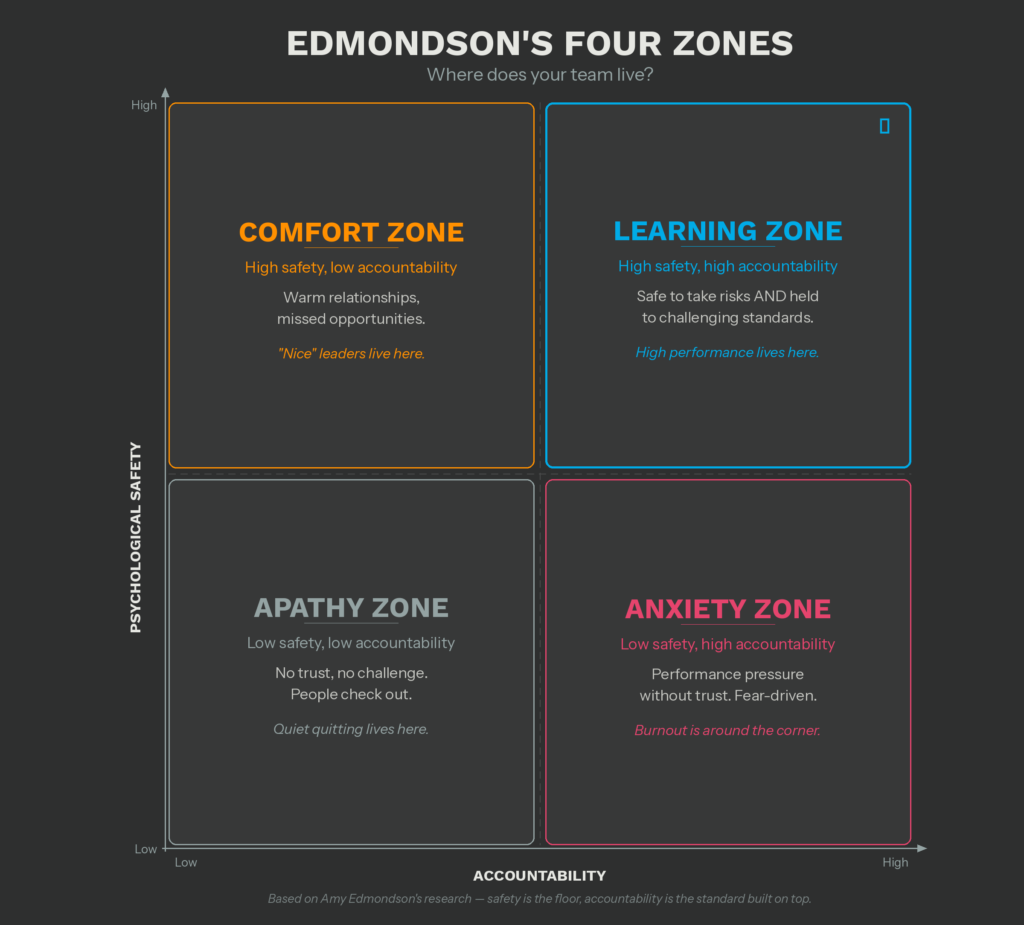
The Learning Zone sits where both are high. People feel safe to take risks AND are held to challenging standards. This is where high performance lives. A study published in BMC Medical Education confirmed this across two institutions, and cited a large-scale study of roughly 58,000 teachers showing that psychological safety “acts as an accelerant” for the positive impact of accountability over time.
The Comfort Zone is high safety, low accountability. Everyone feels great, nobody’s challenged, and you end up with warm relationships, but missed opportunities. This is where “nice” leaders live.
The Anxiety Zone is low safety, high accountability. Think tons of performance pressure without trust. People perform out of fear. They’re doing the work, but are worried about their job. Maybe they’re even hitting their targets, but burnout is around the corner; they’ve already disengaged and will eventually leave.
The Apathy Zone is low everything. No trust, no challenge. People check out and start looking for the exit. (Quiet quitting anyone?)
The lesson here is that we don’t have to choose between being a supportive leader and being a results-driven leader. The research shows that the best teams live in the Learning Zone — where safety is the floor and accountability is the standard you build on top of it.
The model from The Five Dysfunctions of a Team talks about exactly this. Trust leads to productive conflict, which leads to commitment, which leads to accountability, which leads to results.
Trust → Productive Conflict → Commitment → Accountability → Results
Skip trust and accountability becomes control. People comply because they have to, not because they want to.
Accountability is really not about consequences, but rather ownership. It’s more of a character trait that you develop and a life stance that you create within yourself. Accountability is creating owners of the future.
The big shift that we have to make as leaders is moving accountability from something you impose to something the team shares. The question changes from “Did you hit the deadline?” to “How are we tracking against what we committed to?” The team holds the standard together. And when a group of people holds that standard together, that’s how it sticks. Because that standard is no longer only you, but the collective.
In the 1980’s-90’s, Bill Walsh built the San Francisco 49ers around exactly this idea. When he arrived, he didn’t start with a timetable for winning a championship. He started with what he called the Standard of Performance — behavioral norms, not results targets. How people treated each other. How they practiced. How they prepared. His belief was pretty straightforward: get the culture right, and the score takes care of itself.
I see it the same way. In my last role, I was hired to do great content marketing. So I set out to develop great content marketers. If you make people great, the outcome is going to be damn close to what you’re trying to achieve.
The Leadership Infrastructure Test
So here’s the question I want to leave you with.
If you stepped away from your team for two weeks — no calls, no Slack, no checking in — what would happen? Would the team get stronger? Stay steady? Or fall apart?
That answer tells you exactly where your Influence Gap is.
Richard Hackman and Ruth Wageman, studying everything from flight-deck crews to surgical teams, found that leaders matter most when they set compelling direction, design enabling structures, and provide a supportive context. Once those components are in place, real-time leader behavior can step back. The leadership lives in the system, not in the leader’s presence.
Being a sports buff, I really enjoyed what Sam Walker wrote in his book The Captain Class. Walker studied the greatest sports dynasties in history and found something counterintuitive: “A team is more likely to become elite if it has a captain that leads from the shadows.” A lot of the work that goes on in teams is from the little moments of pushing others up.
In the business world, Eric Schmidt (formerly of Google), reflecting on coaching legend Bill Campbell in Trillion Dollar Coach, recognized that “The higher you climb, the more your success depends on making other people successful.” That’s the Influence Bridge in one sentence.
When you become a leader, your job changes from being excellent to making others excellent. From being a cog to being the architect.
So remember:
Shift the Signal. Stop transmitting and start landing. Give people context and ownership, not instructions.
Build the Floor. Create genuine psychological safety where people speak up because they trust the environment, not because you told them to.
Raise the Bar Together. Layer accountability on top of that safety. Make standards something the team holds, not something you enforce.
The gap between individual excellence and team influence is real. But it’s an identity shift, not a skills upgrade. Once you see it, you can build the bridge.
And once you cross it, everything changes.
Research from the Center for Creative Leadership shows that 60% of new managers receive no formal training when they move into their first leadership role. Gartner’s global research confirms that 60% of those new managers fail within the first 24 months. The core issue is an “Influence Gap” — organizations promote people for execution and then expect leadership, but these require fundamentally different operating systems.
The Influence Gap is the space between being excellent at your work and being excellent at leading others. It’s dangerous because the people who fall into it are usually the ones who’ve been succeeding their entire careers. The Center for Creative Leadership found that 74% of first-time manager success is driven by behavioral and team-responsibility factors — not technical skills.
Google’s Project Aristotle studied over 180 teams and found that psychological safety was “far and away the most important” dynamic for team effectiveness — more important than who was on the team, how experienced they were, or what resources they had. Amy Edmondson’s original research found that psychological safety predicted learning behavior, and those learning behaviors drove actual team performance.
Research by Natasha Lorinkova and colleagues found that teams with directive leaders performed better initially — faster execution, clearer output. But teams with empowering leaders caught up and overtook them through higher levels of team learning, coordination, and shared mental models. Only empowering leadership increased proactive behavior.
The most effective approach combines high psychological safety with high accountability — what Amy Edmondson calls the “Learning Zone.” The shift is moving accountability from something you impose to something the team shares. Bill Walsh’s Standard of Performance with the San Francisco 49ers demonstrated this: set behavioral norms rather than results targets, and the results follow.