

Peter Drucker wrote the manual for working with AI in 1999. He just didn’t know it yet.
Drucker spent his last years writing about a specific kind of worker. Someone whose value didn’t come from the company they worked for, but from what they knew, how they thought, and what they could produce. He called them knowledge workers.
The knowledge worker, he wrote, has to know three things to be useful: their strengths, their performance mode, and their values. Skip those, he warned, and you become a problem to manage instead of an asset to deploy.
Drucker was writing about people. The same rule turns out to govern AI.
I spent the first year of the AI shift learning that the hard way. By now you probably remember trying to get better at prompting. Then switching between Claude, ChatGPT, and Gemini in the same hour. Then came “context engineering.” The output was always almost good. It was close to specific and close to mine, but never quite there.
I kept assuming the problem was the model. It wasn’t. The model was fine. The bridge between the model and me was missing.
This newsletter is about how to build that bridge. Three documents that take a weekend to write and change every AI conversation you have going forward. I’m calling it the Self-Leadership Stack, and the spec was written 27 years before AI made it urgent.
Why AI Outputs Sound Generic (And How Context Fixes It)
Most people treat AI like an intern. The framing is everywhere, and it’s wrong.
Allie K. Miller, named one of Time’s most influential people in AI and a teacher to operators at Novartis, Samsung, and Salesforce, puts it bluntly. Stop treating AI like an intern. Treat it like one of the best teammates you’ve ever worked with. That made me stop and think for a bit, because it shifts the framing from this junior employee you don’t want to give important tasks to, to someone who is extremely competent and just needs better context. The intern framing isn’t just wrong. It’s the reason most people are getting generic output.
An AI model trained on the entire internet has to be useful to everyone, which means it defaults to safe, general responses that fit no one in particular. The model doesn’t know you. It doesn’t know your background, your career, or what you’re trying to build or achieve. So it gives you the default answer that fits the most cases, and you get back something that sounds, let’s call it, generic.
There’s research on this, too. A 2024 study looked at what actually makes AI outputs feel personal. The biggest difference didn’t come from a better prompt or a better model. It came from telling the model who you are and what you’ve done before, especially if you load that information at the start of the conversation. Context really is king in this land. Letting your AI know who you are will do more for your output than six months of prompt tweaking ever will.
This is the gap most people aren’t closing. They keep iterating on the prompt. The prompt is the wrong layer.
What Peter Drucker Got Right About AI Personalization
Drucker would have known why this happens. He wrote in Managing Oneself:
Most people, especially highly gifted people, do not really know where they belong until they are well past their mid-twenties. By that time, however, they should know the answers to the three questions: What are my strengths? How do I perform? and, What are my values?
He was talking about how to be useful inside a company. The rule turns out to be portable to AI. If you don’t know your strengths, your performance mode, or your values, you can’t brief AI on them. That means your output will immediately reflect that gap.
James Clear says the same thing: “You do not rise to the level of your goals. You fall to the level of your systems.” (I wrote more on that idea in my piece on systems vs. goals.) The point holds here. The AI conversation is the system. The system is missing the operator.
Dickie Bush sharpens the same idea in an essay titled “My 12 Operating Values.” (Seems he took it down, so I can’t link to it unfortunately.) In it, he distinguishes between implicit operating values (the subconscious values that actually guide your decisions) and explicit operating values (the ones you say guide your decisions). The work, he writes, is to align them. AI exposes the gap. Every output reveals which set is steering. If your stated values say “long-term compounding” and your implicit values say “quick win that looks impressive,” your AI-drafted content will swing between those two voices in the same paragraph.
The Time Objection: How Long Building an AI Context Stack Actually Takes
Most people read up to this point and assume building a context stack is a multi-week project. It isn’t. I mean, you somehow know yourself, right?
The Constitution document is about a page. The Vault is about two pages. The first Playbook is half a page. Total writing time runs two to four hours over a weekend. I did mine one morning with coffee, some music, and some “me” time.
(My suggestion is to really have AI interview you and you dictate your answers instead of just writing. That way, you can speak more freely. I use Wispr Flow to do this all the time. Here’s a free month of Wispr Flow Pro to test it out.)
Now, the upside of all this is that when you have hundreds of AI conversations a year without the stack, each one always starts from zero. The model has to get to know you first. It’s the equivalent of that Adam Sandler movie, 50 First Dates. Every day, starting over from scratch.
But with the stack loaded, every conversation you start already starts five steps ahead. You’re no longer in first-date territory. You’re now in a relationship. A 2024 paper on how AI handles context found that giving the model a small, focused set of information beats dumping everything you have on it. In plain speak, a one-page document does more work than a ten-page dump, as long as the one-pager is the right one. You write the stack once, and it pays off in every conversation you have afterward.
Drucker wrote that knowledge workers outlive organizations, and they are mobile. The stack is similar. It moves with you when the company or model changes, or when you switch tools. It’s portable. That’s the whole point of writing it down. Once you have this, it doesn’t matter what company you’re working for. It doesn’t matter if you’re using ChatGPT, Claude, or Gemini.
Think of the Self-Leadership Stack as a minimum viable system for AI context. Small enough to keep updated. Robust enough to compound over time.
The 5 Outputs That Get Better Immediately
If you take the few hours to build your stack and give AI the context that it needs, you’ll immediately realize that your AI conversations feel different.
If you’re drafting a newsletter or emails, all of a sudden, they start sounding like you. The amount of rewriting you have to do goes down dramatically. If you want to book a trip, you don’t need to re-explain where you live, how big your family is, why you need activities for your kids, every time. It’s all already considered.
One unexpected payoff that I’ve seen is the pushback. Once AI knew what my beliefs and values were, it started flagging anything that seemed off. Not just for my writing, but also my logic. If something goes against the grain of your beliefs and thinking, it’ll call it out and ask, “Are you sure?” Allie K. Miller calls this the compound effect. The AI gets better at helping you because it’s no longer guessing. Your outputs get more specific. Your time gets more valuable.
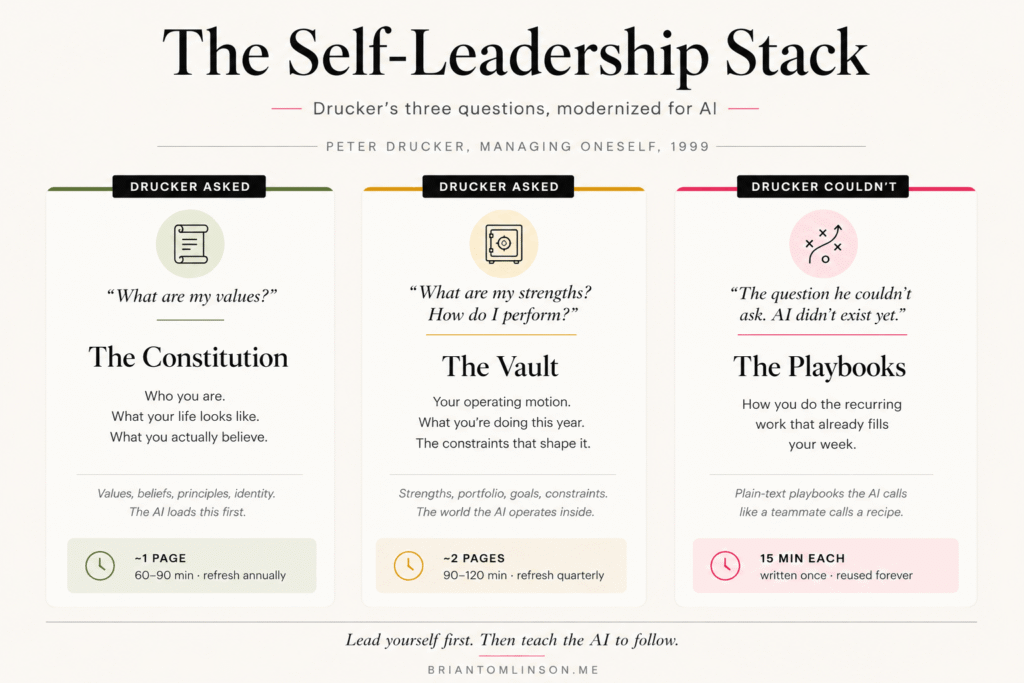
It comes down to three documents. None of them is novel on its own. The compounding comes from the combination and from running them upstream of every conversation. Drucker wrote two of them. The third is the one he couldn’t have written, because AI didn’t exist yet.
The Self-Leadership Stack: Three AI Context Documents
Two of the three documents answer Drucker’s three questions directly. The third one closes the gap Drucker didn’t have to solve since he didn’t have AI to worry about at the time.
Let’s have a look at them.
Document 1: The Constitution
This is who you are, and what your life actually looks like.
The Constitution is where you give the AI the fabric of your life. Your background, what you do for work, what your family situation is, the experiences that shaped how you see things, the values you make decisions against. The goal isn’t to write a memoir, but to help the model understand the day-to-day shape of your life. So when it answers a question, it answers like someone who already knows you.
You’re going to cover things like who you are (your background, the work you’ve done, what shaped how you see the world). What your life looks like right now (family, location, the constraints that come with both). What you actually believe (three to five core values, with one behavior per value so the model can spot them in your work). And how you want the AI to talk to you (direct or exploratory, brief or thorough, when to push back instead of agreeing). Heck, you can have it take on the personality of your favorite coach, like Elon Musk or Oprah Winfrey.
Drucker would have called this the values question. Whatever you call it, this is the document the AI loads before it does anything else.
One page is plenty for a first draft. Two, if you want to be precise. You’ll edit it over time, and the bones don’t need to be perfect on day one.
Document 2: The Vault
This is your operating motion. What you’re actually doing, week to week, and how you do it.
The Vault is where you tell the AI what you’re working toward and what shape your work takes. If you’re running a business, this is where you describe what you sell, who you sell it to, what stage you’re in, and what you’re trying to grow toward. If you’re inside a company, this is where you tell it you’re a marketing manager with five direct reports, that you own brand and social media, that you report to a VP who cares about the numbers above everything else. Either way, the AI needs to know the world you operate in before it can be useful inside it.
I think about it as four sections.
- Your strengths and the conditions where you do your sharpest thinking.
- Your current portfolio of projects and commitments, with a rough sense of how much time each one takes (so the AI doesn’t propose plans that ignore reality).
- Your top three goals for the year, with one measurable outcome for each.
- Your constraints (financial, time, ethical, brand) that any plan has to respect, otherwise the AI proposes things that look great on paper and crash into your actual week.
These are Drucker’s strengths and performance questions, written down so the AI stops guessing. Update it quarterly. Your life moves, and the document should too.
Document 3: The Playbooks
This is where you teach the AI how to handle the recurring tasks that already fill your week.
I write this newsletter to be sent out every Sunday. It has a shape I use every time, a voice the reader can recognize, and the same kind of inputs week after week. The Playbook is where I describe to the AI exactly how I write it. I tell it the structure I follow (Excite, Disturb, Assure, Framework), how I want research integrated, the phrases I use and those I never use, and how I open and close each piece. Once that’s written down, the AI doesn’t have to guess at any of it. It just runs the playbook.
Now, one thing to note here. Even though the AI runs this, particularly for writing, you need to go through and make your edits for voice and tone. Even now, I’ve never had something come back that I would consider final.
In Claude, this lives as a Skill. A plain-text file that the model loads when it’s asked to do that specific kind of work. Anthropic shipped this as a native pattern in their developer tooling, yet most operators still treat their AI like a chat window. The playbook layer is what shifts it into a teammate that can actually do the work the way you want it done.
You don’t have to write all your playbooks at once. Start with the work you do most often. The weekly newsletter, the monthly board update, the recurring client email, the Q1 plan you rewrite every January. Anything you’ve drafted more than three times deserves a playbook. (If you need a system for deciding which tasks deserve the playbook treatment first, my AI Skills Audit framework gives you a scoring approach. I’m also running this same approach inside the workflow I use for my own AI operating system, and it’s the single biggest accelerant in my week.)
What the Self-Leadership Stack Buys You Over Time
The Self-Leadership Stack isn’t productivity hygiene. It’s preparation.
Drucker argued that careers don’t get planned. They develop when people are ready for opportunities they couldn’t have predicted, because they know their strengths, their performance mode, and their values. AI multiplies that bet. New models and new platforms keep arriving. The stack is what travels with you through every shift.
Two to four hours of writing buys you hundreds of hours of better output. That’s the math that you need to use.
Lead yourself first. Then teach the AI to follow.
The Self-Leadership Stack is a set of three plain-text documents that give AI models the context they need to produce personalized output instead of generic answers. It includes the Constitution (who you are and what you believe), the Vault (your current goals, strengths, and constraints), and the Playbooks (repeatable workflows the AI can run on demand). It’s based on Peter Drucker’s three questions for the knowledge worker from his 1999 essay Managing Oneself.
Most AI outputs sound generic because the model starts every conversation without knowing who you are. The fix is to give the model context documents about your background, values, current goals, and recurring workflows before you ask it to do work. Research from 2024 found that user context placed at the start of a conversation outperforms better prompting and better models for personalization quality.
A context document is a plain-text file that tells an AI model who you are, what you do, what you believe, and how you work. Instead of explaining yourself in every conversation, you write the context once and load it whenever you need the AI to give personalized output. Common examples include a Personal Constitution (values and identity), an Operating Vault (current work and goals), and Playbooks (repeatable task instructions).
Two to four hours of writing over a weekend. The Constitution document runs about one page. The Vault is about two pages. The first Playbook is about half a page. You can dictate the answers instead of typing them, and many people use AI itself to interview them as they build the stack.
Prompt engineering optimizes the question you ask AI. Context engineering optimizes who’s asking. Better prompts produce marginally better outputs from a model that doesn’t know you. Better context produces outputs that match your voice, work, and decision-making style, regardless of how the prompt is phrased.