

If you’ve been writing with AI for a while, you’ve probably felt it too.
You put in a solid prompt, and it gives you back something clean. Everything is right: the structure, the grammar, and it sounds as if you know what you’re talking about. The problem is that it still feels a bit empty. A little hollow. As if it just appeared out of the ether from no one in particular.
I felt that a lot last year. This was before I rebuilt my AI operating system to carry real context about how I think and who I am. If I asked for something, the output that I got was well-structured, professional, and clean. But there was always something that I just couldn’t really put a finger on. That strange feeling, like when you have déjà vu or if you’re not sure that the shoes you put on fit your outfit.
What I’ve realized, harkening back to my marketing background, which naturally relies heavily on writing, is that writing is not so much about great structure and grammar. It’s very important when you are leading someone somewhere. But good writing has a lot to do with having a point of view, which in turn gives life and soul to a piece. It turns out that the structure is the easy part, and the machine has that handled. What it can’t do is decide what you actually think.
It’s why good writers tell you the same two things. They’ll tell you, “Read your work out loud,” and “write like you talk.” That’s because when we speak, we carry our own rhythms, our own small euphemisms, the offhand way we make a point. There’s a voice in it, and a bit of soul. Capturing that same voice on a piece of paper or on a screen is the hard part.
So the real question for the next few years isn’t whether AI can write. It clearly can. Instead, it’s going to be how you can infuse your worldview and your essence into what you create.
When AI writing feels empty
Let me give you an example of when this really hit me.
At the end of last year, I wrote a piece about kintsugi. It’s the Japanese art of repairing broken pottery with gold, so the cracks become part of the beauty instead of something you hide. I picked it for a reason. It was not long after I’d been laid off, and I was doing the kind of reflecting you tend to do at a time like that. I wasn’t really sad about it. It was more of a quiet, where-to-from-here kind of feeling. The kind where you feel a little bit broken, but you know it’s going to be alright anyway.
So I worked the way I usually do. When I’m working with AI, I usually take a bit of a sparring partner approach. I write a rough draft, hand it over, get something more fleshed out in return, and we go from there. That time, the draft came back clean, well-organized, and nicely phrased. The usual. You know what I mean, the kind of thing you’d read and nod along to like you were listening to an Obama speech (Yes we can, and all that.)
But it didn’t feel right. The facts were all there, but the feeling was off. It was too structured and too nice. It wasn’t how I was “feeling” at the time. All the gold in the cracks had been polished down a bit too much.
Why AI makes your writing sound generic
There’s a reason this happens, and it isn’t really the model’s fault. (At least it’s not yours, right 😅?)
A group of researchers at Google DeepMind ran a study this year where they asked AI to make grammar edits only. Just tidy up the writing, change nothing else. The models still shifted what the essays meant. They quietly (read sneakily) traded personal reasoning for a safer, more neutral argument. In plain speak, you ask it to fix your commas, and it edits your point of view.
That’s the point that you need to keep in the back of your mind after you read this. The machine is built to make writing clean and agreeable, because clean and agreeable is the safe bet across millions of examples. Your slightly odd, particular way of seeing a thing is exactly what tends to get averaged out. And who the f*ck wants to be average?
We were already doing it to ourselves
The truth is, apparently, we all secretly want to be average. In 2023, before any of this, a strategist named Alex Murrell published an essay called The Age of Average. He showed that coffee shops on three continents had converged on the same wood and the same bulbs, that rental apartments from Lisbon to Seoul shared one interior, and that cars and logos and even faces were drifting toward a single template. An anthropologist once coined a word for buildings defined by transience and anonymity. He called them non-places: airports, hotel lobbies, gas stations. They function perfectly and belong to no one. Most of what fills a feed now is non-place writing. It works, it scans, and it could have come from anyone, written for anyone, from nowhere in particular.
We were producing that long before the models arrived. The friction of writing by hand just kept the volume low enough that nobody had to look at it directly. Now the machine has removed the friction. Now the “sameness” is being scaled with everything else.
No AI prompt can copy your writing voice
So you’re probably asking yourself, “How do I not sound average?” Or at least not sound like everyone else might be a nice way to put it. I’m going to be honest with you, because a lot of people writing about this aren’t.
This isn’t a piece where I hand you the magic prompt that makes AI write exactly like you. That prompt doesn’t exist. I’ve loaded my system with a lot of context about how I think and who I am, and it helps. It clears out most of the obvious nonsense. But every now and then, the writing still comes back missing that little thing I can’t quite name.
I’ve stopped treating that as a problem to fix and more as a signal to pay attention to. When the words feel a bit hollow, that’s the moment tapping you on the shoulder and whispering that your work isn’t done yet. It’s also the opportune time to stop prompting, start editing, and bring your work back to life.
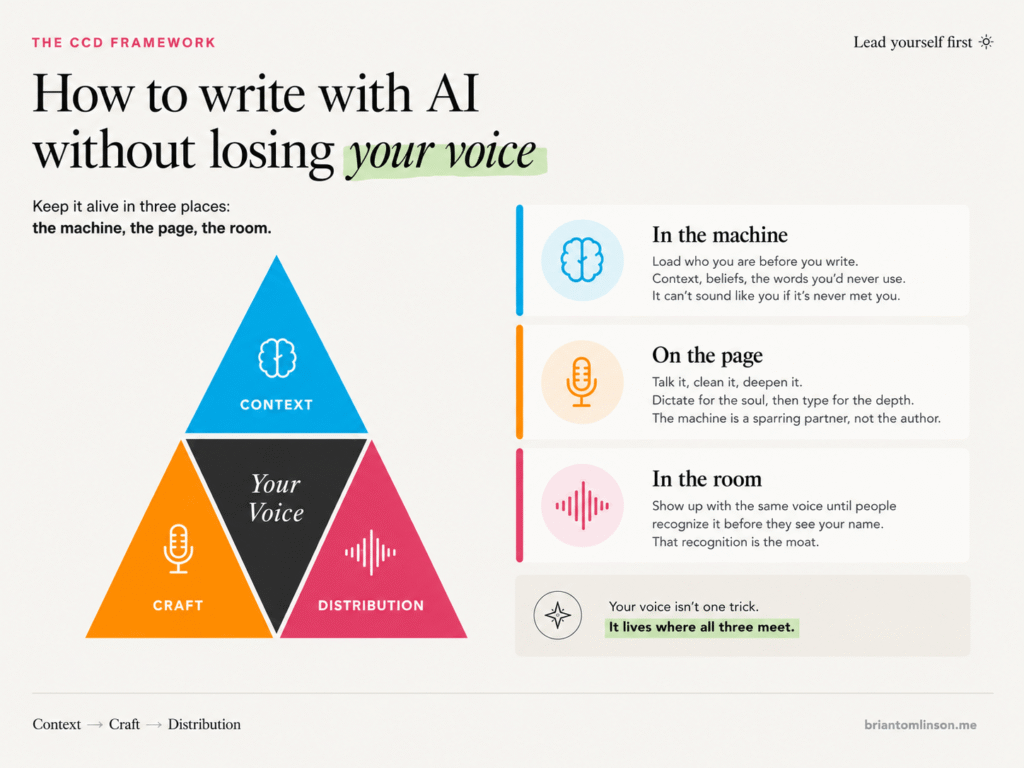
Your voice has to live in three places
So if there’s no magic prompt, what do you actually do? Over the past year, I’ve come to think of it like this. Your voice has to live in three places, and if you lose it in any one of them, the writing goes a little gray.
In the machine
The first place is the machine itself.
Before I write a word, the tool already knows a lot about me. How I think, what I believe, the stories I reach for, the words I would never use. That’s the whole reason I built so much context into my Self-Leadership Stack. It can’t sound like you if it’s never really met you.
I’ve written before that this is the part most people skip because it’s the hardest part. So instead of doing a bit of self-work, they open a blank chat, type a quick prompt, and wonder why the writing sounds like everyone else’s. Loading that context is the difference between asking a stranger to write for you and asking someone who has spent a year studying how you think to help you out.
On the page
The second place is the work itself, the actual writing.
This is where my dictation habit comes in. For a big chunk of what I make, I talk to the page before I type a thing. I’m doing it right now, as a matter of fact. When I speak, the rhythm is mine, and the little asides are mine, and the soul kind of comes along for free, because it’s already there in the way I say things. Now, there are a lot of things that get lost when you go from voice to paper. Things like cadence and tonality go out of the window, and only the best of us manage to keep the written word feeling the same. (Sigh…if only I did enough of the writing work to get there. Maybe one day.)
Quick one → I use WisprFlow to dictate. It is, as of this
speakingwriting, the best tool for this.
Then I clean it up. And then, a lot of the time, I switch to typing, because that’s where the more expansive thoughts tend to show up. The deeper ones. The words that don’t quite make it to my lips in the moment, but do come through my fingers when I slow down a bit. Talking gets the soul onto the page, and typing is usually where the depth shows up. I’ve found I need both. The machine is a sparring partner in here, never the author.
In the room
The third place is the one people forget. Your voice has to live in the room, by which I mean the audience.
A voice only really becomes yours when enough people recognize it. When it haunts them, as Ta-Nehisi Coates writes in The Message. The honest test is whether someone could read a paragraph with your name stripped off the top and still know it was you. You don’t get there with a clever prompt. You get there by showing up with the same voice, again and again, until people start to recognize it before they see who wrote it.
(Another side note here: this is f*cking hard. If you have a favorite author, then you know their voice. If you’re a part-time writer like me, this is going to take a TON more practice. The key here is just to enjoy the process. 🤷🏾♂️)
That recognition is the slowest of the three to build, and it’s the part no tool can do for you. It’s also the part that compounds. Once people trust a voice, everything you make travels a little further. (If you want the long version of how that trust gets built without performing a character, I wrote about visibility without becoming someone you’re not.)
These three places feed each other. When the machine knows you, it stops fighting your voice. When you talk your drafts before you type them, the work keeps its pulse (vibe/soul whatever you want to call it). And when you show up with that same voice long enough, people recognize it before they see your name. Skip any one of them, and you start to feel the gap.
Why your voice still matters in AI writing
So, no, I don’t think AI is quietly making everyone sound the same. It’s just showing that we are probably not using it the right way. If you use it as a tool for thinking, then it’s asking each of us a quieter question. Do you actually know what you think? How to communicate it. And if you believe it enough to keep it saying it in different ways.
The writers who’ll matter over the next few years won’t be the ones with the best prompts. They’ll be the ones who held on to a point of view worth infusing into their work, and who learned to feel the golden moment the machine had sanded off.
The tools will keep getting better at the clean part. But the clean part was never really the hard part. The hard part is the soul, and that part is still yours to put in.
Because models are trained to produce clean, agreeable text — the statistical average across millions of examples. Your specific point of view is what gets smoothed out. A 2026 Google DeepMind study found that even when asked to make grammar edits only, AI shifted essays toward safer, more neutral arguments.
Not exactly, and no prompt fully solves it. Loading deep context about how you think helps, but the final voice still requires human editing. The reliable signal: when a draft feels hollow, that’s where your editing begins.
Protect it in three places: the machine (load real context about who you are), the page (dictate to capture your natural rhythm, then edit for depth), and the room (publish consistently so an audience recognizes your voice).
Context, Craft, Distribution. Context means teaching the AI who you are before you write. Craft means talking your draft before typing it. Distribution means showing up with the same voice until people recognize it.
Convergence is real and measurable, but it predates AI — sameness was already spreading through market-tested design and content. AI removed the friction and scaled it. Writers with a clear point of view use AI to amplify it instead.