

In 2015, Zappos offered its employees a strange deal. Adopt a new system with no bosses and no managers, or take a severance check and leave. Around 18% took the check and walked out the door.
The system was called holacracy. No titles, no managers, just overlapping circles of self-governing roles. For a while, it was the poster child for the flat, boss-free future everyone said was coming.
Then, a few years later, the managers came back. Not all at once, and never with an announcement. Zappos rebuilt much of the structure it had torn down because running a company with no one responsible for developing anyone turned out to be harder than it looked on the whiteboard.
Buffer, the software company, ran almost the same experiment around the same time. It dropped its managers, then reversed and brought back the coaching, the mentoring, and eventually the metrics it had thrown out. Same story, just on a smaller stage.
Those two experiments spring to mind right now, because the entire corporate world is about to run them again at scale, and this time it’s calling it artificial intelligence.
Companies are cutting middle managers and telling themselves the software will cover it. Korn Ferry found 41% of employees have already watched the layers come out. Gartner expects one in five companies to use AI to flatten more than half their middle-management roles by the end of this year (I’m writing this in 2026).
What that actually does is simpler than what we’re being sold in the media. It doesn’t make companies faster. It erases the next generation of leaders before anyone notices they’re gone. I’ve started calling it leadership debt. A few things about it stand out.
The cut doesn’t even pay for itself
Gartner studied 350 executives at billion-dollar companies and sorted them by how hard they cut. Eighty percent had reduced headcount. Then someone checked the outcomes. The deepest cutters landed almost exactly where the most cautious ones did.
All that pain for employees, their families and everywhere else it reverberates, and it barely moved the needle.
So the honest name for most of these cuts isn’t “we got leaner and stronger.” It’s “we freed up some budget for a couple of quarters.” Now that’s something any company would want. But ultimately, it’s just not the same as getting better. Yet somehow we seem to confuse the two all the time.
I’m certainly not claiming that every company is lean or that every layer of management is sacred. We can all name plenty of orgs that are genuinely overmanaged and need three approvals for a decision that should probably be automated anyway. Cut those. That’s real fat. The mistake is swinging at the manager and the paperwork with the same axe because they look identical on a spreadsheet.
A manager is a pipe, and the pipe runs both ways
What more people could appreciate is that a middle manager isn’t dead weight between the workers and the executives. They move something in two directions.
Downward, they develop the juniors. Not on paper. In the 1:1 nobody else sees, in the hard feedback nobody else gives, in the stretch project handed to someone who isn’t quite ready. John Whitmore, who wrote the book on coaching, teaches us that: “telling negates choice, disempowers, limits potential, and demotivates. Coaching does the opposite.” Sixty percent of new managers already fail in their first two years. Pull out the layer that used to catch them, and that number has one way to go.
Upward, the manager is the only training ground we have for executives. Nobody learns to run a division at 45. They learn it at 30, managing five people and getting most of it wrong. Delete the role, and you delete the rung.
So the cut breaks the pipe in the middle, and the flow stops from both ends. The juniors below stop being developed. The executives above stop being grown. The problem with all of this is that it’s something that you don’t feel for years, not quarters.
I’m already seeing the pattern where middle managers are pushed out. Juniors start reporting to executives who have little to no time to coach and develop them. The work gets judged, but the person never gets developed. As you can probably gather by now, this is a never-ending cycle. AI may create new opportunities, but it won’t rescue companies that have forgotten how to develop people.
Picture a 27-year-old promoted into her first people-manager role. Six months later, her own manager is cut. She now reports to a VP with 20 direct reports and no time to coach her.
Her team needs clarity. The business wants numbers. A hard conversation is required, but nobody has ever taught her how to have one, so she avoids it.
Six months later, two people leave. And she decides leadership is not for her.
That is leadership debt. It doesn’t show up immediately as a failed quarter. It shows up later as a person who might have become a great leader, but never got the chance.
The damage is a decade out, so almost no one plans for it
This is why smart companies do it anyway.
Leadership debt doesn’t land on a quarterly clock. The board wants this quarter. The bonus rides on this quarter. A cost that arrives in 2035 barely exists to a person whose whole world is the next earnings call.
I understand the pull, I really do. Things move so fast now that planning ten years out can feel almost silly. But that’s the trap that we need to avoid. The faster the world moves, the rarer and more valuable the people become who can see around the long corner, and the more it costs to have none of them left.
You can already see the early cracks. Span of control is nearly three times what it was in 2017. 97% of managers now do their own individual work on top of managing. The ones still standing are stretched so thin that coaching is the first thing to fall off the calendar, because it’s the one task with no deadline attached.
And the people meant to become tomorrow’s executives are already heading for the exits. Trust in immediate managers has fallen to 29%, only one in five leaders feels ready for what’s coming, and 40% of the stressed ones say they’re thinking about leaving leadership altogether. Across the market, the manager ranks are down 6.1%, and the executive ranks are down 4.6%. A farm system doesn’t collapse loudly. It stops producing, and you find out years later when nobody’s ready to come up.
The machine is worst at the one thing that makes leaders
Give AI its due. It handles the admin half of management better than a tired human at 6pm, and you should let it. But the admin was never the job.
Gallup studied tens of millions of workers and found that managers account for at least 70% of the variance in team engagement. Not the comp plan. Not the mission on the wall. The person. And developing people is, by Harvard’s own measure, about the least automatable work there is, a nine percent automation potential. So companies are racing to cut the one thing the machine can’t do, to make room for the machine.
Clayton Christensen called management “the most noble of professions if it’s practiced well… no other occupation offers as many ways to help others learn and grow.” Poetically and prophetically, he was right, and we’re about to prove it in the most expensive way possible. Most managers aren’t overhead. Done right, a manager is the thing AI still can’t be: the person who turns a junior into someone worth promoting.
None of this is new
Every one of these experiments ends in the same place. Zappos rebuilt its managers. Buffer brought back its coaches. The flat, boss-free company keeps turning out to be a phase companies pass through on the way to admitting that someone has to grow the next someone.
Leaders have always been made the same way. Slowly, by other leaders, in the roles we’re now deleting to save a quarter. AI didn’t change that. It just gave companies a more modern-sounding reason to forget it.
The truth is that you’re probably not the one holding the axe. You’re inside a company that is, watching your layer, or the one you’re climbing toward, get labeled as overhead.
The Opposite of Leadership Debt
So the useful question you need to ask isn’t what the CEO should do. It’s what you should do, so the cut can’t reach you.
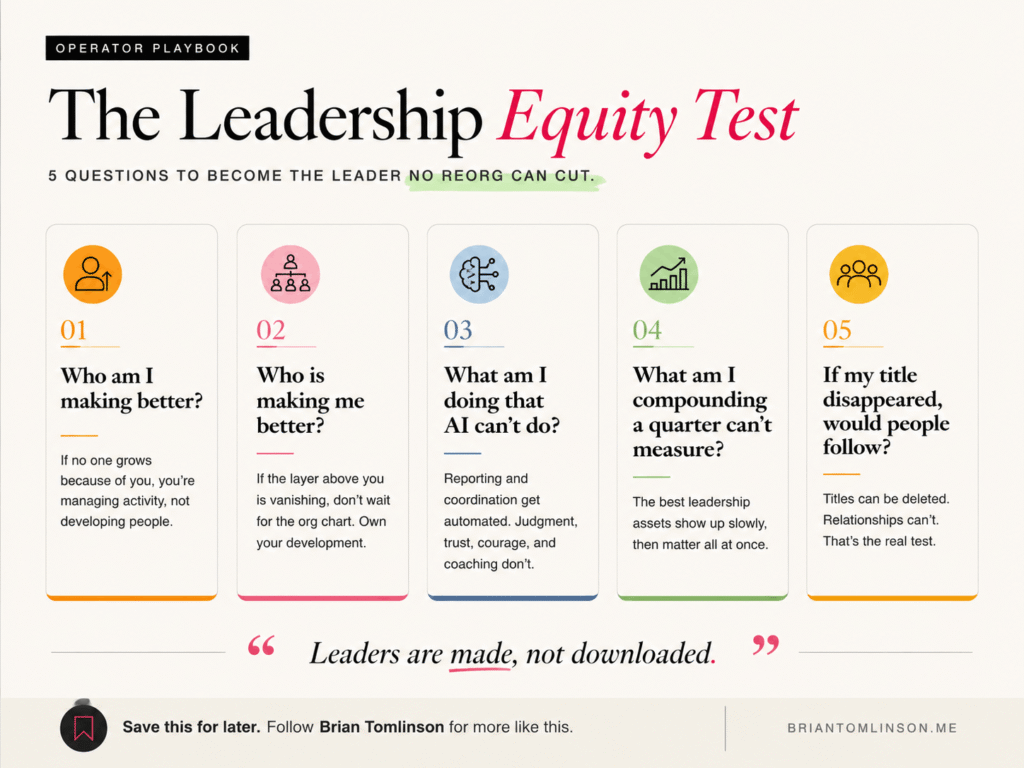
If leadership debt is what companies accumulate when they stop growing people, leadership equity is what you build when you keep doing the work anyway.
It is the trust you compound.
The judgment you sharpen.
The people you develop.
The hard conversations you learn not to avoid.
The followership that remains when your title changes or disappears.
Five questions are worth asking now:
- Who am I making better?
If no one is growing because of you, you are managing activity, not developing people. - Who is making me better?
If the layer above you is disappearing, you can’t wait for development to arrive through the org chart. Take agency of your own development. - What am I doing that AI can’t do?
Status updates, reporting, and coordination will keep getting automated. Judgment, trust, courage, and coaching will not. - What am I compounding that this quarter can’t measure?
The most valuable leadership assets rarely show up immediately. They accumulate slowly, then matter all at once. - If my title disappeared tomorrow, would people still follow me?
This is the real test. Titles can be deleted. Relationships can’t.
What’s actually yours
The company can erase the role. It can’t erase what you became while you held it.
AI can run the numbers all day. It still can’t make a leader out of anyone. That part was always going to be our job. And if companies are about to forget that, then the people who remember it will become more valuable than ever.
So if ever there was a time, now is the time to take agency over who you’re becoming, and to make those unique levers that you have visible to the world.