
“Be so good they can’t ignore you.”
Steve Martin
When I was around 16 or 17, I made it, for the first time, onto Antigua’s senior national football team. But what most people don’t know is that I was actually never called up.
I was training with the under-23 team, and one of my best friends, who played for my club, had been called up. In the first few weeks of training, before the whole senior squad was there, they were often short of players.
So when our session finished, I’d leave the under-23s, go over, and walk up to the senior coach, a gentleman named Zoran Vraneš. I asked if I could fill in and kind of make up the numbers.
He took one look at me, thought for a second, and said, “Okay.”
The next day, I came back and asked again. He’d already said yes, and I asked anyway. And that went on for a week until he finally told me, “Stop asking. You’re going to stay and train.”
Then I worked my ass off. And yes, I got capped.
Ever since then, I’ve tried to put myself in positions to be seen, to be noticed, to have some little inkling of luck that I wouldn’t otherwise have had unless I took some form of action.
Years later, I came across an article by Sahil Bloom in which he wrote about what he called your luck surface area. I liked the idea as soon as I read it, but there’s a bit of a catch. If you’re anything like me, you would just rather do good work and get on with it. You hear telling and think that you’re bragging, which, of course, you don’t want to do because nobody wants to be a brown-noser, right? Instead, what we want to do is to take that walk across the pitch and show our work. Let people watch us do it.
Where luck surface area actually comes from
In March 2022, Sahil Bloom published How to Get Lucky, and after that, he compressed it into what he calls the Luck Razor: “When choosing between two paths, choose the path that has a larger luck surface area.”
The phrase isn’t his, though, and he never really says where it came from. Turns out, it popped out of a software developer named Jason Roberts during an episode of his podcast, TechZing, way back in 2010. A few months later, Roberts wrote it up on his blog, Codus Operandi:
“The amount of serendipity that will occur in your life, your Luck Surface Area, is directly proportional to the degree to which you do something you’re passionate about combined with the total number of people to whom this is effectively communicated.”
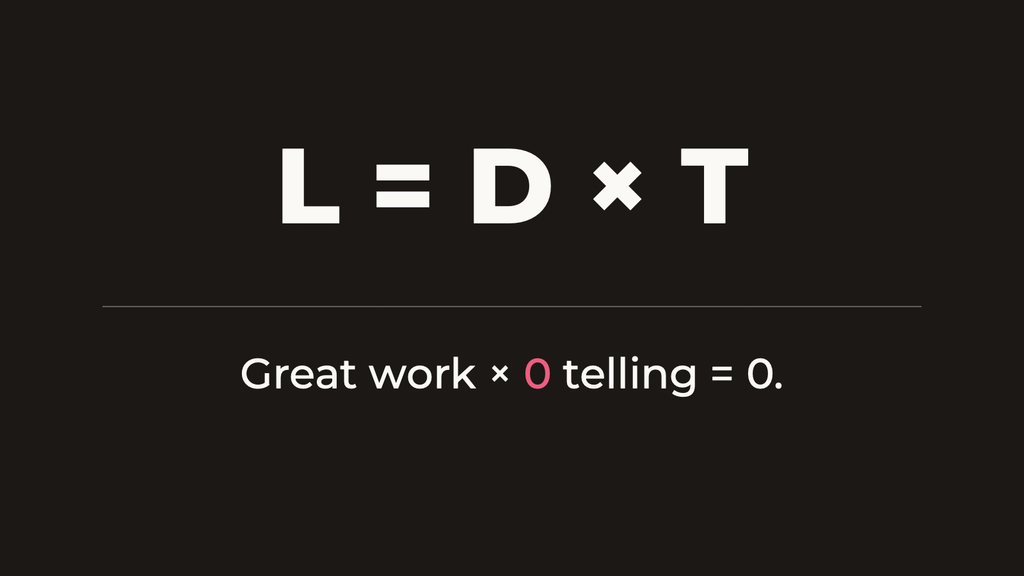
Being a programmer, he (of course) turned it into an equation: L = D × T. Luck equals Doing times Telling. (You’ll sometimes see the idea credited to Jim Collins, but his term is “return on luck,” which is a different idea.)
I mentioned luck surface area in passing back in March, when I wrote about building a body of work. I liked the idea then, and I still do. But the formula can come across as a bit intimidating and might make a lot of us check out.
The trap in the luck surface area formula
Read L = D × T as a quiet person, and the T already makes you start to sweat. Telling sounds like doing everything that you don’t really want to do publicly. Posting about your wins, working the room, and talking about yourself in meetings. Ick. Many of us will read that, decide this luck thing isn’t for us, slowly back away, and head back to our desks. The downside is that math doesn’t lie. Great work multiplied by zero telling is still zero.
And the quiet folks just might have a point. Back in 2019, a startup advisor named Sean Murphy noticed a flaw in Roberts’ chart. The chart assumes that you have unlimited hours. I know I sure as hell don’t, and you don’t either. Every hour you spend talking about your work is an hour you’re not doing it.
Telling people how awesome you are doesn’t work out the way you’d expect either. When Chad Higgins and his colleagues pooled the research, self-promotion helped in job interviews with strangers who’d never seen your work. With bosses who saw your work every day, it hurt. And in one set of experiments by Irene Scopelliti and her colleagues, people who bragged guessed that about a quarter of their listeners would be put off. It was closer to three out of four.
If telling means talking about yourself, then quiet people are right to hate it. It eats your time, and it can cost you goodwill with the very people who know your work best. So we skip it, and the T stays at zero.
A few weeks ago, I wrote about why good work doesn’t speak for itself. But there’s still hope. We should still be aiming to let our work speak without talking.
Showing up is the quiet way of telling
Go back to the football pitch for a second. I never told the coach anything about myself. I didn’t pitch him on my talent. I asked if I could fill in, and then he watched me train.
That was the telling. It just didn’t involve any talking. Now, I recognize that this is easier in sports. But most of what we do becomes visible.
Woody Allen’s line, “80 percent of success is showing up,” is often quoted as if it’s about being seen. Years later, he said he really meant sitting down and actually finishing the play or the novel, rather than talking about writing one. For him, showing up meant doing the work. Getting away from the procrastination and the “talk” and actually doing the thing.
If you can manage to do that work somewhere the right people can see it, the doing and the telling happen at the same time. You’re not stealing hours from the work to talk about it.
Kimberly Elsbach and her colleagues found that just being seen at work also counts for something. They call it passive face time. Managers who simply saw people working were more likely to call them dependable and committed. Most of them couldn’t say why that was. In a way, it is literally “seeing is believing.” This certainly explains one of the biggest challenges behind the return-to-the-office dilemma that many companies are facing. (Though that is also much more about trust. But that’s for another day.)
On the other hand, Jonathan Berman and his colleagues found what they call the braggart’s dilemma. Bragging seems to help when no one necessarily knows what you do or the work that you’re doing. When people already know the work that you do, bragging then costs some credit.
I love how Joshua Medcalf writes this in his book Chop Wood Carry Water:
“You do not shine under the bright lights; the bright lights only reveal your work in the dark.”
Why asking again works
Most of us are afraid to ask.
Francis Flynn and Vanessa Bohns (then Lake) had people ask strangers for small favors, like filling out a short survey. First, though, they had them guess how many people they’d need to approach in order for someone to say yes. They ended up needing about half as many as they’d predicted. When she looked across more than 14,000 strangers in the research, Bohns found that we tend to underestimate how often people say yes by nearly half.
That’s because when we ask, all we can feel is the anxiety of hearing the word “no.” What we forget is that saying no to someone’s face is just as uncomfortable.
That entire effect is strongest in person, though. Over email, it flips, and people tend to overestimate how many people will reply. A cold email, I can easily ignore or blame on the spam folder. But if a kid is standing at your door with cookies, it’s a lot harder to silently close your door and pretend they didn’t see you.
It also turns out that “how” you ask matters as much as how often you ask. Adam Grant, Sharon Parker, and Catherine Collins found that proactive people earn credit from their bosses when the push reads as helping the team. When it reads as being about themselves, the credit disappears. So, for example, I didn’t ask the coach to rate me or give me a chance. I asked to make up the numbers, which solved a problem he had that week.
Ryan Holiday calls this being an anteambulo in Ego Is the Enemy. You clear the path for the people above you, and eventually you find you’ve made a path for yourself.
Three of the four kinds of luck are yours
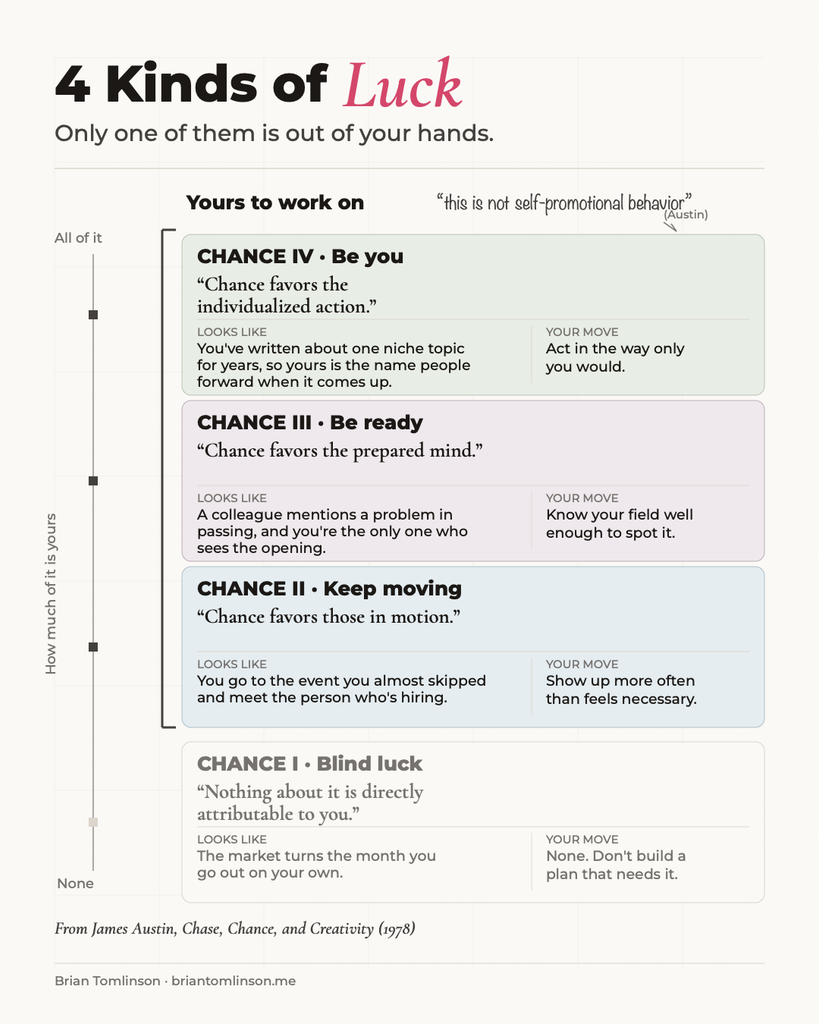
Long before anyone said “luck surface area,” a neurologist named James Austin wrote Chase, Chance, and Creativity, first published in 1978. He split luck into four kinds.
Chance I is blind luck. It “happens, and nothing about it is directly attributable to you.” There’s nothing to do about that one.
Chance II, which he calls the Kettering Principle, says “chance favors those in motion”: keep moving and you stir things up.
Chance III is what Austin calls the Pasteur Principle: “chance favors the prepared mind.” In other words, you’ll only notice the opening when it shows up if you’ve already put in enough work to know what you’re looking for.
Then there’s Chance IV, which he calls the Disraeli Principle: “chance favors the individualized action.” That’s the kind of luck that finds you because of the way that you, specifically, tend to show up and act. Funny thing is, right where he introduces it, Austin adds a little note that you might otherwise skip: “this is not self-promotional behavior.” Which, for those of us who hate bragging, is a pretty nice thing to read.
Walking over was Chance II. Being ready to train with the seniors was Chance III. Asking every day, after I’d already been told yes, was Chance IV. Austin borrows a line from Disraeli for that last one: “We make our fortunes, and we call them fate.”
Most of the time, nothing happens
Let’s be honest. This is not a magic potion or a waft of fairy dust. You don’t get to snap your fingers and click your heels, and it works every time. (I’ve tried that.) It backfires all the time. You go to events, and nothing comes of it, and that probably happens more often than not.
Morgan Housel talks about this in The Psychology of Money, where he argues that every outcome in life is guided by forces other than individual effort. The economist Robert Frank tested it in his book Success and Luck. In his simulated contests, luck made up only a sliver of each score, and talent and effort made up the rest. Once the field got big, the most deserving contestant still usually didn’t win. Effort gets you into the final, and then luck tends to have a say in picking the winner.
For example, I had an advantage because I could walk over, as I was already training on the same field. Raj Chetty and his colleagues studied the friendships of 72 million people. Now, if you don’t know, it turns out that people mostly don’t know each other because they never end up in the same room in the first place. Snubbing each other once they’re in there plays a much smaller part.
Access isn’t necessarily fair. A lot of people put in a ton of effort and never even manage to get into the room where things can change for them. Even if they might be right next door.
Taking the walk is one thing. Being able to do it again and again adds a little bit of value to it. You just want to make sure that you are walking into the right rooms. While action definitely increases luck, proximity is another key part of that equation. But this needs to be something that you recognize, a bit like in Chance III.
The Luck Razor, revisited
Sahil’s razor says to choose the path with the larger luck surface area. For those of us who’d rather work than talk, I’d put it a little differently: choose the path with more rooms where people can watch you work. More often than you’d think, one of them is right next door.
When you get there, ask if you can help. Then come back the next day and ask again, even if the answer was yes.
You’ll know it’s working when someone finally tells you to stop asking.
Frequently asked questions
Luck surface area is the idea that the amount of luck in your life grows with how much you do and how many people know about it. Developer Jason Roberts wrote it as L = D × T: Luck equals Doing times Telling.
Jason Roberts coined the phrase on his podcast TechZing in 2010 and wrote it up on his blog, Codus Operandi. Sahil Bloom made it popular in 2022 with his newsletter “How to Get Lucky” and the Luck Razor.
Do your work where the right people can see it, so the doing and the telling happen at the same time. Ask to help instead of asking to be rated, ask again even after a yes, and choose rooms where the people who matter can watch you work.
It depends on who’s listening. A meta-analysis by Chad Higgins and colleagues found self-promotion helped in job interviews with strangers but hurt with supervisors who saw the person’s work every day.
Neurologist James Austin described four in Chase, Chance, and Creativity: Chance I is blind luck; Chance II comes from staying in motion; Chance III favors the prepared mind; and Chance IV favors the individualized action, luck that finds you because of how you specifically show up.