

“When you look back at the body of work you’ve built and the people you have impacted, what do you want to see?”
Todd Henry asks that question in The Daily Creative. I sat back in my chair, gazed out of the window into the treetops, and sighed. I didn’t have an answer.
The truth is that for most of my career, there wasn’t much to look back on. Not publicly. I’ve done some great work. I’ve led teams, built up teams, started departments, launched products, positioned executives, built change and education programs, and started and scaled social media. The brands I worked with today have more than a million followers on LinkedIn alone — on foundations I helped build.
But a lot of that work? Nobody outside those companies ever saw it.
That’s the problem with doing great work behind closed doors. The work is real. The proof isn’t visible. And if the proof isn’t visible, opportunity doesn’t know where to find you.
Henry puts it bluntly in Die Empty: “You are building a body of work today through both what you do and how you do it.” The question isn’t whether you’re building one. You are. The question is whether anyone besides your immediate team will ever know it exists.
The most powerful career move isn’t optimizing your resume. It’s building a visible body of work that compounds over time — and makes you the obvious choice.
Why Invisible Work Costs You Opportunities
Here’s what nobody tells you about credentials: they’re the entry ticket. Not the currency.
Research on skills-based hiring backs this up. When companies evaluate candidates based on demonstrated competence rather than degrees and titles, those hires perform better and stay roughly 9% longer. That’s not a fluke. It’s a pattern. Demonstrated capability beats credentialed assumption.
Signaling theory explains why. A degree signals general ability and conformity — “I can finish what I start.” Documented work signals something far more specific: current capability, initiative, and the willingness to put your thinking out where it can be tested.
Because that’s how people actually make decisions. Behavioral economics research shows decision-makers give more weight to vivid, contextual evidence over abstract qualifications. A framework you’ve published, a case study you’ve shared, a lesson you’ve taught in public — these are more persuasive than any bullet point on a resume. They show how you think, not just where you’ve worked.
The fact that should bother us the most, though, is that credentials decay. I studied marketing in university, and I can tell you even back then, five years after I finished school, a massive chunk of what I learned had become irrelevant. The truth is, companies restructure, titles change, technology changes. That role that you had in 2019? Even if it’s the same job, it’s more than likely changed. Your experience lives in your head — and nowhere else.
Unless you start putting it somewhere people can see it.
Why Building in Public Changes Everything
When you build in public, the math changes entirely.
Austin Kleon writes about this in Show Your Work: “Think process, not product.” You don’t need to be finished to be valuable. Share the thinking behind the work — where it came from, how it was made, why it matters. That’s what builds connection. Not the polished end result. The messy, honest process of figuring it out.
Cal Newport calls it career capital. The things you actually want — autonomy, mastery, meaningful work — aren’t given. They’re earned by accumulating rare, valuable skills and then making those skills visible. The accumulation alone isn’t enough. Visibility converts the capital into opportunity.
As Naval Ravikant writes in The Almanack of Naval Ravikant, “Code and media are permissionless leverage.” Every framework you publish, every essay you write, every case study you share — these become media assets that compound. They attract opportunities, build trust, and prove competence without requiring your presence. They work while you sleep. That’s not a metaphor. That’s leverage.
Here’s what changed for me and what I’ve seen work for a number of people. The experience is there — no matter how much or how little. We all have our own unique experiences and expertise. You don’t have to become a different person. You just need to share that expertise and experiences with others. Make your work visible. The body of work becomes the unlock.
So how do you actually build one? Three steps.
Step 1: Document Your Expertise
Turn your experience into teachable assets.
You already have the raw material. You just haven’t captured it yet.
Todd Henry warns us in Die Empty: don’t go to the grave with your best work inside you. The tragedy isn’t failing — it’s never putting your thinking into a form that outlives the moment. Kleon puts it simply: “Share something small every day.” Documentation isn’t about writing a book. It’s about consistently turning what you’re learning into something other people can use.
Nicolas Cole calls this the dividing line in The Art and Business of Online Writing: “Practicing in public is what separates aspiring writers from professional writers.” And Robert Greene frames it as craftsmanship in The Daily Laws: “You must think of yourself as a builder, using actual materials and ideas. You are producing something tangible.”
So what do you document?
Frameworks you’ve developed — even the informal ones sitting in your head. Lessons from projects: what worked, what didn’t, and why. The behind-the-scenes process of how you think through problems. Case studies from your actual work.
I’m not asking you to write a memoir. I’m asking you to start capturing what you already know. One idea. A single framework. One hard-won lesson. Written down. That’s the first brick.
The Proprietary Objection
“But my work is proprietary — I can’t share it.” Fair. Share the thinking, not the IP. Frameworks. Principles. Lessons learned. That’s what builds trust — not trade secrets. (Just a note here: this is actually what trips up folks who work in enterprise organizations. They feel as if they are too locked down to share what they do, when actually you just want to be sharing the thinking behind. If you can, you can go into more detail. But your thought process and experience are the most important parts of this.)
Step 2: Ship Your Work Across Platforms
Put your work into the world.
One idea. Multiple lives. Your body of work doesn’t compound if it lives in a Google Doc.
Ryan Holiday writes about creating work that endures — a perennial seller. The principle applies here: build something worth shipping for years. Then promote it through multiple channels. A framework that proves effective can become articles, workshops, keynotes, and products over a decade. That’s how one idea becomes an empire.
Here’s the thing most people get wrong about distribution: they think it’s repetitive. It’s not. Most of your network never sees any given piece on first publication. Resurfacing ideas in different forms increases perceived depth and intentionality — not redundancy.
The system is simpler than you think:
- Create one substantial piece — a newsletter essay, an article, a video
- Extract 3-5 key ideas for native social posts
- Adapt the angle for each platform — story-led on LinkedIn, punchy on X, visual for carousels
- Space releases over time. Don’t dump everything at once
- Add new context when resurfacing — iteration, not repetition
The Leverage in Practice
I write one newsletter a week. From that single piece, I pull 3-5 LinkedIn posts, a framework graphic, and eventually feed a course module. Not hustling. Leverage.
“I don’t have time to post constantly.” You’re not posting constantly. You’re writing one thing and shipping it everywhere. Big difference.
If you can do that right, you’ll be getting something done that even most companies struggle with.
The Sharing Paradox
This is the objection I hear most often: “If I give away my best thinking, why would anyone pay me?”
Look at Seth Godin. Daily free blog posts for over twenty years. Simultaneously: bestselling books, premium workshops, altMBA. What clients pay for isn’t information — it’s application, guidance, and community. The free work builds the trust that makes the premium work possible.
Industry surveys show top specialists command $300–$1,000+ per hour. That rate isn’t driven by secrecy. It’s driven by depth, rarity, and demonstrable impact. Public content becomes the proof of expertise. Paid work focuses on context-specific implementation that free content can’t replace.
Nobody hired me because I was keeping frameworks secret. They hired me because they’d already seen how I think. The body of work did the selling before I ever got on a call.
Giving away your best thinking doesn’t erode your value. It compounds it.
Step 3: Let Consistency Compound Your Reach
Let time and consistency do the work.
A body of work doesn’t pay off in week one. It pays off in year two. And year five. And year ten.
James Clear writes in Atomic Habits: “Habits are the compound interest of self-improvement.” His math is instructive — 1% daily improvement compounds to roughly 37x in a year. The principle translates directly: small, consistent actions stack disproportionately over time.
The key distinction that most people miss is that intensity makes for good stories, but consistency makes real progress. A sustainable cadence — one quality piece per week, sustained for a year — outperforms a burst of daily posts that tapers off after six weeks. The system beats the sprint.
Clear himself is the proof. Before Atomic Habits became one of the bestselling nonfiction books of the decade, he spent three years writing articles on his website — consistently, week after week, building an email list one subscriber at a time. No viral moment launched that book. The compounding did. And Seth Godin? Daily blog posts for over twenty years. That consistency built the platform that supports bestselling books, premium workshops, and the altMBA. No hack. Just showing up.
Research and case evidence converge on this: compounding effects in personal branding typically emerge over one to three years. Most people quit before the curve bends.
That’s why the first six months feel like shouting into the void. You publish, and the response is silence. By month twelve, something shifts. People start saying “I see you everywhere.” Inbound messages land that reference a post from three months ago. Opportunities appear that you didn’t chase. That’s the compound kicking in. And it only accelerates from there.
The Body of Work Flywheel
When you zoom out, the system looks like this:
Do the work → Document the process → Ship consistently → Repurpose across platforms → Engage and refine → Productize and price
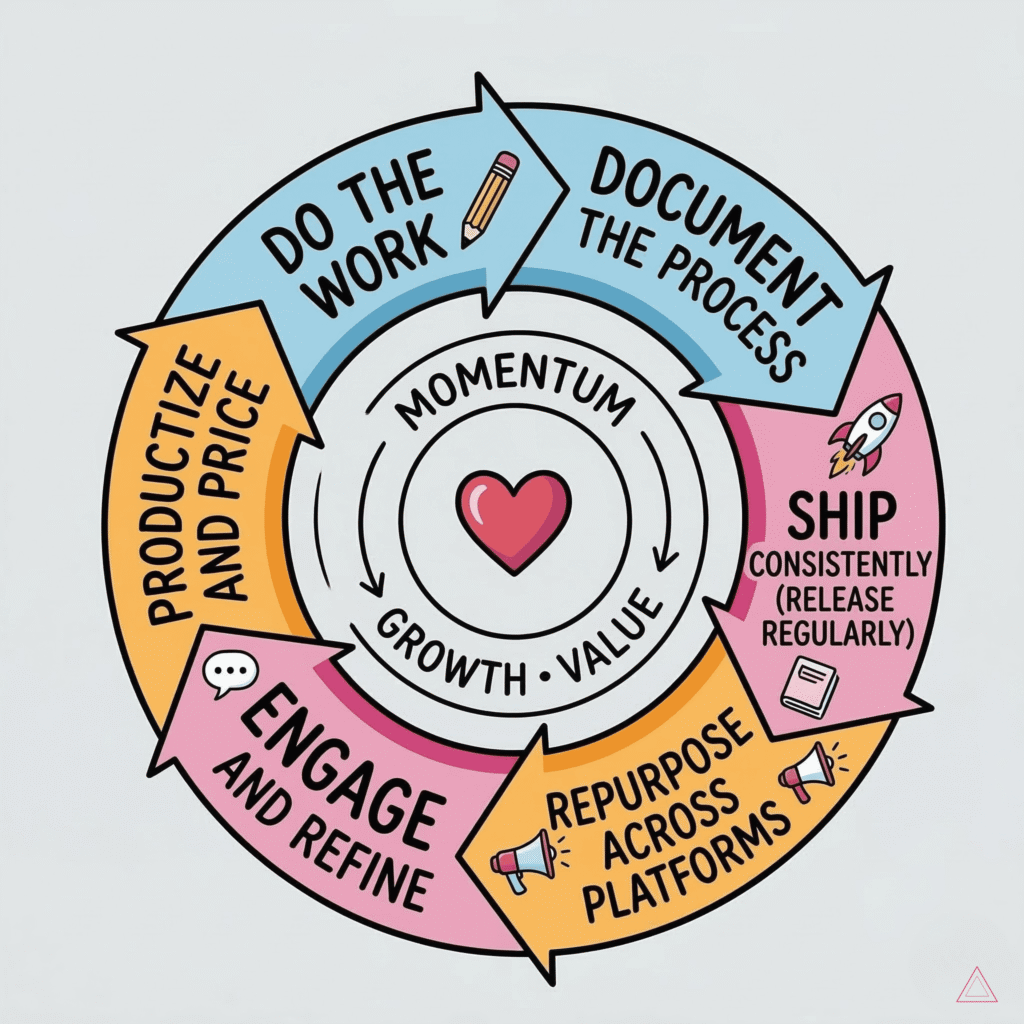
Each revolution adds assets. More assets create a larger luck surface area. Creates more room for serendipity. More serendipity generates more opportunities. Better opportunities lead to better work. The flywheel accelerates.
That’s how a body of work goes from “a few LinkedIn posts” to “the reason people call you first.”
The Question That Started This
Let’s come back to where we began.
“When you look back at the body of work you’ve built and the people you have impacted, what do you want to see?”
A resume is a summary of where you’ve been. A body of work is proof of how you think.
One collects dust. The other compounds.
You don’t need more credentials. You need more evidence. Evidence that you’ve learned something worth sharing. Evidence that you can help someone get from where they are to where they want to be.
Start with one piece this week. Document one thing you know. Ship it.
Then do it again next week. And the week after that.
That’s not content strategy. That’s building a body of work. And it’s the most valuable career asset you’ll ever own.
A body of work is a visible collection of your frameworks, case studies, essays, and documented thinking that proves how you approach problems. Unlike a resume, which summarizes where you’ve been, a body of work demonstrates current capability and compounds over time — attracting opportunities, building trust, and making you the obvious choice.
Three steps: Document (turn your experience into teachable assets — frameworks, lessons, case studies), Ship (distribute one core idea across multiple platforms), and Compound (maintain a sustainable cadence and let consistency create compounding returns over 1–3 years).
Skills-based hiring research shows employees selected for demonstrated competence outperform and stay roughly 9% longer than credential-selected peers. Behavioral economics confirms that decision-makers give more weight to vivid, contextual evidence — like a published framework — over abstract qualifications like degrees and titles. Credentials signal general ability; documented work signals specific, current capability.
Yes. Seth Godin has published daily free blog posts for 20+ years while running premium workshops and the altMBA. Industry data shows top specialists command $300–$1,000+/hr driven by depth and demonstrable impact, not secrecy. Free content builds trust; paid work delivers context-specific implementation.
Research and case evidence suggest compounding effects in personal branding typically emerge over 1–3 years. James Clear spent three years consistently publishing articles before Atomic Habits became a bestseller. Most people quit before the curve bends — the first six months feel silent, but by month twelve, inbound opportunities accelerate.