

The Minimum Viable System: Three Actions, One Review, One Reset
When I was training for my first marathon, I assumed I needed to run more miles. Longer runs. More intensity. More volume. That’s what ambitious people do, right? Go big or go home.
Except I didn’t get faster by running more. I got faster by running slower, and running the same four days a week. The same routes, the same boring consistency. Week after week after week.
Now, that’s something that you can learn from running, but it’s actually something that can be applied to just about everywhere in your life.
Why Complex Productivity Systems Always Fail
When life gets chaotic, most of us reach for the same solution: a bigger system.
More apps. A new habit tracker. A 90-day sprint. A color-coded Notion dashboard with 47 toggles and a weekly scoring matrix that takes 45 minutes to fill out.
It feels productive. It looks as if you’re doing something. And it almost always falls apart the as soon as real life shows up.
There’s research behind why this happens. A 2019 study in Frontiers in Psychology by McCloskey and colleagues analyzed 25 everyday behaviors across 459 people. They found that the more complex a behavior feels, the slower it becomes automatic — and the more effort it continues to require. That simply translates to simple behaviors or easily becoming habits. The more complex something is, the more effort it’s going to take, and that doesn’t change.
That means the elaborate morning routines that we see across social media have eleven steps and includes journaling, an ice dip, and let’s not forget gratitude, it’s all fighting your brain. And it’s going to keep fighting your brain, because complexity never transitions to autopilot. It just stays hard.
More Goals, Worse Results
There’s more where that came from. Dalton and Spiller (2012) ran a series of experiments published in the Journal of Consumer Research and found something called Implementation intentions — the “if-then” plans that make goals actionable. These worked beautifully for one goal. But when participants planned for six goals at once, the benefit disappeared entirely. In some cases, multi-goal planning actively reduced commitment.
Planning for more goals didn’t just dilute focus. It undermined the entire mechanism that makes planning work.
And Chernev, Böckenholt, and Goodman’s 2015 meta-analysis of 99 studies confirmed the pattern from a different angle: large, complex choice sets produce choice overload — more decision avoidance, lower satisfaction, and worse decisions across the board. It’s essentially what you feel when you go to a restaurant and they hand you a menu with a hundred different options.
Your 30-item to-do list? That’s a choice overload device. Every time you look at it, your brain has to re-decide what matters. That’s not a system. That’s a daily tax on your executive function.
Masicampo and Baumeister’s work on unfulfilled goals drives the nail in further. Every active, incomplete goal is another open tab in your mental browser — dragging resources from the work that actually matters.
Complexity is what’s adding friction to you doing your best work.
The Simple System That Survives Real Life
My best months aren’t the ones where I’m most motivated.
High performance doesn’t come only from high energy. It also comes from clarity. Some of the best months that I’ve had were the months when my system required the least thinking. It’s when there is something in place, and you know you only need to do a handful of things to keep moving forward. The more simple it is, the less chance resistance has of grabbing on to you.
If you look at the success that Dave Brailsford had with British cycling you see this in motion. Brailsford was performance director for British Cycling. His approach — the “aggregation of marginal gains” — led a team that had never won a Tour de France to win five in six years. But the strategy wasn’t some massive performance operating system. It was simplicity. Break everything into small components. Improve each one by about 1%. Measure. Repeat.
Small, clearly defined, and boringly repeatable actions.
I also love James Clear’s now-famous quote: “You do not rise to the level of your goals. You fall to the level of your systems.”
And Atul Gawande, in The Checklist Manifesto, wrote that checklists “remind us of the minimum necessary steps and make them explicit.”
So I built my system around those ideas. I call it the Minimum Viable System. Something that’s memorable, fits on one page, and is built for real life. Not for the version of life where you have no kids, no chaos, and unlimited willpower.
On a normal week, it runs on autopilot. Three actions done by lunch. Weekly review on Friday afternoon. Something that barely has any friction, so much so that I almost forget that it’s there. That’s the point.
The Minimum Viable System (MVS)
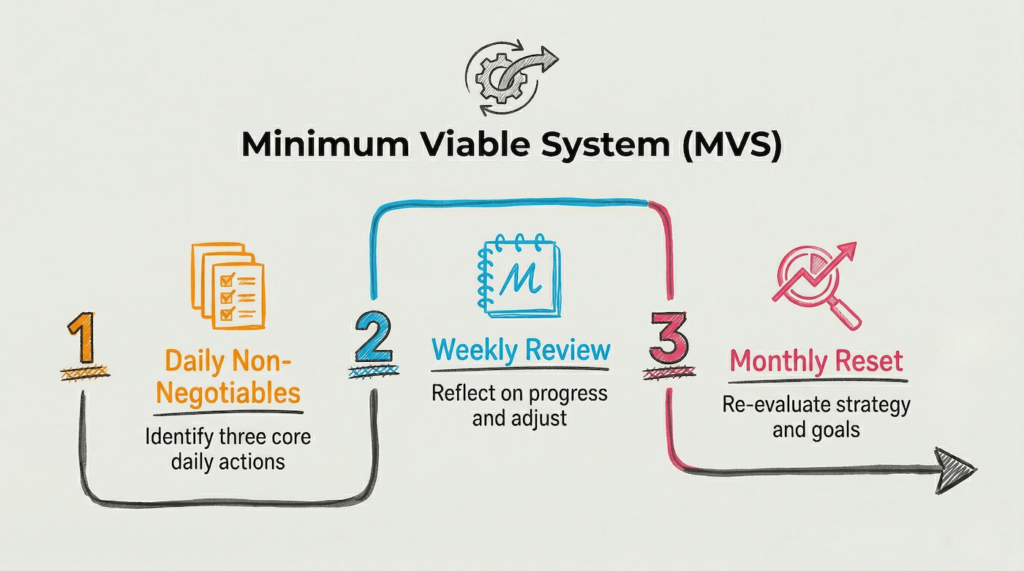
1. Three Daily Non-Negotiables
Pick the three actions that, if done every day, move your life forward.
Three. That’s it. You should be able to remember three.
A productivity dashboard with 10 items is a wish list. A “morning routine” that takes 90 minutes before you’ve had coffee is a fantasy. (At least in my world.) Three actions you can do in any conditions — busy days, sick days, travel days, kid-birthday-party days — that’s a system.
My three right now: 30 minutes of writing, five pieces of outreach on LinkedIn, and one strategic block (working on my business, not in it). Yours will be different. That’s the point.
Rant: One thing that always bugs me is productivity gurus on the internet who tell you to do X, Y, and Z. You try it, and it doesn’t work. That’s mainly because it doesn’t fit your life and your lifestyle. It’s not that what they are saying is wrong; it’s that you haven’t found a way to implement it in a way that works for you.
Why three? Because the research is clear on constraint. Dalton and Spiller’s work showed that implementation intentions — the specific plans that make goals stick — work for one goal but collapse at six. Three sits in the sweet spot: enough to create real momentum, few enough to actually become automatic.
McCloskey’s team found that simple behaviors transition to habits more quickly and remain habitual longer. Complex multi-step routines don’t. Your daily non-negotiables should be so simple that doing them requires less energy than deciding not to.
Clear called this “standardize before you can optimize.” Master the habit of showing up first. Optimization comes later.
And this isn’t set in stone because your three will evolve. That’s what the monthly reset is for. But today, pick three. Write them down. Do them tomorrow.
2. The Weekly Review That Changes Everything
Take twenty minutes. A Friday afternoon or Sunday evening might make the most sense. Just pick one that works best for your situation and try to keep it consistent.
Four questions:
- What moved the needle this week?
- What was noise?
- What am I carrying that I should drop?
- What’s one thing I’ll change next week?
That’s the whole review that you need. No spreadsheet. No scoring matrix. The point of this is to get it out of you, get you thinking and reflecting. I try to do mine on Friday afternoons before I fall into the weekend. I’m looking for wins and where I had a lot of friction so that I can try to avoid that in the upcoming week.
Why weekly? Because Harkin and colleagues’ 2016 meta-analysis — 138 experiments, nearly 20,000 participants — found that progress monitoring causally improves goal attainment. The effect was moderate and consistent. And it was strongest when people monitored frequently and recorded their observations.
Moran and Lennington built the entire 12 Week Year system around this principle. Their Weekly Accountability Meeting is the centerpiece — not the plan, not the goals, not the vision board. The weekly check-in.
The weekly review is the steering wheel. Without it, you’re driving with your eyes closed. You might be moving fast but you’re probably heading somewhere you didn’t choose.
3. One Monthly Reset to Prevent Drift
The first Monday of the month, block out sixty minutes. Block it like you’d block a meeting with your most important client or your boss. (Because that’s exactly what it is.)
Three questions:
- Are my daily three still the right three?
- Am I drifting from what actually matters?
- What do I need to stop, start, or shift?
A 2025 meta-analysis of 235 studies on goal adjustment found that the ability to disengage from outdated goals and reengage with new ones is directly linked to better well-being and more adaptive progress. In plain speak: the people who regularly ask “is this still the right goal?” do better than those who just keep grinding on autopilot.
The 12 Week Year, which, in my opinion, is one of the best books on planning you can find, argues that annual planning horizons are too long to sustain urgency. People defer action because there’s always “later.” Shorter cycles — whether 12 weeks or monthly — force sharper decisions and more honest recalibration.
Here’s what makes the monthly reset different from the weekly review. The weekly review adjusts tactics. The monthly reset questions strategy. You’re re-signing the agreement with yourself. That’s a deliberate and purposeful decision. It’s one that you make on a random Tuesday in April, not a New Year’s resolution.
Why Your Productivity System Failed (and How to Fix It)
If you’ve tried building a personal system before and it fell apart, you didn’t fail at discipline. You failed at design.
You built something too complex for your actual life. The mistake here is optimizing before you standardize. You planned for the version of you with infinite willpower, not the one with a full calendar, a sick kid, and zero margin for error.
The Minimum Viable System works because it respects how your brain actually operates. Simple behaviors become automatic. Frequent check-ins keep you honest. Regular resets keep you aligned. And the whole thing runs on structure, not on motivation — which means it doesn’t collapse the first time you have a bad week.
I’ve been testing this from February through March, when I’ve had a ton on the plate. Tons of calls, a conference talk to prepare, writing to do, kids at home during vacation, and then their activities every afternoon. The kinds of weeks where a complicated system would be the first thing that falls to the wayside, but three simple things I could knock out most days. The Friday review happened — sometimes in 15 minutes instead of 20, because I was tired, but it happened. The system bent. It held. Nothing broke.
Brailsford didn’t ask his riders to transform their entire approach at once. He asked them to improve one small thing. Then another. Then another.
That’s what this is. Marginal gains for real life.
Then Last Month Happened
Three family birthdays in two days. My wife traveling for work. Then someone got sick. School holidays — so both kids were with me, all day, every day. And somewhere in the middle of all of it, I still had stuff to get done.
Everything that could disrupt the system tried to.
The three daily actions still happened. Some mornings, I knocked a couple out at 6 AM before everyone woke up. Some days, I did them at 10 PM after everyone was asleep. But they happened. The weekly review happened on Saturday that week instead of Friday. The monthly reset happened on schedule.
Nothing broke.
I didn’t white-knuckle through it. I didn’t need a heroic burst of discipline. The system was so simple that there was nothing to fight against. Three things. Four questions. Three bigger questions. That’s it.
And these are exactly the types of systems that we need going forward, something that, like us, is adaptable.
Build Your Minimum Viable System Today
Today: write down your three daily non-negotiables. Tomorrow: do them. Friday: ask yourself four questions. First Monday of next month: check whether you’re still on the right track.
That’s the whole system. One page. No app required.
Seems to work pretty well — even when everything else doesn’t.
A minimum viable system is the smallest productivity framework that still works: three daily non-negotiable actions, one weekly review (20 minutes), and one monthly strategic reset (60 minutes). It’s designed to be so simple that it survives chaotic weeks without requiring willpower.
Research from Dalton and Spiller (2012) shows that implementation intentions work for one goal but backfire at six. Three daily non-negotiable actions sit in the sweet spot — enough to create real momentum, few enough to become automatic.
Most productivity systems fail because they’re too complex. A 2019 study in Frontiers in Psychology found that perceived behavioral complexity slows habit formation — complex behaviors never become automatic. Simpler systems with fewer components have higher compliance rates.
Weekly. A 2016 meta-analysis of 138 experiments (Harkin et al.) found that frequent progress monitoring causally improves goal attainment, especially when observations are recorded. A 20-minute weekly review is the minimum effective dose.
Monthly. A 2025 meta-analysis of 235 studies found that the ability to disengage from outdated goals and reengage with new ones is linked to better well-being and progress. Monthly resets prevent drift without the procrastination trap of annual planning.