

The most dangerous person in any industry right now isn’t the 25-year-old who grew up on AI.
It’s the 40-year-old with 20 years of pattern recognition who finally sat down and asked: “Which of my skills should AI never touch?”
That question — not which tool to buy, not which prompt to master — is the one that separates leaders who get faster from leaders who get replaced.
While some people are offloading everything to AI, the smart ones are leveraging it as a thought partner and helping hone the skills that AI can’t touch.
Here’s why I know. I’ve spent over 20 years across sales, marketing, communications, and digital transformation. I’ve seen skill audits happen three ways: accidentally (too late), never (fatal), and systematically (when it sticks).
Last year, 37% of senior business leaders used generative AI weekly. This year, it’s 72%. The tools aren’t the bottleneck anymore. The question is whether you’re pointing them at the right things.
Most people aren’t.
Why Learning Every AI Tool Is the Wrong Strategy
What I’m seeing right now looks a bit like this: leader discovers ChatGPT, Claude, or Perplexity. Gets excited. Starts plugging AI into every workflow they can find. Three months later, they can’t tell you what’s actually different. Outputs look the same. Hours feel the same. The tools work — but the results don’t compound.
Why? Because they skipped the audit.
BCG’s 10-20-70 Rule: Why 70% of AI Value Is People, Not Tools
BCG’s research on AI transformation breaks it down with a ratio they call 10-20-70. I wrote about this in depth a few weeks ago. Ten percent of AI value comes from the algorithm itself. Twenty percent from data and technology infrastructure. And seventy percent — the overwhelming majority — from redesigning people and processes around what the technology makes possible.
Most teams invert this. They spend 70% of their energy on the tool and 10% on the people. Then they wonder why adoption stalls. Only about a quarter of organizations report that AI delivers the ROI they expected. The gap isn’t technology. It’s strategy.
At the individual level, the same pattern holds. You’re automating tasks that should be protected, learning skills that should be delegated, and protecting work that’s just friction you’ve tolerated for too long.
And there’s a cost to getting this wrong.
The Real Risk: You Lose What You Don’t Practice
When you automate a skill, you don’t just free up time. You start losing the skill itself.
Researchers at Aalto University documented this in an accounting firm that had automated core financial processes. When the system was temporarily removed, employees couldn’t perform basic accounting tasks. I’m not talking about edge cases. Core work. Their skills had eroded because nobody practiced them anymore.
What Autopilot Taught Us About AI Skill Decay
The aviation world already learned this lesson — at 35,000 feet.
A comprehensive review published in PMC found that pilots flying with high automation showed something surprising: their motor control was “rusty but intact.” They could still physically fly the plane. But their situation awareness — the ability to read instruments, recognize failures, make judgment calls under pressure — had significantly declined.
The decay wasn’t in their hands. It was in their heads.
The FAA’s response? They now recommend pilots periodically fly manually, even when autopilot can handle the entire flight. Not because the machine can’t do it. Because the humans can’t afford to forget how.
Think about that for a second. You’re probably not flying a 747. But you make judgment calls every day that compound over years — which market to enter, which message will land, which hire fits the culture, when a deal smells wrong. Those calls depend on pattern recognition you built through thousands of reps. What happens to that pattern recognition when you outsource the reps?
Just think about it: when we have self-driving cars, how is the next generation going to know how to drive?
Here’s the kicker: Gallup found that employees whose managers actively support AI adoption are 2.1x more likely to use AI weekly and 8.8x more likely to say AI helps them do their best work. But only 28% of employees say their manager actually provides that support.
Why? Because most managers haven’t done the audit themselves. They can’t guide their teams on what to automate and what to protect because they haven’t figured it out for their own work yet. The audit isn’t just a personal productivity play. It’s a leadership responsibility.
The AI Overconfidence Trap: When Experience Becomes a Liability
Here’s where it gets uncomfortable.
David Epstein makes the case in Range that highly credentialed experts can become so narrow that they actually get worse with experience. That basically means that while you’re becoming more confident in your declining judgment, that actually becomes a trap. You’re not actually getting sharper or smarter; you’re just getting more certain that you’re sharper or smarter.
Experience without deliberate adaptation? That’s how you get worse while feeling more confident.
Why Deliberate Practice Matters More Than Years of Experience
Decades of research on deliberate practice, originally formalized by Anders Ericsson, confirm that years of experience correlate poorly with actual performance. What actually works is focused, effortful practice with feedback loops. The kind of practice that forces you to check your assumptions — not confirm them.
I see this in myself. There were workflows I’d done for years that felt productive because they were familiar. Fast, even. But when I actually mapped them against outcomes? Some were just muscle memory burning hours. I wasn’t getting better; I was simply doing the things that I always did.
Ethan Mollick puts it sharply in Co-Intelligence (must read btw): AI works best when it thinks with you, not for you. The moment you let AI handle judgment — not just execution — you’ve handed away something you can’t easily get back.
This is where Daniel Kahneman’s System 1 / System 2 thinking comes in. That’s your moat on one side and your blind spot on the other. Your fast, intuitive pattern recognition (System 1) is what 20 years of experience gives you. That’s real. That’s worth protecting. But the audit itself — the slow, deliberate work of deciding which skills matter and which are dead weight — that’s System 2. Most people skip it because System 2 is uncomfortable. It asks questions you’d rather not answer.
Like this one: Am I protecting this skill because it creates value, or because it’s comfortable?
What Happened When I Audited My Skills for AI
I’ll be honest. I didn’t start here.
My first month using Claude, Perplexity, ChatGPT, and Midjourney, (just to name a few), I tried to learn every workflow. Writing with Claude. Research with Perplexity. Decks with Gamma. Meeting notes with Granola. I was productive as hell.
The problem was that I was building inefficiency into my system.
Because I never stopped to ask the most important question:
If this task disappeared tomorrow, would my unique value disappear with it?
Would what makes me different, or what makes me, “me” vanish?
The One Audit Question That Changed My AI Workflow
That question forced me to rethink my approach a bit. Some skills I thought were essential turned out to be friction. First-draft writing? AI handles that now. I handle the thinking, the editorial judgment, the voice. Research compilation? Automated. Strategic interpretation of that research? That’s on me. Client-facing communication? That stays with me — nobody hires you to get a chatbot’s opinion on their challenges.
Once I classified the work, the bottlenecks vanished. I stopped spending two hours on research compilation and started spending two hours on strategic decisions that actually move the business. The time freed up wasn’t empty space. It was leverage.
The result: I’m shipping at 10x the speed I was two months ago. Not because of better tools. Because of clearer decisions about where to spend my attention.
The World Economic Forum’s Future of Jobs 2025 report projects that by 2030, 92 million jobs will be displaced — but 170 million will be created. Net positive of 78 million new roles. Eighty percent of employers plan to upskill their people, not replace them. That’s a positive spin on the data that’s out there.
The WEF estimates that 39-40% of workers’ “core skills” will change by 2030. Not jobs. Skills. The building blocks of what you do every day. (Your expertise has a shelf life — and it’s shorter than you think.) That’s not a vague threat about robots taking over. That’s a concrete signal that the composition of your work is shifting under your feet — and the audit is how you stay ahead of the shift instead of reacting to it.
Research on seasoned professionals and AI adoption shows that experienced practitioners view AI integration more positively and more effectively than their less-experienced peers. The people with the deepest skill stacks aren’t the most threatened by this shift. They’re the best positioned to navigate it — if they audit first.
Experience is the advantage. But only when it’s directed.
The 4-Quadrant AI Skills Audit Framework
Every skill in your professional stack fits one of four quadrants. The audit is figuring out which.
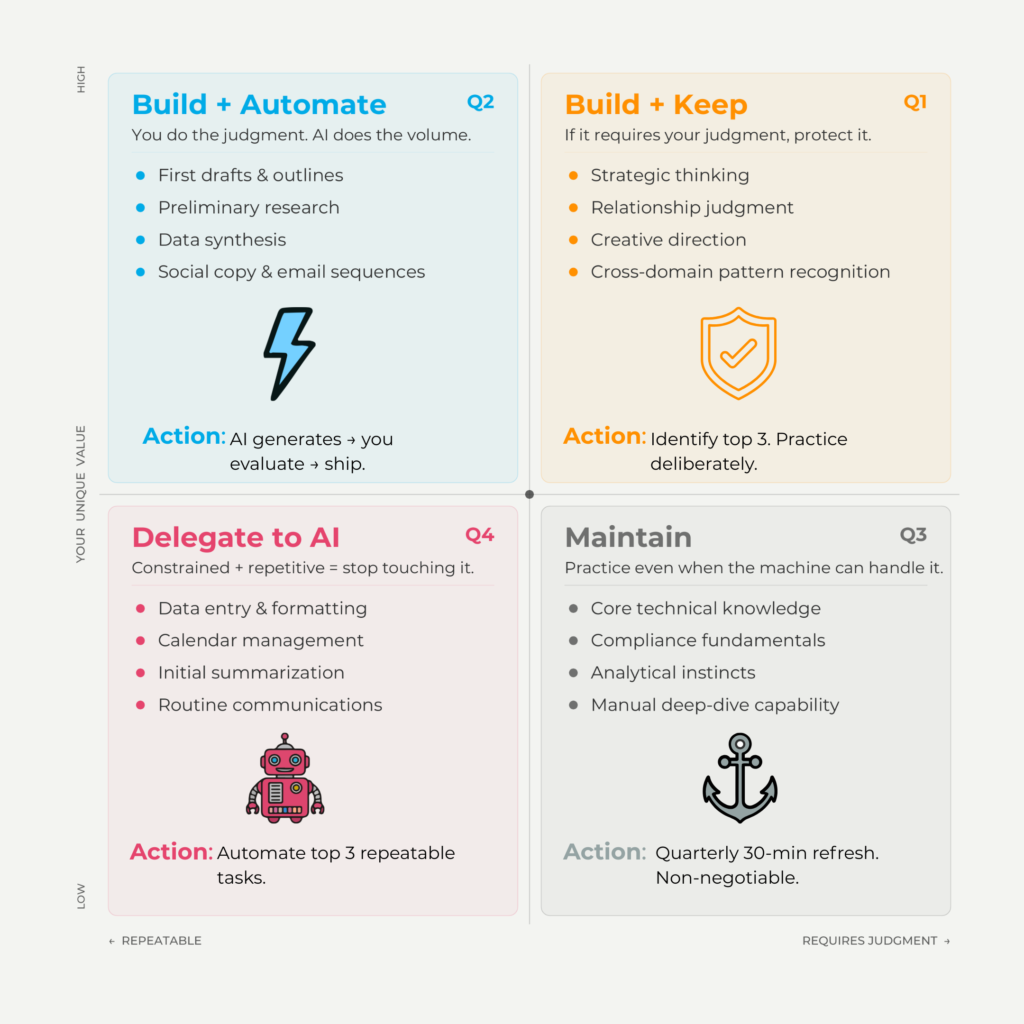
Quadrant 1: Build + Keep (High Value, Differentiating)
This is your moat. Strategic thinking. Relationship judgment. Creative direction. Domain expertise that requires taste — the ability to know what’s good before the data confirms it. (I mapped the specific skills AI won’t master in an earlier piece — worth reading alongside this.)
The rule: if it requires judgment unique to your experience, protect it.
Epstein nails this in Range: constrained, repetitive challenges get automated. The advantage flows to people who can take thinking from one domain and apply it somewhere completely new. That cross-domain judgment? That’s the thing AI can’t replicate. And it’s the thing 20 years of career pivots and cross-functional work gave you.
Your move: Identify your top three “Build + Keep” skills. Schedule deliberate practice on them weekly — not passive reps, but focused effort with feedback. This is where your competitive advantage compounds.
Quadrant 2: Build + Automate (Medium Value, Acceleratable)
These are skills where you do the judgment and AI does the volume. First drafts. Preliminary research. Data synthesis. Social media copy. Email sequences.
I write every newsletter article. But Claude builds my research briefs, generates first-pass outlines, and drafts deliverables packages. I make the decisions. AI handles the throughput.
The difference between this quadrant and “Delegate” is simple: you stay in the loop. Your judgment is the quality gate. AI is the engine, not the driver.
Your move: Pick one “Build + Automate” workflow this week. Set up the pipeline: AI generates → you evaluate → final output ships. Pay attention to where your judgment adds the most value in that pipeline. That’s your editing instinct at work.
Quadrant 3: Maintain (Non-Negotiable, Low Leverage)
These are skills you rarely use at full capacity but need when it counts. Core technical knowledge. Compliance fundamentals. Baseline competencies that keep you dangerous when systems fail — and systems do fail.
Remember the accounting firm. Remember the pilots.
The FAA principle applies here: practice deliberately, even when the machine can handle it. A marketing leader who automates all analytics should still schedule a monthly manual deep-dive to keep their analytical instincts sharp.
Your move: Identify one or two “Maintain” skills. Build a quarterly 30-minute refresh into your calendar. Not busywork — targeted practice that keeps the neural pathways alive.
Quadrant 4: Delegate to AI (Low Value, Repetitive)
Data entry. Calendar management. Formatting. Initial summarization. Routine communications that follow a predictable pattern.
If the task is constrained and repetitive, stop touching it.
Siemens automated production planning — 15% reduction in production time, 99.5% on-time delivery. Johnson & Johnson used AI-driven skills mapping for 4,000 technologists and saw a 20% increase in learning platform engagement. Not because they added more work. Because they removed the low-leverage work, and people reinvested that time in growth.
That’s the unlock most people miss. Delegation isn’t about doing less. It’s about doing less of what doesn’t matter so you can do more of what does.
Your move: List every task you did this week that followed a repeatable pattern. Automate the top three by the end of this month.
How to Run Your AI Skills Audit Every Quarter
Run it quarterly. As your business changes — new clients, new markets, new capabilities — skills shift quadrants. Something that was “Build + Keep” six months ago might become “Build + Automate” today because the tools caught up. Something in “Delegate” might need to move to “Maintain” because you realized losing it entirely creates risk.
I’m aiming to run this audit on my own business at the start of every quarter now. Fifteen minutes with a blank page and four columns. Some things move. Most things will probably stay. But that fifteen-minute check forces me to stay honest about where my time goes — and whether the way I’m working still matches the business I’m building.
We’re at a stage now where things are going to change quickly and more often than we’re comfortable with.
That means that these 15 minutes might be some of the highest leverage time that we can spend.
As Brendon Burchard writes: “Look to the future. Identify key skills. Obsessively develop those skills.”
That’s not motivation-speak. That’s a system. And systems compound in ways that scattered tool-hopping never will.
The leaders who thrive in the AI era won’t be the ones who learned the most tools. They’ll be the ones who knew which skills to protect.
Audit first. Automate second. That’s the system.
An AI skills audit is a structured process for categorizing every professional skill you have into four quadrants: Build + Keep (protect and deepen), Build + Automate (use AI for volume, you for judgment), Maintain (practice deliberately even if AI can handle it), and Delegate to AI (automate completely). The audit determines which skills to protect and which to surrender.
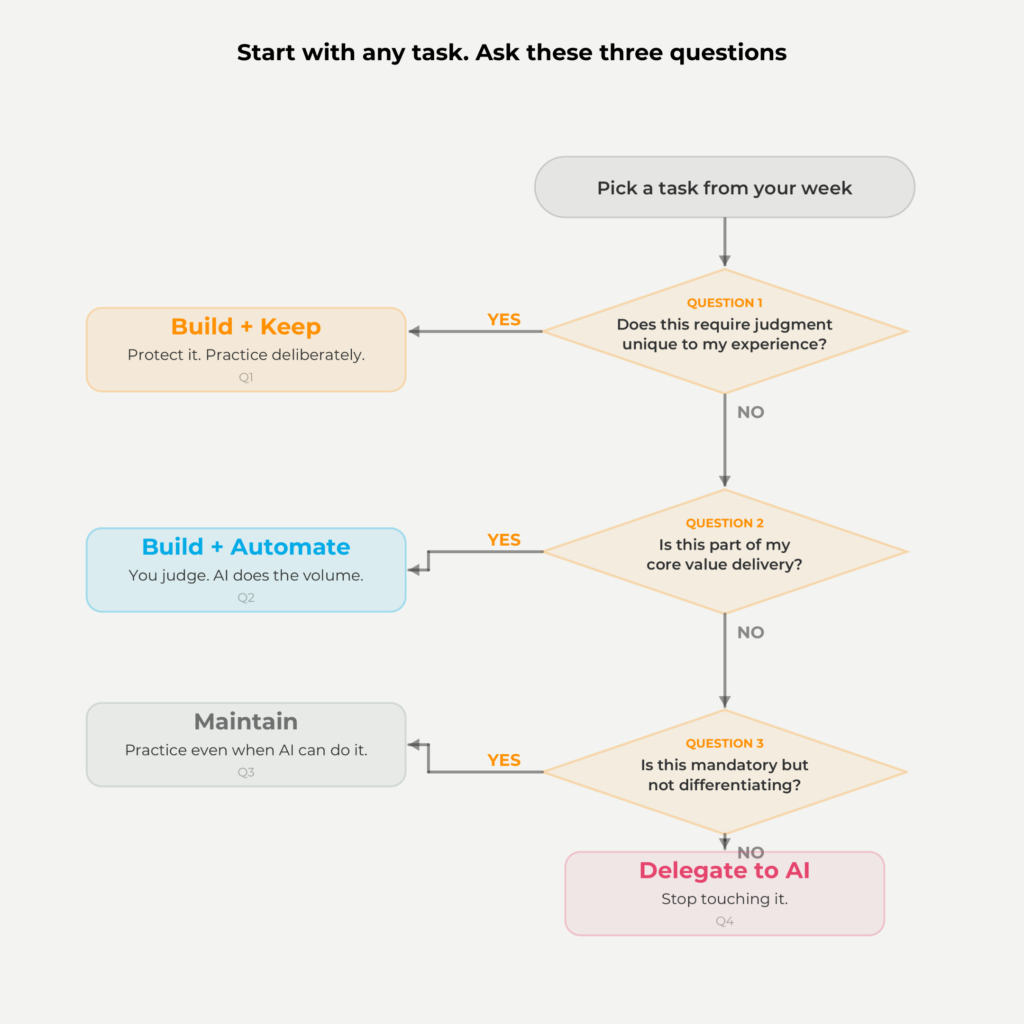
Use this decision flowchart: Does the task require judgment unique to your experience? If yes, protect it. Is the task part of your core value delivery? If yes, keep it and use AI to accelerate it. Is it mandatory but not differentiating? Maintain it deliberately. Is it repetitive and low-value? Delegate it to AI entirely.
According to the World Economic Forum’s 2025 Future of Jobs report, the skills rising fastest are analytical thinking, creative thinking, resilience, and adaptability. Skills that require cross-domain judgment, relationship-building, and strategic decision-making are becoming more valuable as AI handles routine cognitive work.
Yes. Research from Aalto University documented an accounting firm where employees lost the ability to perform basic tasks after automation. Aviation studies show pilots with high automation experience significant declines in situation awareness and decision-making, even while retaining motor control. The FAA now recommends mandatory manual flying to prevent skill erosion.
Experience is an advantage — but only with deliberate audit. Research shows seasoned professionals view AI integration more positively and effectively than less experienced peers. However, David Epstein’s work in Range warns that experts can become narrower with experience while growing more confident, creating an overconfidence trap that the audit is designed to catch.