

Build a learning system that fits your role, your gaps, and your goals — in 30 minutes.
Why Method Beats Willpower (Tim Ferriss’s Secret)
Tim Ferriss failed Spanish in high school. Twice.
Years later, he moved to Tokyo for intensive Japanese study — full immersion, strong teachers, motivated classmates. Almost perfect learning conditions, you’d think.
He failed again.
So he stopped blaming himself and changed the method. He broke the skill into parts, cut the busywork, and practiced what moved the needle.
Eight weeks later, he tested at university-level Spanish proficiency. He later learned Japanese in 11 months, Mandarin in 6 months, and German in 3 months.
“It was just the method,” Ferriss said. “Method is more important than the person applying it.”
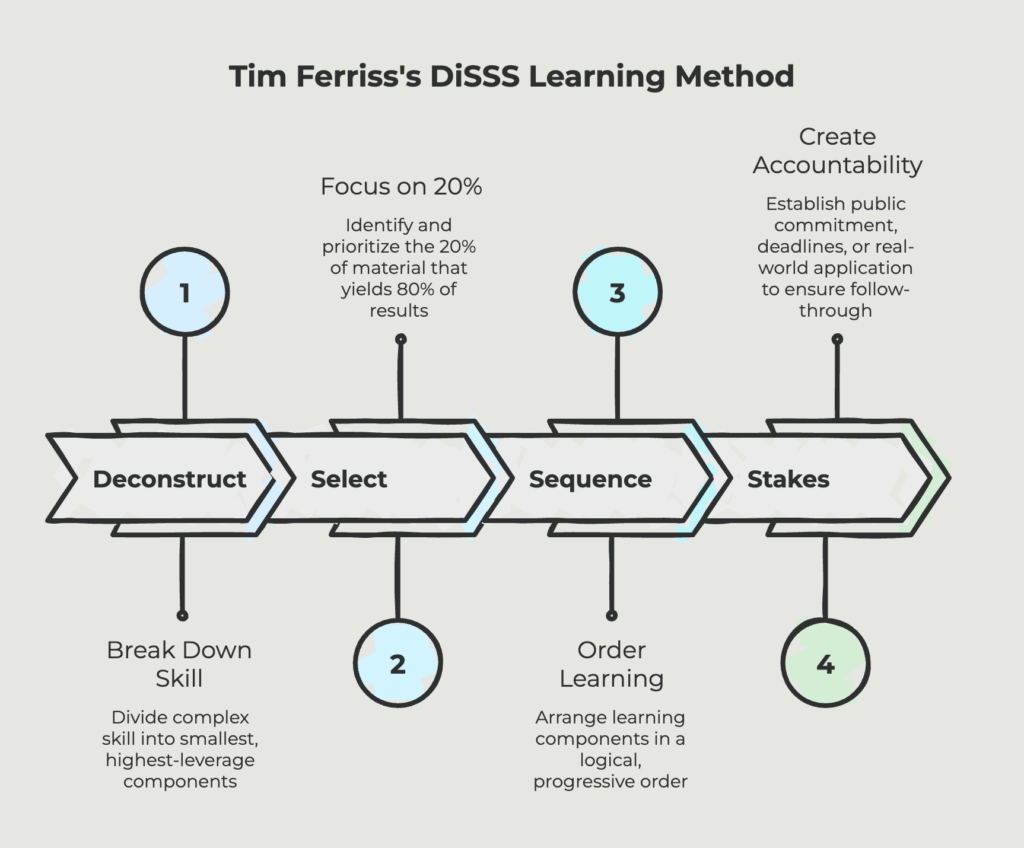
Tim basically wrote an entire book about this process of learning and used cooking as the subject of choice in The Four-Hour Chef. He breaks learning into a method he calls DiSSS.
- Deconstruct: Break complex skill into smallest, highest-leverage components (for languages: most common 1,000 words, not the full dictionary)
- Select: Focus on the 20% of material that generates 80% of results
- Sequence: Order learning in logical progression
- Stakes: Create accountability (public commitment, deadline, real-world application)
Most professionals don’t have a method. They wait for budgets, programs, and permission. In the meantime, the gap stays.
The good news is — you can build your own path with tools that are free or close to it. The setup should take you about 30 minutes.
So in this guide, I’m going to show you how to:
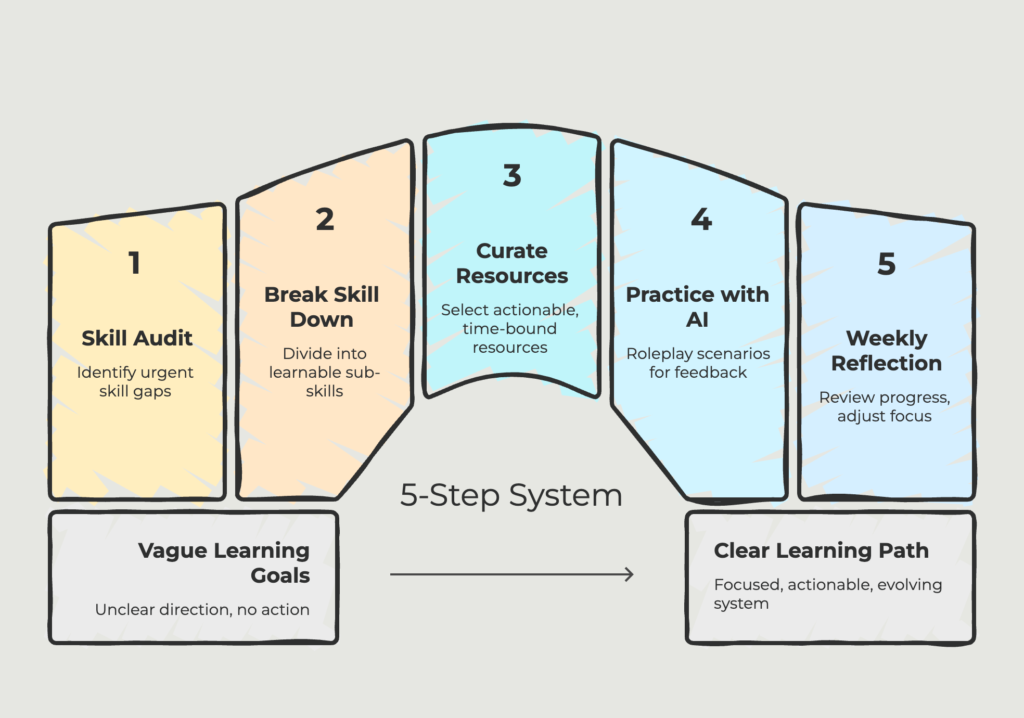
- Audit your skill gaps without a 360 review or manager feedback
- Break a big skill into a few parts you can practice
- Curate the best resources without drowning in options
- Practice with AI-created role-specific scenarios
- Set up a simple reflection loop that sticks
Let’s get at it.
Why Self-Directed Learning Outperforms Corporate Training
Shell Oil needed to train thousands of employees in AI. So they took a different approach to the usual Learning and Development playbook most companies use. They didn’t force a course. They offered a self-paced program and let people choose when to learn and what to build. (Wild, right?)
More than 2,000 employees enrolled. 800 became “citizen developers” who could build AI applications. One predictive maintenance project at a single refinery caught two equipment failures early and saved over $2 million.
Dan Jeavons, Shell’s General Manager of Data Science, explained: “We don’t want people to feel stagnant and not growing as the company changes.”
Three takeaways for us here:
- Ownership beats compliance. When you pick the goal and the reason, you remember more and use it sooner.
- Specific beats generic. A path built around your gaps moves faster than a broad course aimed at everyone.
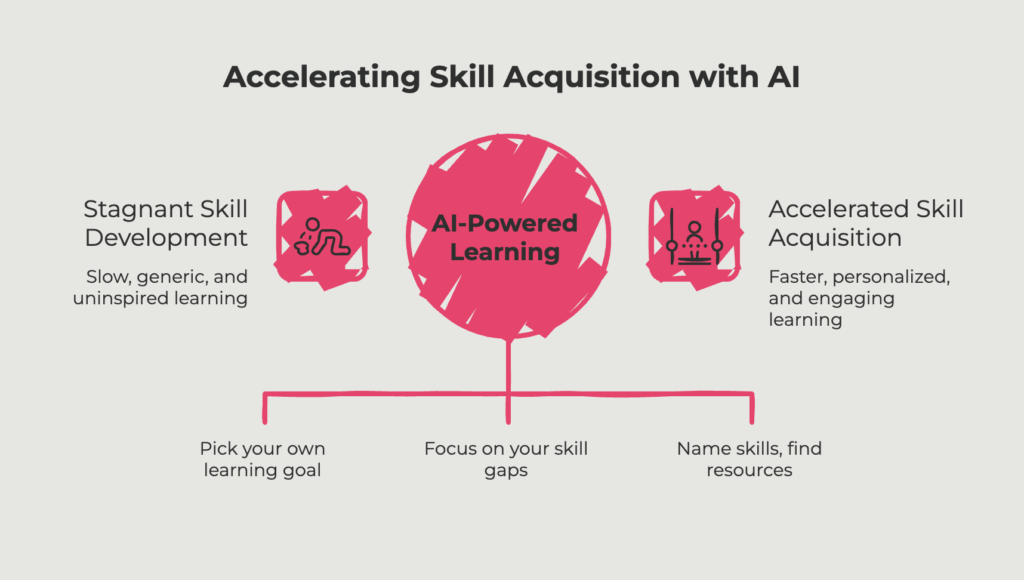
- AI lowers the cost. It can help you name the skill, break it down, find resources, and create practice—quickly.
Six Ways to Use This System
Use this system for almost any skill. Here are a few that came to mind:
Preparing for a promotion: Pinpoint what the next level expects, then close the gaps before you step into the role.
Career pivots: Build the basics in a new field fast—without going back to school.
New role onboarding: Ramp up in a new job faster than your company’s 90-day plan.
Leadership development: Build management and communication skills without waiting for your company’s leadership program.
Technical upskilling: Learn AI, data analysis, or other technical skills at your own pace — and apply them right away.
Credential-free expertise: Build real depth through structured self-study instead of paying for certifications.
Pick one skill. Run the five steps. Repeat when needed.
The 5-Step System: Build Your Learning Path in 30 Minutes
Step 1: The 10-Minute Skill Audit (Find Your Real Gaps)
Vague goals don’t move. “Get better at leadership” or “learn AI” is too fuzzy to act on.
Use AI to name the gaps.
Prompt:
I’m a [your role] at a [company type/industry]. I want to advance to [target role or level] in the next [timeframe]. Based on typical requirements for that transition, what are the 5 most important skills I likely need to build? For each skill, describe what “good” looks like at my target level versus what someone in my current role usually does.Pick one skill — the one where the gap between “where I am” and “where I need to be” that feels most urgent or most blocking.
Example:
A senior marketing manager aiming for director in 18 months might see: strategic planning, exec communication, cross-functional leadership, budget management, team development. If “exec communication” feels shaky, that’s the target.
If you want to compare against job posts, search for requirements for your target role and scan for overlap.
Pro Tip: Claude and ChatGPT both work well here. If you want to cross-reference with real job postings, use Perplexity AI to search “director of marketing job requirements [your industry]” and compare.
Extra tip: upload your CV and any annual or quarterly reviews so that AI knows your experience.
Step 2: Break the Skill Into Learnable Parts
You can’t practice “executive communication.” You can practice pieces of it.
Prompt:
I want to get better at [skill]. Break it into sub-skills. Then tell me which 2–3 sub-skills will matter most for someone at my level. Explain why.Example for exec communication:
Sub-skills might include: concise messaging, narrative structure, stakeholder read, handling tough questions, data visuals, and presence.
A common priority set: concise messaging, narrative structure, handling tough questions.
Now your target is clear: “Brevity and structure for executive audiences,” not “communication.”
Pro Tip: Claude tends to give more nuanced breakdowns for soft skills. For technical skills, ChatGPT with web browsing can pull in current industry frameworks.
Step 3: Curate Resources You’ll Actually Finish
Many people spend hours hunting for resources, then don’t use them.
Ask AI to gather options, then force a hard constraint.
Prompt:
I’m working on [sub-skills]. Recommend: the top three books, best courses or video series, five articles or frameworks, and two podcast episodes or interview. For each, tell me what I’ll learn and how long it takes. Favor examples over theory.Then:
If I only have 3 hours to start, what single resource should I use first? Why?That gives you a starting point you can complete.
Pro Tip: Perplexity is best for this step because it searches the web in real-time and cites sources. You can verify the recommendations actually exist and are well-reviewed. I also like to ask for the best books, thought leaders and podcasts on the topic.
Step 4: Practice with AI-Powered Scenarios
Reading is not practice. Practice needs reps and feedback.
Use AI as a sparring partner.
Prompt:
I’m working on [sub-skill]. Create a realistic scenario for my role as [your role]. Play the other person. After I respond, give me direct feedback on what worked and what to change. Let’s do this as a roleplay.Example:
You’re my CFO. I’m pitching a new initiative that needs $200K. I have 2 minutes. After my pitch, tell me where you tuned out and what would have helped you say yes faster.
Write your response. Get feedback. Revise. Run it again.
Pro Tip: Claude excels at nuanced roleplay and thoughtful feedback. For technical skills, both Claude and ChatGPT’s code interpreter can check your work and explain errors. Run 3-5 scenarios per practice session for best results. For quick theory checks, I’d also use Google’s NotebookLM to quickly cover areas of knowledge.
Step 5: The Weekly Reflection Loop
Without reflection, learning stays scattered. You finish a book, feel good for a day, and forget most of it by next week. There’s no feedback loop.
Once a week, spend 10 minutes.
Prompt:
Here's what I practiced this week on [skill]: [brief summary]. Here's what felt difficult: [your observation]. Here's what I think I'm improving at: [your observation]. Based on this, what should I focus on next week? Is there a different sub-skill I should consider adding or a resource that might help?This turns AI into a thinking partner, not just a content generator. You’re building a system that evolves with you.
Ferriss’s fourth principle was Stakes — create real consequences for following through. Add one simple accountability step:
- Tell someone your goal and a deadline, apply the skill in a real meeting by a set date, or block the time on your calendar.
- If it’s not on the calendar, it doesn’t happen. Block 30 minutes weekly on your calendar labeled with your learning focus.
Pro Tip: Keep a running document (Notion, Google Doc, even Apple Notes) where you paste your weekly reflections. Over a month, you’ll see patterns you’d never notice session-by-session. NotebookLM can analyze this log and surface insights across multiple entries.
Your 30-Minute Setup (Complete Breakdown
Here’s roughly what your initial time investment looks like:
- Step 1: Skill audit — 10 minutes
- Step 2: Break it down — 5 minutes
- Step 3: Curate resources — 10 minutes
- Step 4: Practice session — 5 minutes (just to test)
- Step 5: Set your weekly block + reflection template — a few minutes
Total setup: 30 minutes.
Ongoing commitment: 2-3 hours per week, split however works for you:
- 30-60 minutes consuming your curated resource
- 30-60 minutes running practice scenarios
- 10 minutes weekly reflection
Why This System Works Better Than Traditional Training
Traditional development is often passive, generic, and slow to start. You get content someone else picked, with little practice.
This approach is different:
You choose the target, practice it, get feedback, and adjust each week.
| Traditional professional development | AI-powered self-directed learning |
|---|---|
| Passive: You consume content someone else chose for you | Active: You practice, get feedback, and iterate |
| Generic: Same curriculum for everyone regardless of gaps | Personalized: Built around your specific gaps, role, and goals |
| Delayed: Waits for budget approval, program availability, manager support | Immediate: Start in 30 minutes with tools you already have access to |
| Low retention: No practice, no personalization, no feedback loop | High retention: Deliberate practice plus spaced reflection compounds over time |
You’re not just consuming information. You’re building capability—on your schedule, at your pace, for your goals.
Your Turn: Start Today
Start today:
- Choose one skill that would change your next 90 days.
- Run the skill audit and pick a focus.
- Find the 2-3 sub-skills that matter most.
- Choose one resource for the week.
- Block the time. Put 30 minutes on your calendar tomorrow.
Time: 30 minutes to set up. 2–3 hours per week after.
Result: steady, visible progress on a skill that matters — without waiting for permission.
What’s the first skill you’re going to tackle? Reply and let me know—I’d love to hear what you’re working on.
A: The initial setup takes about 30 minutes. This includes auditing your skill gaps (10 min), breaking down your target skill (5 min), curating resources (10 min), running a practice session (5 min), and setting up your weekly reflection cadence. Ongoing commitment is 2-3 hours per week.
A: You can build a complete learning path using free or low-cost tools: Claude or ChatGPT for skill audits, breakdowns, and practice scenarios; Perplexity for resource curation with real-time web search; and NotebookLM for processing books or long documents. Total cost ranges from free to $20/month.
A: AI doesn’t replace formal education entirely, but it removes the barriers that make self-directed learning impractical. It helps you identify specific skill gaps, curate high-quality resources, practice with realistic scenarios, and reflect systematically — all without waiting for budget approval or program availability.