

The job market is brutal right now. More highly qualified people chasing fewer roles than maybe ever in my career. And credentials might get you in the door, but they almost never get you hired.
What I keep watching, over and over, is that the people landing the role are the ones with a story to tell. The résumé sits politely in the inbox. But the story is what gets them remembered.
Credentials get you in the door. Stories get you hired.
That’s not only true in hiring, by the way. Buyers do this. Investors do this. Partners and board members do this. I’ve written about this dynamic before in my piece on building a body of work, where credentials are the entry ticket, not the currency.
Let’s look at what LinkedIn has done this year. They’re aiming to stop rewarding polished, templated, credentialed-sounding posts and push more lived-experience-type posts that only you could have written because of your experience.
So we’re now seeing a situation where the most qualified person in the room doesn’t necessarily win anymore. Visibility essentially becomes the name of the game in 2026, and that visibility needs to be built on a story, not on titles.
Why Credentials Stopped Working in 2026
The truth is, we all stack credentials. It’s just how careers work. You get hired, you do the work, you collect roles, titles, and outcomes. By the time you’re mid-career, your résumé reads clean. The trouble is, everyone else in the room with you has some version of it that looks pretty similar.
Then AI arrived and has raised the noise floor. Platforms are flooded with credentialed-sounding voices that all sound the same, partly because of the tools, partly because everyone is optimizing on the same playbook. The result is a feed of polished people saying polished things, and a buying public that is exhausted and just wants real views, values, and vision (and yes, I just made those three up, pats own back) from the content that they consume.
Earlier this year, researchers at UC Irvine published a study in Scientific Reports, where they created fictional experts and ran them past hundreds of participants. They varied three things about each expert: how credentialed they were, how peer-recognized they were, and whether they agreed with the participant on a tough, controversial issue.
The factor that mattered most was not the credential level, and not by a small margin. Agreement on values mattered more than twice as much as credentials did when participants decided whether to trust the expert. This line says it all: “Agreement made up for the lack of credentials. Disagreement wiped out the benefit of credentials.”
In plain speak: a low-credentialed expert who shares your worldview gets trusted more than a high-credentialed expert whose worldview is unknown. Stacking degrees does not save you from a values mismatch. And in a market where your values aren’t on your résumé, your stories are the only signal of what you actually believe.
The Neuroscience of Why Stories Beat Credentials
There is a brain-level reason this keeps showing up. Lisa Cron, in Wired for Story, points out that the brain processes about 40 of the 11,000,000 pieces of sensory information your senses register every second. Conscious attention is roughly seven bits of data at a time on a good day, five on a bad one. That, my friend, is a brutal filter, and credentials live on the wrong side of it. Credentials are abstract, and abstract things get filtered out fast.
Stories don’t. Cron’s research says: “Our brain is hardwired to respond to story; the pleasure we derive from a tale well told is nature’s way of seducing us into paying attention to it.” Brain imaging confirms it. When you’re inside a story, the regions that process real sights, sounds, and movement light up the same way they do in actual life. The story isn’t being processed as information. It’s being processed as experience.
That’s the thing credentials cannot do.
There’s also the persuasion science. Going back to the Green and Brock work on narrative transportation from 2000, being absorbed in a story reduces counter-arguing. Readers stop poking holes. They start integrating the story-consistent beliefs into their own. Credentials invite skepticism by default. Stories disarm it.
Stack those three findings together, and a pattern starts to appear. Credentials live in the abstract layer of the brain that filters most inputs out, and they invite skepticism on top of that. Stories activate the sensory regions where readers stop counter-arguing and start integrating. The first proves you are eligible for the work. The second proves you are the right person for it.
This is where Donald Miller’s Building a StoryBrand shifts the way you should use storytelling: “Customers aren’t looking for another hero; they’re looking for a guide.” Stacking credentials is playing hero. It says, “look at me, look at what I’ve done.” Telling stories is being a guide. It says, “I’ve been where you are, here’s what I learned, here’s what to do next.” Guides get hired. Heroes get scrolled past.
The trust layer is the one most leaders skip, and it’s the layer on which the story builds.
What Patagonia and Microsoft Did With Founder Stories
If you want to see what happens when leaders run this on purpose, look at two cases that don’t get compared often enough.
Most corporate town halls go like this: new strategy, new metrics, a wall of credentials. Senior leaders walk the team through a deck. Nobody remembers a word by Monday. (Be honest. You’ve sat through a few of those shit shows.)
Patagonia operates on the opposite end. Founder Yvon Chouinard’s climbing stories, the near-misses, the guilt over environmental damage from a piton he himself designed: those stories get told so often inside the company that employees can finish them. The mission line, “We’re in business to save our home planet,” lives downstream of those personal turning points. The stories make ordinary product decisions feel like moral choices. Designers, supply-chain managers, retail staff all walk in with the same internal compass, because they’ve heard the founder’s why a hundred times.
Now let’s look at Microsoft in 2014. When Satya Nadella took over, he didn’t lead with strategy decks. He told stories. The “learn-it-all versus know-it-all” frame became a cultural reset. He shared personal stories, including ones about his children’s disabilities, to model empathy in a company that had spent two decades rewarding aggression. Market cap went from roughly $300 billion to over $3 trillion during his tenure.
If you look at both of those stories, they essentially have the same pattern. A personal turning point that named the leader’s values. A community defined by a shared moral commitment. A time-bound inflection point that demanded action this decade, not someday. Founder stories you could not only remember, but actually care about. On top of that, a cultural language that employees repeated when the leader wasn’t in the room.
That’s not personality. That’s architecture.
The 3-Story Architecture: Self, Us, Now
Here is the structure that holds both Patagonia and Microsoft together. Marshall Ganz formalized it at Harvard Kennedy School as the Public Narrative framework: Story of Self, Story of Us, Story of Now. My mentor, André Chaperon, has adapted it for digital trust-building in his Tiny Digital World builders work, where solo operators run the same three stories on their websites and in their offers.
This is my version, built for a single human in a conversation. It works the same way on sales calls, podcasts, keynote stages, and hiring interviews. Same three stories, every time.
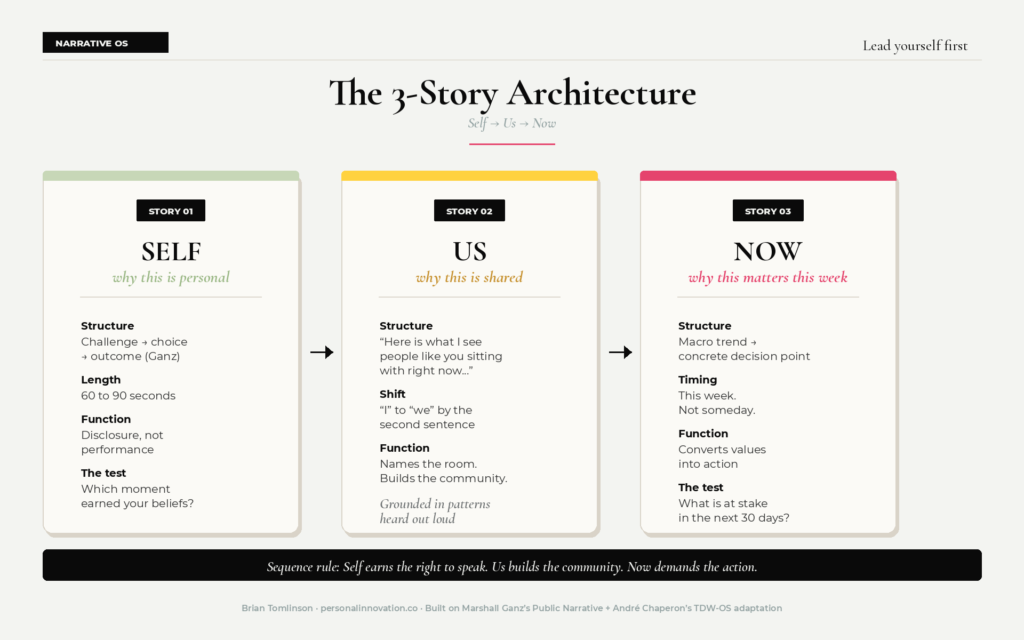
Story of Self: why this is personal
Sixty to ninety seconds is usually enough. The turning point that made the work personal. The moment your job stopped being abstract and became a matter of identity.
I’ll do mine.
A few months after my first layoff, after the shock had subsided and I was ready to move forward, I realized that things weren’t going to be as easy as I thought. In layman’s terms, I reached a come-to-Jesus moment. Who was I? What did I want to do? All big questions. And as much as it felt like a curse, it was very much a blessing in disguise.
That was the moment for me. That’s when I realized that, in many ways, your CV doesn’t mean much. I had to dig a lot deeper to figure out what I’ve been doing this whole time. Because the credentials I’d stacked over twenty years had not saved me. What carried me was the body of work that I’d done. Behind the work was a story about why I do it. I figured out that I’d spent twenty years teaching people how to communicate when the ground was moving. That through-line is what hiring managers, partners, and clients actually buy. Your titles can change, but your story doesn’t.
Your Story of Self needs to have the same shape. A Challenge, a choice, and an outcome. (Ganz’s pattern, not mine.) It is not humblebragging, but more of a disclosure. And disclosure earns trust in a way performance never will.
Story of Us: why this is shared
This is the step most experts skip. Which is a shame because I think it’s the part that builds what will probably become your most important business asset for the next few years. Community. The Story of Us names the room. It says, “here is what I see people like you sitting with right now,” and grounds it in patterns you’ve actually heard out loud. The line from a friend who just got laid off. The Slack message from a colleague at midnight.
Try this.
You are mid-career. You have 15 years of expertise that almost no one outside your current company can see. The market is shifting fast, the AI flood is making polished people more interchangeable, and you can feel the gap between what you know and what the market knows you for. Your kids are growing up on screens you don’t understand. Your parents are getting older. And somewhere underneath all of it, the quiet question you can’t quite name: the role you used to point to when someone asked who you are — what happens to that in two years?
If any of that hits, you’re already in the room I’m describing.
The shift from “I” to “we” is what makes it work. The leader stops being a distant authority and becomes a member of the room.
Story of Now: why this matters this week
This is where most experts go vague. They drift into philosophy. They talk about the future of work, the AI revolution, and the next decade. Nothing in that frame asks the reader to do anything today.
The Story of Now connects a macro trend to a concrete decision point. Let’s take the LinkedIn example, where they just changed their algorithm to reward lived experience over credentialed polish. The buyers you want are scrolling that feed right now. The window has never been wider. It’s also never been shorter. In my advisory work, I’m hearing more hiring managers say it out loud — they’re scanning for narrative fit before they scan for credential fit. That decision is happening this week, not in 2030.
Without urgency, the story drifts. Miller’s line in Building a StoryBrand is the test: “If there is nothing at stake in a story, there is no story.”
So here’s the question worth holding for the week:
What’s at stake — specifically, for you — in the next thirty days if you keep delaying the story?
Sequence rule
Start with Self, then Us, then Now. Don’t reorder the stack.
The Self earns the right to speak, the Us builds the community, and the Now demands the action. Most experts invert it. They lead with Now (“here is what is happening in the market!”), bolt on credentials in the middle, and never get back to the Self. The audience tunes out before the Self ever lands, because they have no reason to care who is speaking.
You HAVE to give them a reason to care first.
Run the three in that order, and you have something that’s repeatable. Something that’s deployable on a sales call, in a hiring conversation, or on a keynote stage.
“But I Don’t Have a Story” (and Two Other Objections)
Whenever I teach this, three pushbacks come up.
The first one is “I don’t really have a story. My work is just my work.” That objection is fair, but it isn’t actually true. Everyone has a story. The reason you can’t see yours is that you’ve been living inside it. The audit isn’t whether you have one. It’s about which moments in your career taught you what you believe today. Pick one of those moments and start there. The story is sitting right inside it.
The second is “Story-led selling sounds manipulative.” That one comes up a lot, and it’s worth pulling apart. Manipulative storytelling is a performance where the seller already knows the punchline and steers the buyer toward it. Story-led trust works the opposite way. You share where you’ve been, what you’ve learned, and what you actually believe. The first version makes the buyer feel cornered. The second leaves the buyer feeling more in control of the decision. Most buyers can tell which one is happening within the first thirty seconds.
The third is “Credentials still matter.” They absolutely do (Don’t get it twisted.) But this is a question of order, not replacement. Lead with the story. Let the credentials confirm what the story already proved. Most people invert that order, lead with the résumé, and then wonder why nobody is paying attention to the credentials they worked so hard to earn.
The real deal, though, is that a story without competence doesn’t work. Patagonia and Microsoft both work because their operations align with the narrative. There is a real product and a real culture. Actual people doing the work actually meant what the story claimed they meant. If your underlying work doesn’t hold up, the story will make that gap show up faster, not slower. Story is amplification. It makes you more visible as whatever you already are. The work is to build the real thing first, then to stop hiding behind it.
Bernadette Jiwa puts this fear of telling stories into one sentence I keep coming back to: “We’re afraid to say something nobody cares to listen to. But our fear of saying things that people hear and reject is even greater. So we play it safe and end up looking and sounding like everyone else.”
And looking like everyone else is the strategy that’s expiring this year.
What This Means for the Next Conversation You Have
The world wants more stories. LinkedIn’s algorithm is asking for it. Buyers are asking for it. The room you want to be in is asking for it.
A good story informs. A great story moves people. That’s the line Jiwa lands on, and it’s the one I want you to carry into the next conversation that matters. Your credentials will sit politely on your résumé. Your stories will do the actual work.
Trade the baggage for the currency.
Credentials answer eligibility (“can this person do the job?”). Stories answer fit (“do I want this person?”). A 2026 UC Irvine study published in Scientific Reports found that values agreement had more than twice the effect of credential level on whether participants trusted an expert. In an AI-saturated market where credentialed-sounding content is everywhere, stories are the only signal of what a person actually believes, which is what buyers are screening for.
The 3-Story Architecture is a deployable storytelling framework built on Marshall Ganz’s Harvard Kennedy School “Public Narrative” model and André Chaperon’s TDW adaptation. It runs three stories in sequence: Story of Self (the turning point that made the work personal), Story of Us (the shared struggle or aspiration of the people served), and Story of Now (the time-bound reason this matters this week). Self earns the right to speak. Us builds the community. Now demands the action. Used by Patagonia, Microsoft under Satya Nadella, and any operator running it on sales calls, podcasts, keynotes, or hiring interviews.
LinkedIn rebuilt its feed system in 2026 around semantic matching, which means the algorithm reads what content actually means and matches it to viewers based on their professional interests. The result is that polished, templated, credentialed-sounding posts get filtered out as low-signal, while lived-experience posts that only the writer could have written get rewarded with reach. The shift made personal narrative the dominant unlock on the platform.
A Story of Self runs 60 to 90 seconds and follows a challenge → choice → outcome structure. It names the turning point that made your work personal, not a list of credentials. The point is disclosure (showing your values through a specific moment) rather than performance (claiming authority through titles). Example: instead of opening with “I have twenty years of experience in X,” open with the specific moment your work stopped being a job and became a matter of identity, then let your credentials confirm the story rather than substitute for it.
Yes. The question is order, not replacement. Credentials still answer the eligibility filter (“can this person do the work?”) and remain table stakes for being considered. What changed is that credentials no longer answer the selection filter (“should I work with this person?”). Lead with the story. Let the credentials confirm what the story already proved. Inverting the order, leading with credentials and bolting on the story at the end, is why most experts find their credentials aren’t landing.