

“Knowing others is intelligence; knowing yourself is true wisdom. Mastering others is strength; mastering yourself is true power.”
— Lao Tzu
“We don’t have an intelligence problem. We have a compassion problem.”
That line is from Blake Crouch’s novel Upgrade. With no spoilers, it’s a novel set in the not-too-distant future and focuses on gene editing. Think the movie Limitless without the pills. Upgraded humans so to speak. It reminded me of how different the world has become. We’re in a time when we’re swimming in intelligence now — in our tools, our feeds, our pockets. But even with all of that, you might question if we’re actually getting smarter at all. Because it feels as if something’s missing.
AI can research, write, analyze, and automate. It can’t feel the weight in a hard conversation. Can’t spot the moment your team checks out. And it can’t tell when someone needs to be heard, not “fixed.” (And as a man, let me tell you, I’ve been guilty of that last one 🙋♂️.)
So as more work gets automated, the advantage shifts to the human parts of leadership: self-control, empathy, trust.
AI can’t be emotionally intelligent. But it can help you practice it. It won’t get defensive or gossip. It will let you run reps — hard questions, messy drafts, awkward conversations — until you show up better.
This is the playbook to let you do exactly that.
The $29,000 Leadership Skill Most Leaders Ignore
In 2006, Ford was bleeding $17 billion a year. Leaders were siloed. Executives hid bad news to avoid blame. Meetings became theater: everyone acting confident while the company burned.
Then Alan Mulally arrived from Boeing and changed the rules.
Now Alan wasn’t a “car guy.” Most people expected him to fail.
He ran weekly Business Plan Reviews where every leader had to report status as red, yellow, or green. For weeks, everything was green.
Except Ford was losing billions.
Then Mark Fields put up a red slide — serious problem. The room went quiet, waiting for Mulally to punish him.
Mulally clapped.
“Great visibility,” he said. “Who can help Mark with this?”
That moment flipped the culture. Red slides spread. People told the truth. Problems got solved instead of buried. By 2010, Ford posted a $6.6 billion profit — the only Big Three automaker to skip a government bailout.\
*Interesting side note — Mark Fields became CEO of Ford in 2014.
What saved Ford wasn’t a clever plan. It was a leader who could handle bad news without turning it into personal blame.
Someone who just made it safe to tell the truth.
The numbers back it up. Research from TalentSmart says:
- EQ accounts for 58% of job performance across roles and is the biggest predictor of workplace success.
- 90% of top performers score high in EQ. Only 20% of low performers do.
- People with high EQ earn $29,000 more per year on average. Each point increase adds about $1,300 to the salary.
- IQ predicts about 20% of success in life. EQ explains the rest.
Great teams aren’t just talented. They’re safe to tell the truth in. That starts with trust. Trust starts with leaders who can manage their own emotions, read the room, and choose their response.
The good news is that EQ is trainable. There’s hope yet for all of us.
The Four Skills That Separate Great Leaders
We feel before we think.
It’s biology: what you see and hear moves through the limbic system before it reaches the frontal lobe. Emotion first. Logic second.
That’s why smart people seemingly make not so smart decisions under pressure. The emotional brain gets there early and sometimes takes over.
Emotional intelligence is your ability to manage the traffic between these two centers.
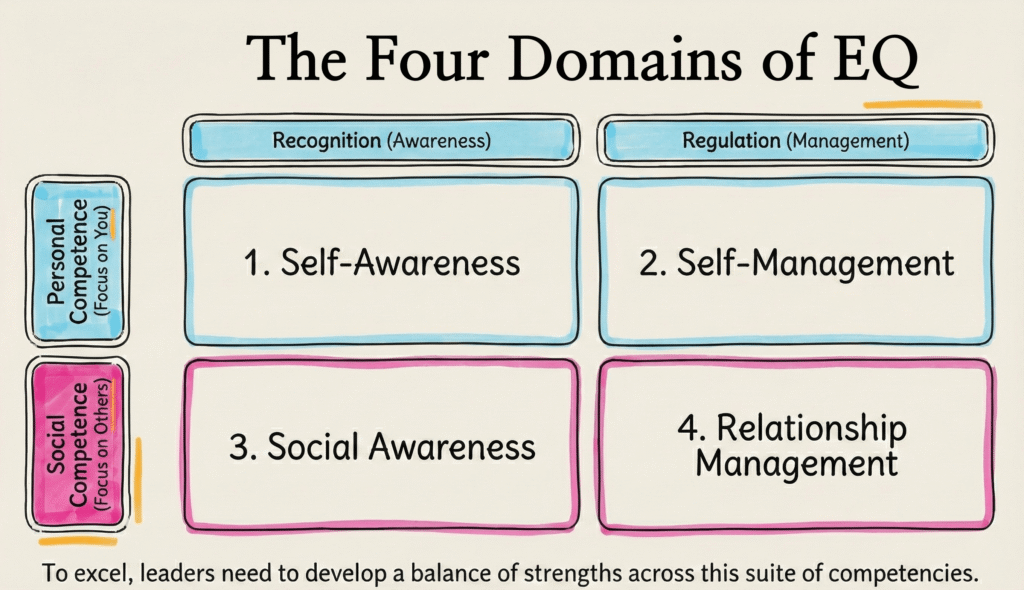
At its core, emotional intelligence is four skills:
- Self-Awareness — recognizing what you’re feeling and why
- Self-Management — choosing your response
- Social Awareness — reading other people’s emotions and perspectives accurately
- Relationship Management — building trust, navigating conflict, and leading through influence
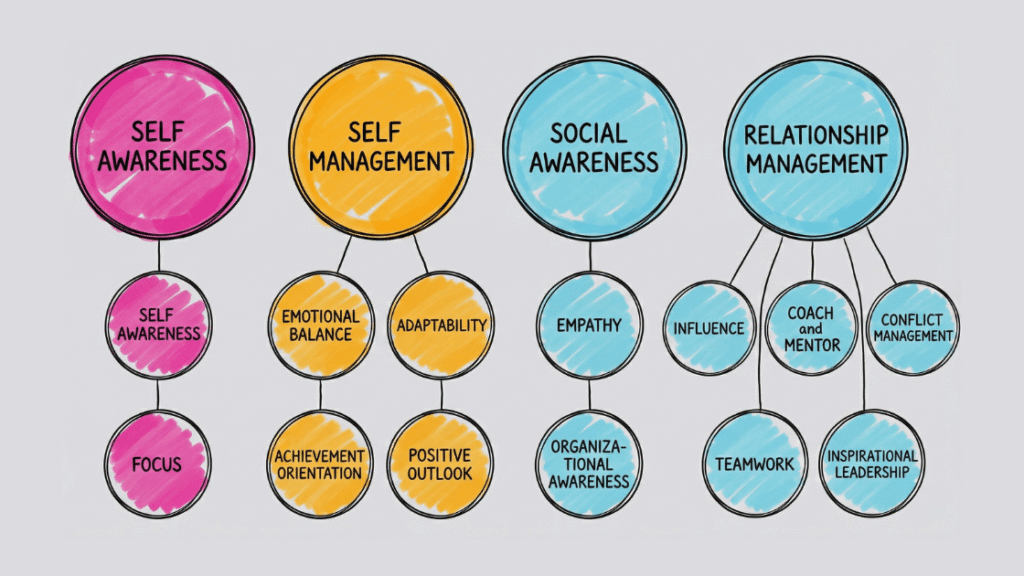
With 12 competencies. i.e., the skill needed to perform a role or task.
- Emotional Self-Awareness
- Emotional Self-Control
- Adaptability
- Achievement Orientation
- Positive Outlook
- Empathy
- Organizational Awareness
- Influence
- Coach and Mentor
- Conflict Management
- Teamwork
- Inspirational Leadership
“Emotional Intelligence, a different way of being smart, is a key to high performance at all levels, particularly for outstanding leadership. It’s not your IQ; it’s how you manage yourself and your relationships.”
— Daniel Goleman, author of Emotional Intelligence: Why It Can Matter More Than IQ
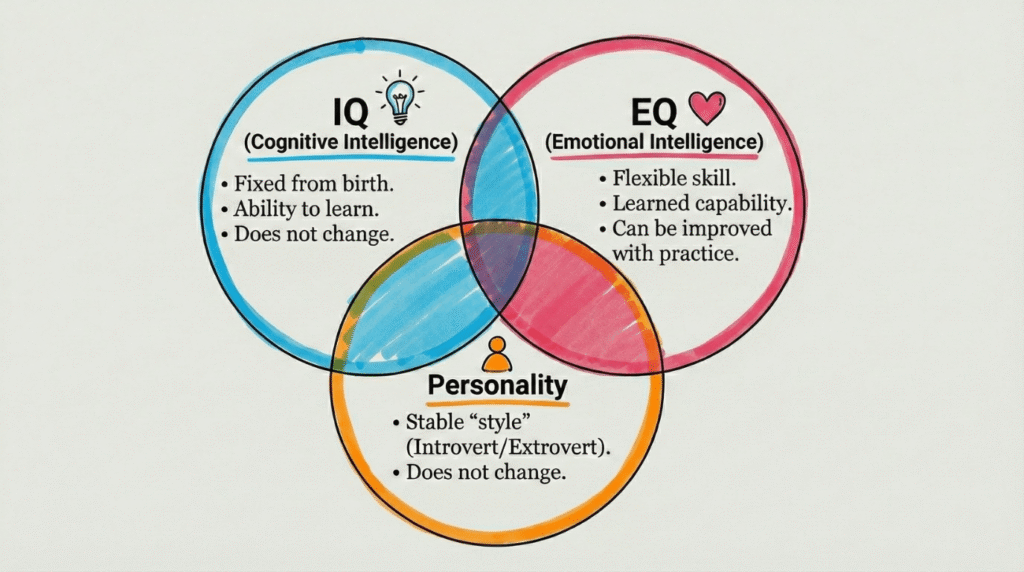
IQ and personality are relatively fixed. EQ is flexible. Your brain can physically change — a single neuron can grow up to 15,000 connections. Practice strengthens the pathway between emotion and reason until a new behavior becomes a habit. A single neuron can grow 15,000 connections.
Most EQ frameworks stop at explanation. They tell you what emotional intelligence is. They don’t tell you how to practice it.
That’s where AI can help.
Why You Can’t See What Everyone Else Sees
The leaders who need EQ most often assume they already have it.
Only 36% of people can accurately name their emotions as they happen. The rest of us get steered by feelings we don’t even notice.
You judge yourself by intent. Others judge you by impact. That gap between how you show up and reality is like the difference between an influencer shot on Instagram and the real world. Those don’t match as often as you think.
Daniel Coyle writes in The Culture Code: “It’s very hard to be empathic when you’re talking… But not when you’re listening. When you’re really listening, you lose time.”
A lot of leaders aren’t listening. They’re writing their next line.
And your emotions don’t stay contained. A burst of anger doesn’t just hit one person; it changes the temperature of the whole room. A bit like a stone thrown into a pond. Those negative ripples keep on going and can create the wrong climate in your team.
Your kids can struggle with controlling their emotions. Adults shouldn’t.
You’re going to have blind spots. The question is whether you’re willing to find them.
Your AI-Powered EQ Training Plan
1) Self-Awareness
What it is: noticing what you feel in the moment and your patterns over time.
Why it matters: You can’t manage what you can’t see. If you don’t know you’re stressed, frustrated, or defensive, you’ll act out those emotions without realizing it. Your team will notice. You won’t.
The mindset shift: Quit treating feelings as good or bad. Emotions aren’t problems to solve — they are data. Acknowledging them lets them run their course rather than hijacking your behavior.
The Ford lesson: Remember Mulally’s “red slide” moment? Before he arrived, Ford executives couldn’t even admit problems existed — not to each other, and probably not to themselves. Self-awareness at Ford was zero. Mulally didn’t just make it safe for others to be honest. He modeled honest self-assessment at the top.
Daily practice: Emotion check-in (5 minutes)
"I want to process my day. Here's what happened: [describe 2-3 key moments]. Ask me questions to help me understand what I was feeling in each moment, why I reacted the way I did, and what patterns you notice. Don't give me answers — just ask questions that help me see myself more clearly.”Weekly practice: Trigger log
Track moments when you felt reactive this week.
"Here are three moments this week when I felt triggered or reactive: [describe them]. Help me identify patterns. What situations, people, or dynamics seem to set me off? What assumptions might I be making in these moments?”
Pro Tip: Know your buttons. Identify the specific people and situations that trigger you — the colleague who always derails meetings, the email tone that sets you off, the type of feedback that makes you defensive. Awareness is the first step to managing the reaction.
2) Self-Management
What it is: staying in charge of your behavior under pressure.
Why it matters: Leadership is pressure. Deadlines, conflicts, bad news, difficult people. If you can’t manage your own emotional state, you’ll leak stress onto your team. They’ll spend more energy managing your mood than doing their work.
The challenge: Managing the amygdala hijack. Your amygdala — the emotional sentinel in your brain — can go into overdrive, causing you to obsess about distress and lose the plot. When that happens, your rational brain goes offline. You react instead of respond.
The principle: “Don’t get emotional — get focused.” That’s Ryan Holiday, channeling the Stoics. It doesn’t mean suppressing emotion. It means not letting emotion drive the car. You can feel frustrated and still respond thoughtfully. You can feel anxious and still make a clear decision.
The science behind “count to ten”: Neuroscience suggests a simple pause that reboots the limbic system and stops the flow of frustration. Your brain demands 20% of your body’s oxygen. When you’re stressed, shallow breathing handicaps your rational brain. Deep breaths re-engage the frontal lobe.
How to build it with AI:
Use AI to practice high-pressure scenarios in a safe environment.
Difficult conversation rehearsal
“I need to have a difficult conversation with [person/role]. Here’s the situation: [describe it]. Role-play as them and push back on what I say. After we practice, give feedback on my tone and word choice. Point out where I sounded defensive, dismissive, or reactive.”
Angry email audit – Before you send that email you wrote while you’re pissed off:
“Here’s an email I’m about to send: [paste it]. What emotion am I projecting? How might this land? Rewrite it to be direct but not reactive.”
Pro Tip: Self-management isn’t about being emotionless. It’s about what Viktor Frankl writes about in Man’s Search for Meaning. Creating space between stimulus and response. Success comes to those who can put their momentary needs on hold to pursue larger, more important goals.
3) Social Awareness
What it is: Your ability to accurately pick up on emotions in other people and understand what is really going on with them.
Why it matters: Leadership is relational. If you can’t sense what your team is feeling, you’ll miss the signs of burnout, disengagement, and conflict until it’s too late.
Empathy isn’t sympathy.
- Sympathy is feeling FOR someone. “I feel bad for you.”
- Empathy is taking other people’s feelings into consideration to make intelligent decisions. “I get your point, and I’ll factor it into my decisions.”
Think like an anthropologist: watch what’s happening without rushing to answer. Just observe.
How to build it with AI: Use AI to practice perspective-taking in your real situations.
Practice — The Stakeholder Map:
Before a meeting or decision:
"Here are the people involved in this situation: [list names and roles]. For each person, help me think through: What are they likely feeling right now? What do they want out of this situation? What are they afraid of? What might they not be saying out loud?"
Practice — The Perspective Shift:
When you’re stuck in conflict:
"I'm frustrated with [person] because [situation]. Play devil's advocate. Make the strongest possible case for their perspective. What might they be experiencing that I'm not seeing?"
In your next meeting, write less. Watch more. Let AI take the notes for you, so that you can observe.
4) Relationship Management
What it is: using awareness of yourself and others to handle interactions well.
Why it matters: The best teams are those with the highest psychological safety. Psychological safety doesn’t happen by accident. It’s built through hundreds of small moments — how you give feedback, how you handle disagreement, how you show people they matter.
Only 10% of conflict comes from a difference of opinion. 90% is delivery and tone.
Indra Nooyi demonstrated this at scale when she became CEO of PepsiCo and wrote personal letters to the parents of her executive team, thanking them for raising such capable, talented people.
That was no gimmick. That little act was a signal: I see you as a person. That’s boss-level relationship management.
How to build it with AI:
Practice — The Feedback Rehearsal:
Before giving difficult feedback:
"I need to give feedback to [person] about [issue]. Help me prepare. The feedback should be specific, focus on behavior not personality, and open a conversation rather than shut one down. Role-play as the recipient and help me anticipate their reaction."
Practice — The Trust Audit:
Check the health of your key relationships:
"Here are my five most important professional relationships: [list them]. For each one, ask me questions to help me assess: Am I making enough deposits in this relationship? When's the last time I showed appreciation? Are there any unresolved tensions I'm avoiding?"
Practice — The Conflict Protocol:
When you’re stuck in an ongoing conflict:
"I've been in conflict with [person] for a while. Here's what's happening: [describe it]. Help me separate the 10% that's about the actual issue from the 90% that might be about delivery, tone, or unspoken dynamics. What would repair look like?"
Pro Tip: Build bonds over time, not just when you need something. Trust is built before the crisis, not during it. One genuine check-in when the stakes are low is worth ten rescue attempts when things go wrong.
The 1-Hour Weekly System
EQ changes through reps. It’s a practice. Remember — your brain physically changes when you repeat behaviors — neural pathways thicken until the new response becomes automatic.
Here’s what that might look like in practice:
Daily (5–10 minutes)
- End-of-day emotion check-in
- Process one reactive moment
- Deep breathing before high-stakes interactions
Weekly (20–30 minutes)
- Review trigger patterns
- Rehearse one hard conversation
- Run an email audit on anything written while hot
Monthly (30–45 minutes)
- Trust audit on key relationships
- Stakeholder map for your team
- Ask: “What patterns do you see in my reflections this month?”
Quarterly
- Pick one competency for 90 days
- Choose one behavior to change
- Review progress with AI
Total weekly time: about 1 hour.
That’s less than you spend in meetings that could have been emails.
Why This Works
Traditional EQ development looks like this: you attend a workshop, learn some concepts, feel inspired for a few days, then revert to old patterns because there’s no practice environment.
This approach is different.
| Traditional EQ Training | AI-EQ Practice |
|---|---|
| Learn concepts once | Practice daily |
| Get feedback months later | Get feedback immediately |
| Safe environment = classroom | Safe environment = any moment |
| External accountability | Built-in accountability |
| Theory-heavy | Behavior-focused |
You’re not just learning about EQ. You’re practicing it — in the moments that actually matter, with a partner who doesn’t judge, doesn’t gossip, and is available whenever you need to think out loud.
Your Turn
Over the next decade, technical skill won’t be enough. The leaders people follow will be the ones they trust. The ones they know.
AI can move fast. It can’t make your team feel safe enough to tell you the truth.
Start this week:
- Today: do one emotion check-in before you log off
- Tomorrow: pick one reactive moment and unpack it
- This week: rehearse one hard conversation
- Next week: run a trust audit on your three most important relationships
- This month: pick your biggest blind spot and work it
5–10 minutes a day. About an hour a week.
You’ll get clearer on your patterns, have better conversations, build stronger relationships, and create the kind of team where people bring you the red slides.
Because we don’t have an intelligence problem. We have a compassion problem.
AI won’t fix that for you. But it can help you fix your part.
What’s one EQ blind spot you’re willing to work on? Reply and let me know—I read everything.
FAQs
A: Yes. AI serves as a non-judgmental practice partner for high-stakes scenarios. You can rehearse difficult conversations, audit emotional emails before sending, and process triggers without fear of gossip or defensiveness. The key is consistent practice — AI makes that accessible daily.
A: EQ consists of self-awareness (recognizing your emotions), self-management (choosing your response under pressure), social awareness (reading others accurately), and relationship management (building trust and navigating conflict). Research shows these skills account for 58% of job performance.
A: About 5-10 minutes daily plus one hour weekly. That includes emotion check-ins, trigger processing, conversation rehearsals, and relationship audits. Your brain physically changes with practice — neural pathways strengthen until new behaviors become automatic.