

Imagine someone tells you about a psychiatric patient who walks into a shopping mall and stabs a young girl. Your stomach tightens. And somewhere underneath, without you deciding anything, your brain adjusts what it believes about how safe the world really is.
Now imagine you find out none of it happened. A novelist made the whole thing up.
Your beliefs don’t snap back. They already moved.
Researchers ran a version of exactly this. Green and Brock gave people that story, told half of them it was true and half of them it was invented, then measured what it did to their view of the real world. Both groups moved. And they moved by about the same amount. Whether the story was stamped true or made up barely changed how much it rewired what people believed. The truth of the story wasn’t doing the persuading. The story itself was.
We like to believe we update our minds based on evidence. That the best argument always wins, and the person with the better proof and the sharper presentation should walk away as the winner. Mostly, though, we update on narrative first, and then we go looking for the facts that fit.
The part that I find most interesting is that we just solved one half of communication and made the other half harder. AI cracked the information half. With ChatGPT and Perplexity at your fingertips, you can get a sourced answer to almost any question in seconds. The persuasion half, the part where a person actually changes their mind, has barely been touched. Facts are nearly free now, and almost no one has changed their mind about anything that matters to them because of one.
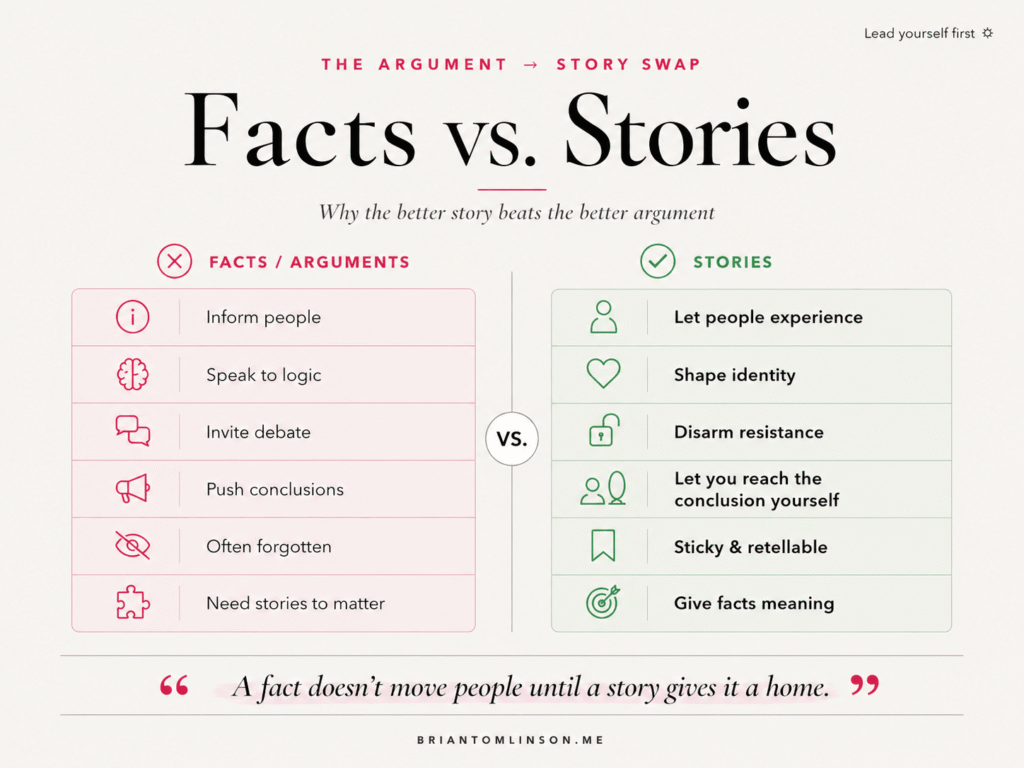
That’s because facts don’t change minds. Stories do. It’s not that facts don’t matter, but a fact can’t travel until a story carries it.
Why facts don’t change minds
A few years ago, I walked into a board meeting to get a big technology project approved. I only had a few minutes and a long list of features, so I did what felt logical. I showed them everything the platform could do and every capability that “I” was excited about. I walked out with no decision. They weren’t sure, or really, they didn’t believe.
I’d made a basic mistake. I assumed the board cared about the same impressive features I cared about. They didn’t.
So the next time, I dropped the feature list. I came back with stories instead: other companies like ours, what the platform changed about the way they worked, what it freed their people to actually do. Same platform. Same underlying facts. This time, the project got approved.
Nothing about the technology changed between those two meetings. The only thing that changed was that I stopped arguing and started telling a story.
That gap, between the better argument and the better story, is where most of us lose. And the hard part is that we hardly ever notice it enough to fix it.
This gap is hard to close. When a belief actually matters to someone, it’s not sitting in their head as a loose fact waiting to be corrected. It’s wired into who they are.
Mark Manson writes in his work on personal values: “You can’t argue someone out of their values.” Push, and you usually make it worse. A person’s beliefs are the aggregation of what they value, and what they value is their identity. So a stronger argument doesn’t always feel like new information. It feels like a threat, like you telling them they’re wrong about who they are.
There’s also good research that sets the foundation for this. Dan Kahan, a legal scholar at Yale, studies what he calls identity-protective cognition. He gave people the same facts on heated topics and watched them split further apart, not closer. What makes it worse is that the more scientifically literate someone was, the more polarized they became. Better thinkers were simply better at defending the team they already belonged to. His summary of it is that “culture is prior to facts in human cognition.” In plain speak: the story you already live in decides which facts you’ll even let through the door.
Blair Warren spent years studying persuasion and noticed the same thing. “The harder you push, the more resistance you get.” He also found that the need to be right runs deeper than most of us admit. People don’t hold onto shaky beliefs because they enjoy being wrong. They hold on because being right feels like having the world figured out, and nobody gives that away for a spreadsheet.
You’ve probably heard that facts can “backfire,” that correcting someone just makes them hold onto the wrong belief even harder. It’s a popular idea, and it mostly hasn’t held up. When scientists went looking for that effect, they usually couldn’t find it. What actually happens is that most of the time, a correction just doesn’t do much. Your facts are fine. But the person is already living inside a different story, and a single fact is only a footnote to it, so it has little effect.
This is the trap underneath so much of our frustration at work. We assume the people we lead only move when we push, so we keep pushing (I wrote a whole piece on why that fails, The Influence Gap). We keep sharpening the argument, and we keep aiming at the wrong target.
People aren’t waiting for better information. They’re waiting for a better story. One they can see themselves inside.
How stories change minds (narrative transportation)
So if pushing harder is the wrong tool, what’s the right one?
A story. And not just because stories are engaging or memorable, though they’re both. A story does something an argument physically can’t. It gives the other person the experience of the thing, without the lecture.
Psychologists call this narrative transportation. When you get absorbed in a story, you stop judging it from the outside and start living inside it. Green and Brock showed that the more someone is transported, the more their beliefs bend toward the story. When they deliberately interrupted that absorption, the persuasion dropped, even though the facts of the story never changed. Two decades of follow-up research haven’t changed anything, and a recent review by Green and Appel found it holds across health, politics, and identity.
Let’s look at a pop-culture example. Think of Christopher Nolan’s Inception (one of my favorite movies). People enter a dream knowing it isn’t real. Once they’re inside, though, they stop questioning it. They react emotionally as though the dream were reality. Narrative transportation works in much the same way. A powerful story quiets the part of your mind that’s trying to decide whether it’s true, and lets you experience it as though it were.
Here’s why it works, and it’s almost unfair how well it works. A transported story is a simulated experience. Lisa Cron, who writes about the neuroscience of story, puts it simply: stories “allow us to simulate intense experiences without actually having to live through them.” Brain imaging backs her up. When a narrative grips you, many of the same perceptual and motor networks that process real sights, sounds, and movement light up, as if the events were happening to you in real life.
Now connect that to how people actually change. Manson again: “the only way to change someone’s values is by presenting them with a contrary experience.” Values, he argues, are won and lost through lived experience, not through logic. That sounds like bad news for anyone who can’t follow their buyer around for a month. But a story is the loophole. A good story is a contrary experience you can hand someone in ninety seconds. It’s a simulated experience, and you can produce it at scale.
That’s what your content actually is, on the days it works. Every piece that you create, whether it’s an essay, teardown, or framework, is a small world your reader steps into. Before a potential client ever books a call or before a recruiter reaches out, they get to feel what working with you is like. It’s how stories outrun credentials, and how you go from one option on a list to the obvious choice.
So stop handing people facts about you. Start building a world they can step into, and let the facts play their supporting role once they’re already in your room.
The Argument→Story Swap: a 5-step framework
If you catch yourself losing the same argument over and over again, here’s a discipline you can try to get off that hamster wheel.
I call it the Argument→Story Swap.
- Name the argument you keep losing. Get specific about it. Try to find the exact claim and the exact person or audience you keep losing it with. “Leadership doesn’t take my team’s capacity seriously” is more concrete than “They just don’t get it.”
- Find the belief underneath. Ask what they would have to experience in order to change their mind. Not hear, but “experience.” If your prospect believes that switching tools is always a painful mess, no promise of “easy onboarding” is going to change their mind. They’ve already lived the painful version. That memory is the belief you’re really up against.
- Build the story that lets them live it. This is the real superpower craft. Luckily for us, there’s research on what makes a story believable. Van Laer and his colleagues studied hundreds of persuasive stories and found four things that pull people in: an identifiable character, concrete detail, an emotional arc, and a clear line of cause and effect. So give them a character who looks like them, facing what they face. Use real specifics. A case study that reads like a spreadsheet isn’t going to transport anyone. Show them the transformation. Then you can layer your numbers into the story rather than replace them.
- Stage it this week. Small and real beats big and someday. Try to have one argument, one story, one demonstration. Maybe it’s a teardown of their actual situation, or a fifteen-minute working session where they feel your product instead of just hearing about it. If your work feels too complex to show, that’s usually a sign that explaining it was never going to work anyway. Find the smallest honest slice and let them touch it.
- Stop explaining. This is the hard part, especially for those of us who like being right. Your job is to build the world. It’s not to stand in the doorway narrating the moral of the story. Set it up, then step back and let them reach the conclusion on their own. That’s not intended to be a manipulation tactic. Instead, it’s the most respectful way to change a mind, because the other person gets to keep their dignity while they do it.
Why stories matter more in the AI era
All of this can start to sound like a license to be a spin doctor. It’s not. The story has to be true. You’re not inventing a reality to trick someone into it. You’re taking something true that’s trapped inside a spreadsheet and making it legible, so a real person can walk through it and see it for themselves. Andre Chaperon calls this a posture of service instead of selling. You’re not pushing. You’re clearing the friction between someone and a true thing. (If the selling-without-cringe part of this still makes you flinch, I wrote about that too.)
The beauty of all of this is that none of it is new. Long before decks and dashboards and AI answer engines, humans decided what was true by the stories they could step inside: the campfire, the parable, the war story your uncle retells every holiday until you believe it in your bones (or not). Making information infinite won’t retire the story. If anything, it raised the stakes. Every year, AI gets better at producing facts, which pushes the human edge somewhere the machines can’t reach, toward the story people actually believe.
Think back to the board that told me no. Nothing about the technology changed on my second try. I just stopped handing them facts and gave them a story they could stand inside. A fact can’t travel until a story carries it.
So the next time you catch yourself sharpening the same argument for the fifth time, stop sharpening. Instead, build the story that makes the argument unnecessary. Because in a world where everyone has access to the same information, advantage no longer belongs to the person with the better facts.
It belongs to whoever tells the better story.
Because beliefs that matter are tied to identity and values, not stored as loose facts. When a fact contradicts a value, it registers as a threat rather than information, so people defend their position instead of updating it. Research on identity-protective cognition (Dan Kahan) shows people often reason to protect their group, not to reach accuracy.
Often, yes, for value-laden beliefs. Stories work through “narrative transportation” (Green & Brock, 2000): when someone is absorbed in a story, their beliefs shift toward it, an effect that holds even when the facts stay the same. A story delivers a simulated experience, and experience moves belief in ways argument cannot.
Narrative transportation is the state of being absorbed into a story so fully that you stop evaluating it from the outside and start experiencing it from the inside. The more a person is transported, the more their attitudes and beliefs move toward the story. It’s the mechanism behind why stories persuade.
Stop adding evidence and give them an experience instead. Name the argument you keep losing, find the belief underneath it, and build a short, true story that lets the person live the point rather than hear it. Then step back and let them reach the conclusion themselves.
The strong version is not well supported. Early studies suggested that corrections could strengthen false beliefs, but later research (Swire-Thompson et al., 2020) largely failed to replicate this effect. The accurate claim is quieter: corrections usually land with little effect because the person is already inside a different story, not because facts reliably backfire.