

There’s a scene in The Dark Knight where the Joker, dressed as a nurse of all things, sits across from Harvey Dent in a hospital room. Half his face paint is smeared off as he says, “Nobody panics when things go according to plan.”
That mirrors the Joker’s point: people accept even extreme outcomes if they fit a narrative or plan.
Building an industry voice works the same way. When you have a system, the growth doesn’t feel chaotic. It feels inevitable. People watch from the outside and think you got lucky. That you were naturally charismatic. That the algorithm blessed you.
None of that is true, of course.
The people who build real authority — the ones who go from invisible expert to the person others call for advice, speaking gigs, and partnerships — are running a system. The same system, every time. And you can run it too.
I know this because I’ve tested it on myself. Multiple times. Across 20 years, three companies, and two continents. And I’ve helped CEOs and executives do the same.
The Path to Building an Industry Voice (The Honest Version)
Here’s the part most people skip in their “how I built my platform” story.
I’ve been inconsistent. Not once. Many times. I’ve gone dark for months. Started a family, moved from the U.S. to Germany, switched companies, got laid off (twice), and every time — my visibility evaporated.
That’s the truth. There was no straight line from zero to 100k followers.
But here’s what I noticed: the times I locked back in and ran the system, real results followed. Brands I’ve worked for and with have created over a million followers, millions of YouTube views, and real business outcomes. A consulting pipeline that fills itself. Speaking invitations I didn’t pitch for.
Not because I came back to some secret. Because I came back to simplicity. The same three things every time: a platform, a point of view, and proof.
The results weren’t random. They were the output of a system I kept coming back to. And systems are teachable.
Why Most Experts Stay Invisible Online
You’re probably good at what you do. Maybe really good. You’ve spent years building expertise. Learning. Doing the work.
And nobody knows.
That’s not a character flaw. It’s a systems problem.
Stanford’s Web Credibility Project has spent years studying how people judge authority online. Their finding? People assess credibility in seconds — based on where you show up, how you present yourself, and who else endorses you. Not based on how smart you actually are. Robert Cialdini’s research on influence backs this up: authority signals and social proof are the two levers that lower perceived risk more than anything else. It’s what I call intentional influence — building trust on purpose, not by accident.
Which means the most qualified person in the room doesn’t win. The most visible one does. Every single time.
A separate study asked over 800 adults to evaluate social media posts for credibility. The two strongest predictors of whether someone was seen as an authority? Perceived expertise and alignment with the reader’s existing beliefs. The actual quality of evidence in the post barely moved the needle.
Read that again. The quality of your argument matters less than whether people already believe you’re an expert. That belief gets built through repeated exposure. Through being seen. Through having a system.
Most experts fail at visibility for one of three reasons:
They scatter. They post on LinkedIn Monday, X on Wednesday, start a newsletter, abandon it, try YouTube, quit after four videos. They never build depth anywhere.
They play it safe. They share consensus opinions dressed up in professional language. Nothing wrong. Nothing memorable either. Safe content creates invisible experts.
They assert without receipts. They say “I’m an authority” but never show the work. No case studies. No documented results. No proof that what they teach actually works.
The cost? Someone less qualified but more visible gets the contract. The speaking slot. The board seat. Not because they’re better. Because they showed up.
The Visibility Framework: Why It Works
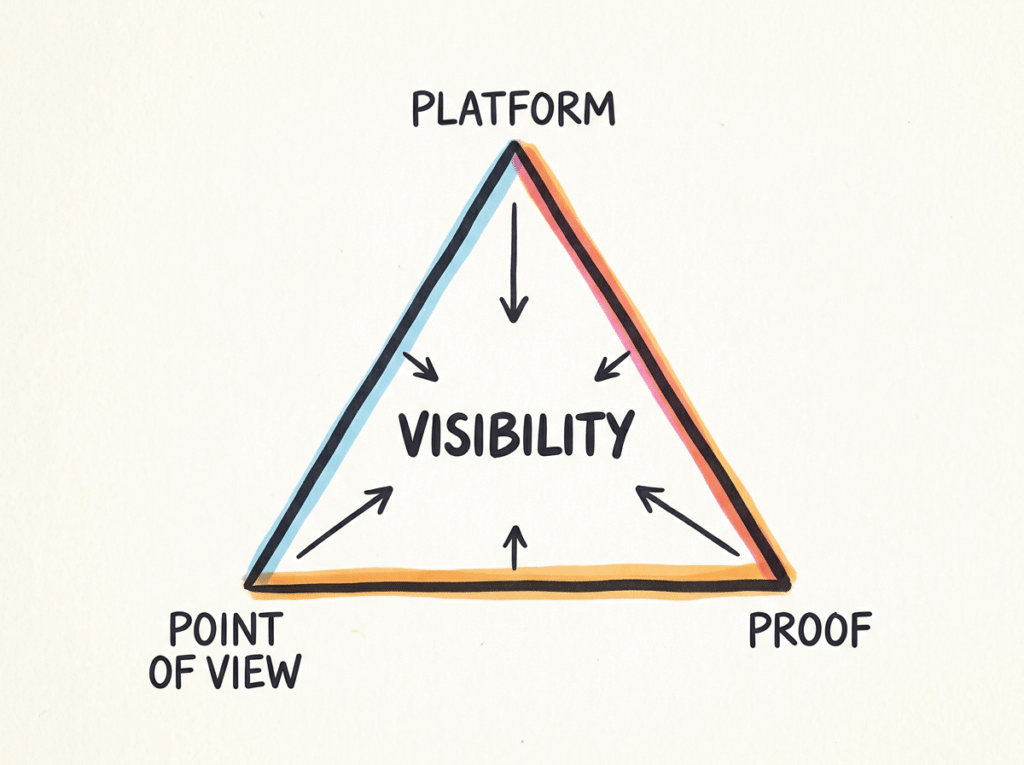
Visibility isn’t a personality trait. It’s not something you’re born with. It’s the output of a system with three components:
Platform + Point of View + Proof.
When those three align, visibility follows. When one is missing, you stall.
Anne-Laure Le Cunff published 100 articles in 100 days at Ness Labs. Research-backed. Specific. She grew the Maker Mind newsletter to over 100,000 subscribers and built a six-figure community business on the back of her writing. (Her book Tiny Experiments is worth your time if you haven’t read it yet.)
These aren’t flukes. They’re the pattern.
Here’s the system.
How to Build an Industry Voice: Platform + Point of View + Proof
1. Choose Your Platform
Pick one place to show up. Master that system first.
This is where most people go wrong. They try to be everywhere. LinkedIn, a newsletter, X, YouTube, a podcast, a blog. They end up mediocre on all of them.
Your platform isn’t about where everyone is. It’s about where your audience already pays attention. I started on LinkedIn because that’s where my people were. Not because it’s the “best” platform. There is no best platform. There’s only the right one for you, right now.
Neil Patel describes newsletters as “thought leadership laboratories” — places where you test ideas, gather feedback, and build depth before going broad. YouTube functions as a searchable library that compounds over time. LinkedIn gives you B2B reach and network effects.
Pick one. Go deep. Expand later.
The decision filter: Where does your audience spend time? Which format fits how you think? (Are you a writer? Are you comfortable on camera? Maybe you enjoy designing.) Where can you be consistent for at least six months without burning out?
Answer those three questions. You’ve got your platform.
2. Develop Your Point of View
Everyone can execute tactics. Very few people have the clarity to say what they actually believe.
That’s your unfair advantage.
A 2023 study with over 800 participants found that people reward information sources that are relevant and accurate. Sensational takes that turn out to be wrong destroy trust. So your point of view can’t just be contrarian for the sake of it. It has to be right. Or at least honestly argued from real experience.
James Clear put it this way: “Behind every system of actions is a system of beliefs.” Your content system flows from what you believe about your craft, your industry, and the people you serve.
My point of view — “You can’t influence your market until you’ve learned to influence yourself” — isn’t clever marketing. It’s what I actually believe after 20 years of watching smart people fail because they skipped the self-work. That’s why it resonates. Borrowed beliefs sound hollow. Earned convictions carry weight.
The POV test: Complete this sentence: “Most people in my industry believe X. I believe Y, because Z.”
If you can’t fill that in, you don’t have a point of view yet. You have a topic. That’s not the same thing.
3. Build Your Proof Stack
Assertions sound like opinion. Proof sounds like experience.
You need both. But proof is what separates industry voices from people who just post a lot.
Nicolas Cole wrote something that stuck with me: “Credibility is in the eye of the beholder — and it’s a ladder anyone can climb.” Earned credibility beats perceived credibility. Every time.
My proof isn’t theoretical. 5.5M YouTube views. Training programs for 12,000 employees. 161% year-over-year growth at my last company. I cite specific numbers because specificity is credibility.
The proof audit: List three concrete results from your work. Not “I helped companies grow.” That’s nothing. “I helped a B2B SaaS company increase qualified leads 40% in six months by redesigning their content system.” That’s proof. Start documenting your work now, even if it feels small. It stacks.
4. Establish a Consistent Content Cadence
Consistency beats frequency. But consistency means showing up more than once a week.
Buffer’s 2026 analysis of millions of social posts found that accounts posting three to five times per week get about 12% more reach per post and more than double the follower growth compared to accounts posting once or twice a week.
A large-scale Tailwind study found something that surprised a lot of people: when accounts increased their posting frequency, engagement rates actually went up, not down. Daily posters grew roughly four times faster than weekly posters. The “posting more tanks your engagement” belief? A myth. Confounded by the fact that bigger accounts naturally have lower percentage engagement rates.
Seth Godin: “Persistent, consistent, and frequent stories, delivered to an aligned audience, will earn attention, trust, and action.”
I don’t post daily. I post consistently. Three to five times per week on LinkedIn. Weekly newsletter. That’s the cadence. A system makes it possible — not superhuman discipline.
Start here: One platform, three times a week. Build the habit before increasing volume. Intensity without consistency is a sprint you’ll quit.
5. Compound Your Authority Over Time
Authority compounds. Each piece of content builds on the last. Proof stacks. Reputation accumulates.
Anne-Laure Le Cunff’s 100 articles in 100 days became the foundation of a 100,000-subscriber newsletter and a business.
The Peak, a Canadian business newsletter, went from zero to 100,000 subscribers and over $3 million in annual revenue in under three years. Then sold for $5 million. A newsletter. As an asset.
The hardest part is the first six months. Nobody’s listening. You’re publishing into silence. Your best work gets three likes and a comment from your mom.
Push through the silence. The people who built real authority all did. And when the compounding kicks in, it accelerates fast.
The compounding play: Reuse your proof across platforms. One newsletter essay becomes three LinkedIn posts. Speak at events. Let visibility grow from signal, not noise.
The Visibility System Anyone Can Run
I want to be clear about something. This article isn’t about me.
The framework works because it’s a system, not a personality type. It works whether you’re introverted or extroverted. Whether you’re 25 or 55. Whether you’re a founder, a VP, a coach, or a creator.
Platform + Point of View + Proof.
That’s it. Pick your platform. Say what you actually believe. Back it up with real work.
The world has enough invisible experts. What it needs is your voice. Your specific, experience-earned, conviction-backed voice.
Ship it.
Want a worksheet to map your Platform, clarify your Point of View, and audit your Proof? I’m building the Thought Leadership Starter Kit. Drop your email, and I’ll send it when it’s ready.
A: Build an industry voice with the Visibility Framework: choose one Platform, develop a clear Point of View, and stack Proof through documented results. Pick one platform where your audience pays attention, say what you actually believe (not consensus opinions), and back it up with real work.
A: The Visibility Framework is a three-component system for building authority online: Platform + Point of View + Proof. When all three align, visibility becomes inevitable. When one is missing, growth stalls.
A: Research from Buffer (2026) shows accounts posting 3-5 times per week get about 12% more reach per post and more than double the follower growth compared to accounts posting 1-2 times per week. Consistency beats frequency — pick a sustainable cadence.
A: Most experts fail at visibility for three reasons: they scatter across too many platforms, they play it safe with consensus opinions, or they assert authority without proof. Visibility isn’t a personality trait — it’s a systems problem.
A: Complete this sentence: “Most people in my industry believe X. I believe Y, because Z.” Your point of view has to be honestly argued from real experience — contrarian for the sake of it destroys trust. Earned convictions carry weight. Borrowed beliefs sound hollow.