
“The best ‘marketing’ in the world is marketing that’s mostly invisible to the person interacting with it. When becoming a customer feels like an inevitability and then it is.” — André Chaperon
That’s the goal.
Not visibility. Not reach. Not a viral moment. The goal is inevitability — that moment when a buyer with a problem you solve doesn’t have to evaluate ten options, because your name is already sitting in their head as the obvious call they need to make.
Most leaders I talk to have the question wrong. They ask, “How do I get more visible?” when the better question is, “How do I become inevitable?” (And not in that Thanos sort of way either.)
I’ve been mapping that journey for about eighteen months now. Trying to figure out how to build authority that actually moves buyers, not just vanity metrics. There are four stages between being invisible and being inevitable. And most leaders are stuck at stage one. Not for a lack of trying, but because they skipped the trust layer entirely.
So here’s the map that I’ve built for you.
The Visibility Trap
Let me tell you what most experts get wrong. They confuse impressions with influence.
They post, they speak, they hit some engagement milestone, and they assume the market is now considering them. It isn’t. Because the actual buying decision happens long before any conversation, you can measure.
Gartner’s research found that 70 to 90 percent of the B2B buying journey is complete before a buyer ever talks to a vendor. By the time you’ve made it into the room to pitch. You have already won or lost based on whether that buyer thought of you when the problem first surfaced in their mind.
So what makes them think of you? That’s where it gets interesting.
When buyers face complex choices with unclear trade-offs, they don’t carefully evaluate every option. A 2019 Cambridge meta-analysis of default effects found that when people are given a pre-selected option, they go with it about 27 percentage points more often than they would have otherwise. That’s an enormous behavioral shift that shows up wherever decisions feel heavy, uncertain, or high-stakes.
Charlie Munger had a name for this pattern. He called it Availability-Misweighing: the brain’s tendency to weigh what’s easy to remember more heavily than what’s actually best. He warned that an idea isn’t worth more just because it’s available. But the brain weighs it that way anyway.
That’s what you’re up against. Not other experts or firms. The brain’s shortcut to whoever comes up first.
And a lot of that work happens somewhere you can’t see.
Amanda Natividad calls it dark social: “The most valuable content now is the content that lives in screenshots, shares, DMs. Content that never appears in your analytics but builds your brand in dark social.” Your real reputation is being built in Slack threads, forwarded emails, and private conversations you’ll never see in a dashboard.
Here’s the thing. When I left Staffbase, I had every credential the standard playbook says matters. I’d led an international team of twelve across multiple time zones. We launched three podcasts and had over 5 million YouTube views in 2025. We had 161% year-over-year growth. Those are great numbers, but the truth was, like so many people, I was invisible.
Not because I lacked expertise. Because in this new context, nobody knew I existed.
Being great and invisible is a lonely place to sit. The market doesn’t beat a path to your door. You have to build the path yourself. And this applies whether you’re building your career or your business. Being great in a vacuum doesn’t help anyone. You have to be visible.
Why Trust Is the Layer Most Leaders Skip
There’s a layer between being visible and being chosen. This is trust and it’s the actual answer to how to build authority that holds up over time. The problem is it’s the layer most people skip, because it’s the slowest one to build and the hardest to measure.
A recent longitudinal study from Seton Hall’s Buccino Leadership Institute, grounded in the Mayer-Davis-Schoorman trust framework, found that meaningful trust in a leader takes between 13 and 24 months to build. And it can be lost in under twelve.
This tells us that trust compounds slowly and evaporates quickly. Which means you have to treat it like a long-horizon asset, not a campaign. Most quarterly marketing plans don’t know how to account for that.
The good news is that the mechanism is well-understood. The Edelman-LinkedIn 2024 B2B Thought Leadership Impact Report, based on a survey of 3,484 global executives, found that high-quality, insight-driven content shifts buyer preference, opens doors, and earns price premiums. Buyers reward expertise that has been demonstrated in public, over time.
This makes a ton of sense when you put it through the lens of Seth Godin. He said that “Persistent, consistent, and frequent stories, delivered to an aligned audience, will earn attention, trust, and action.”
That’s not just a slogan, but a pattern we can learn from and a call to arms.
The I2I (Invisible to Inevitable) Framework
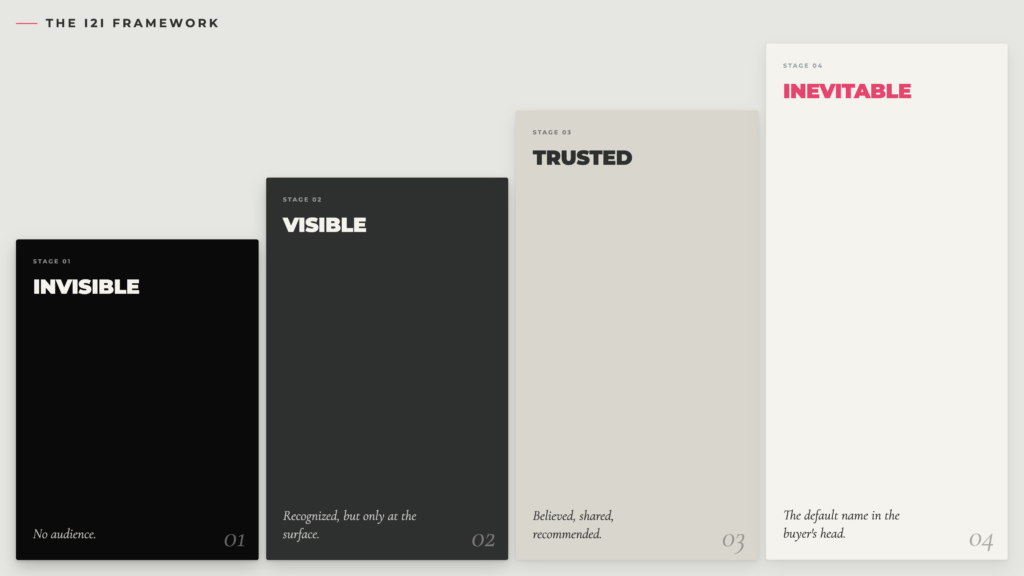
I’ve created a four-stage framework that maps how to build authority systematically through ascending levels of trust. (If you like 4-stage frameworks, this one’s a cousin.)
Stage 1: Invisible
You have expertise but no audience. Your reputation lives in your immediate network and dies there. Nobody outside that circle knows what you do or how you think.
Ask yourself: If a buyer with your exact problem walked into a room of ten peers and asked, “Who do I talk to about this?” — would your name come up? If not, you’re here.
The action: Pick one platform. Start creating. Show up consistently. The goal at this stage is not to convert, monetize, or impress anyone. The goal is simply to be seen.
Most people skip this stage because it feels exposing. Stew Fortier framed the risk correctly: “The real risk isn’t being wrong in public. The real risk is being right in private.” You already have the expertise. The question is whether you’re willing to let it exist somewhere other than your own head.
And consistency actually compounds. Ali Abdaal made 59 YouTube videos before he earned a single dollar from that work. By video 400, he was making about £20,000 a month. The curve is real. But it doesn’t start until you do. Until you create the body of work you build along the way, the asset that compounds with you.
Stage 2: Visible
People know your name. You’re posting, speaking, getting some engagement. That’s progress. But it’s surface-level. There’s a gap between being recognized and being remembered for something specific — and at this stage, most people are still on the recognition side.
Ask yourself: When someone says your name in a room you’re not in, what do they say you do? If they can’t finish the sentence, you’re here.
The action: Deepen. Move from “interesting person who posts” to “the person I go to for X.” That requires a clear niche, sharp specificity, and consistent pillars. Same topics. Same voice. Same problems. Over and over.
Dave Gerhardt has the cleanest line on this in Founder Brand: “The goal isn’t to be known. The goal is to be known for something.”
The trap at this stage is performative branding. People mistake reach for trust and end up optimizing for engagement rather than association. That’s how you stay stuck at Visible for years, collecting impressions while never becoming the obvious choice for anything in particular.
Stage 3: Trusted
Your audience doesn’t just know you — they believe you. They share your work. They recommend you in conversations you’re not part of. Dark social is starting to work in your favor.
Ask yourself: When you publish, do peers DM your work to other peers? Have you gotten inbound that started with, “I’ve been following you for a while”? That’s the signal.
The action: Make the offer clear. Trust without an offer is a hobby. This is where most experts underperform — they build the trust, and then never give the audience a clear way to work with them.
Tsedal Neeley’s work on trust makes a distinction that matters here. Cognitive trust is confidence in someone’s competence. Emotional trust comes from a sense of care. Most experts over-invest in cognitive trust (credentials, credentials, credentials) and under-invest in emotional trust (showing up, helping freely, remembering people’s names).
The research also backs the need for repetition. Simpler sales funnels typically need 7 to 13 touchpoints before converting to a piece of business or a sale. Complex B2B transactions can take 62 or more touchpoints across multiple stakeholders and channels. Trust scales through repetition, not intensity.
Stage 4: Inevitable
When someone in your space hits a problem you solve, your name comes up before they Google. You’re the default option — not because you’re a celebrity, but because you’re the easiest, lowest-risk choice.
Ask yourself: Are you getting referrals from people you’ve never sold to, because someone else told them to call you? If yes, you’ve crossed over.
The action: Compound. Don’t reinvent. Don’t chase the next shiny tactic. The system that brought you here is the system that keeps you here. Run it. Refine it. Defend the moat.
This maps onto what Byron Sharp calls mental availability — brands grow by being easily recalled in buying situations, not by being more loved. Personal brands work the same way.
And the data on professional services is clear. A study by Julian Midwinter’s firm found that 70 percent of respondents rated their referral relationships as their number one source of new business. Winner-take-most dynamics aren’t theoretical. They’re how the market actually clears.
Inevitable doesn’t mean famous. It means default. Your name is the path of least resistance in the buyer’s brain when they hit the problem you solve. That’s the real moat that you’re aiming for.
Where I Am on the Framework Right Now
I’ll tell you where I sit on my own framework, because this matters more than the theory.
I’ve probably just landed in Trusted. The I2I Framework isn’t just some workshop whiteboard gimmick. It’s something that I’m actively building. I’m doing my best to document the journey while I’m on it — and that honesty is part of what builds trust in the first place.
Being great isn’t enough. Being great and invisible is just lonely. The market doesn’t beat a path to anyone’s door, no matter how good the work is. You have to build the path yourself. That’s how to build authority that lasts. One stage at a time.
FAQ
Becoming the obvious choice requires building trust through four stages — invisible, visible, trusted, and inevitable. Most leaders skip the trust layer, which is the slowest to build and the hardest to measure. The journey takes 13 to 24 months of consistent, valuable work before buyers default to your name.
The Invisible to Inevitable (I2I) framework maps four stages between being unknown in your market and being the default choice. Stage 1 is Invisible (no audience). Stage 2 is Visible (recognized). Stage 3 is Trusted (believed). Stage 4 is Inevitable (the first name buyers think of when they have a problem you solve).
Research from Seton Hall’s Buccino Leadership Institute, grounded in the Mayer-Davis-Schoorman trust framework, shows meaningful trust takes between 13 and 24 months to build — and can be lost in under 12. Trust compounds slowly and evaporates quickly, which makes it a long-horizon asset.
Most experts stay invisible because they confuse impressions with influence. They post, speak, and network, but they skip the trust layer that turns visibility into preference. Being great in private produces no inbound. The market doesn’t beat a path to anyone’s door — visibility has to be built deliberately, over months and years.
Dark social is the private sharing of content through DMs, Slack channels, email forwards, and other untrackable channels. Gartner research shows 70 to 90 percent of B2B buying journeys are complete before a buyer talks to a vendor — most of that decision-making happens in dark social, where conventional analytics can’t see.