

I’ve been working my way through Brad Stulberg’s The Way of Excellence for the past few weeks. Long-time fan. The book is about how to find the best in yourself and do your best work, and one line in chapter two stuck with me hard enough that I tried to highlight it twice (didn’t work):
“Yes, you can burn out from doing too much. But you can also burn out from not doing enough of what lights you up.”
We talk about the first kind of burnout constantly. Hours. Workload. Boundaries. The second kind is the one most ambitious people are actually living with right now, and lord knows that I’ve felt that way many a time in my career, and we keep calling it everything except what it is.
It’s misalignment dressed up as exhaustion.
You can hit every metric this quarter, get progressively better at the job, and still feel a low-grade static on Sunday night that you can’t quite name. It isn’t dread or depression. It’s the absence of charge. The kind of quiet hollow that creeps in when your mastery and your mattering have drifted apart from each other.
That “misalignment” is what this week’s essay is about.
The Hidden Burnout Driving Executive Exit
Let me give you the story that more or less played out in public.
Ray Allen won the NBA championship. The thing he had worked twenty years for. Days later, he felt empty. He wasn’t depressed. He had every reason to be celebrating. He was just hollow.
Stulberg writes about the moment in his book: “There is no greater illusion than thinking the accomplishment of some goal will change your life. What will change your life is how you are transformed in the process of going for it.”
Most of us know exactly what Ray Allen was describing. It’s just that we never have a word to really describe it. We’ve finished a big project. Launched a campaign, closed a deal. You hit your numbers. Forty-eight hours later, you’re already searching for the next thing, because the version of you that achieved it didn’t actually change.
I know I’ve been massively guilty of that. I’ve won trophies, launched websites, had decent successes, and the next day, I was looking for what’s next.
There’s cultural pressure underlying this, and Stulberg calls it “heroic individualism.” It’s the limiting belief that measurable achievement is the only arbiter of success. Whether you’re hitting OKRs at a SaaS company or building an audience of your own, the operating system is identical. Score more, win more, optimize. And on the days you aren’t scoring or winning or optimizing, you feel like you’re falling behind.
That’s the air we breathe. It exhausts us, and it disconnects us from the work we’re actually here to do.
The disconnection has a name, too. Brad calls it zombie burnout (anyone else miss Walking Dead?) — the burnout of doing too much that doesn’t matter. The half-dead shuffling through your week when none of what you do is actually lighting you up. (I wrote about a related version of this last year, about the calendar full of work but the week empty of progress.)
Here’s the split that matters. Heroic individualism is the cultural pressure. Zombie burnout is the symptom most ambitious operators see, and the prescription they reach for is rest. (I wrote a version of this point in a different context when writing about leading under chaos.)
Rest fixes fatigue. It doesn’t usually fix the hollowness.
Executive Burnout by the Numbers (2024–2026)
But what do the numbers say? They’re not what you would expect.
Deloitte’s most recent C-suite well-being study found that nearly 70% of executives are seriously considering quitting their roles for jobs that better support their well-being. These are people at the top of their craft. The DDI Global Leadership Forecast 2025 surveyed nearly 11,000 leaders worldwide and found that 71% say their stress has increased significantly since entering their current role. Burned-out leaders are 3.5 times more likely to leave.
The most honest research comes from a 2023 Frontiers in Psychology study by Kruger and De Klerk. They coined a term for what’s happening to senior leaders: existential burnout. Their case-study evidence shows what happens when an executive’s “anti-meaning” — the loneliness, the time scarcity, the identity fusion — outweighs the meaning they get from leading. It looks like success from the outside. From the inside, it feels closer to collapse.
Maunz and Glaser (2024) conducted a study in the Journal of Vocational Behavior in which they tracked 781 working professionals over 12 months and found that meaning and burnout co-evolve in a feedback loop. Eroding meaning leads to rising burnout. Rising burnout further erodes meaning. It’s a loss spiral, and the spiral pulls you down faster than the rest pulls you back up. Definitely not a win-win situation.
On the contrary, Mohamed El-Erian wasn’t an academic case. He was the CEO of PIMCO. By every external measure, he was running one of the most respected investment houses in the world. Then his ten-year-old daughter handed him a list of twenty-two milestones he had missed: recitals, parent-teacher conferences, birthdays. Months later, he decided to resign.
That story isn’t really about workload. It’s about mattering.
The slow burn under all of this is misalignment. The continuous gap between what we’re capable of, what we want, and what we’re actually pouring ourselves into. It tears us apart at the seams. So slowly that we mistake it for tiredness.
Stulberg’s Mastery + Mattering Reframe
What I’m loving is how Brad Stulberg reframes this, and it might just be the most honest read of high performance I’ve come across in years:
“Excellence combines mastery and mattering. Mastery means developing skill and making progress in activities you deem worthwhile. Mattering is a sense that what you are doing has significance, that your contributions and progress are meaningful.”
Excellence is a two-variable equation. Most ambitious people are over-investing in one variable, usually mastery, and ignoring the other. The fix isn’t more skill. The fix is auditing the significance of what you’re using your skill on.
Stulberg draws a line in his book between real excellence and what he calls pseudo-excellence. Pseudo-excellence is loud. It’s chasing attention. It’s performing greatness for the boss, for the algorithm, for the version of you that needs other people to notice. (Actually, I highly recommend following him on Instagram, where he regularly calls out this mad performance culture.)
Real excellence is quiet. It’s invested in the process of self-discovery. It doesn’t require anyone else to validate it.
Last year I ran my first marathon. I didn’t post about it. Almost nobody knew I was training. I ran it because I needed to do something hard, like really hard, and I hadn’t done anything truly hard in years. The training got rougher than I expected. The race itself was uglier than I’d prefer to admit. When I crossed the line, there was no audience and no metric anyone else was tracking. There was just me, my cramped AF legs, and the quiet knowledge that I’d done a thing only I knew the weight of.
That’s what mattering looks like once you strip the performance off it. It’s quiet. It’s for you. And it’s real even when nobody else can see it.
The accomplishment doesn’t change you. The pursuit does, but only when the pursuit is tied to something that actually matters to you in the first place.
Jim Rohn said something almost identical a generation earlier: “Don’t wish to make a million dollars for the money. Wish to make a million dollars for who you will become in the process of making it.”
Same insight, two generations apart. The mastery is real. The mattering is who you become while you build it.
The Mattering Audit: 3 Questions to Realign Your Work
I’m calling this the Mattering Audit. Three questions, about twenty minutes total. It won’t ask you to quit anything. It’ll ask you to see clearly.
After all, clarity is cheaper than burnout.
Question 1: The Sunday Test
When you think about Monday, do you feel curious or do you feel static?
Static is the signal. It isn’t dread or anxiety. It’s that low-grade absence of charge when the work in front of you neither excites you nor frightens you. It just sits there.
Marcus Aurelius wrote that “it’s normal to feel pain in your hands and feet if you’re using your feet as feet and your hands as hands.” Stress is part of being a person who does things. Static is something else. Static is misalignment.
Try this for two weeks: on Sunday night, write one sentence about the upcoming Monday. Just one. “Curious about ___” or “Static about ___.” Track the pattern. The static items are the candidates for the audit.
Question 2: The Substitution Check
If someone with your skill set could swap in for you tomorrow, would the work still feel like yours?
If the honest answer is yes, you’re doing the labor of mastery without claiming the labor of meaning. The work is technically excellent. It’s also interchangeable. And nothing interchangeable will ever feel like it matters.
Michael Gervais writes in The First Rule of Mastery: “If you start paying less and less attention to what makes you you — your talents, beliefs, and values — and start conforming to what others may or may not think, you’ll dramatically limit your potential and your pursuit of mastery.”
Here’s what to do: pull up three pieces of work you’ve done in the last two weeks. Beside each, write the names of three people who could have done it just as well. If those names come easily, the work is substitutable. That’s not a bad thing. It’s just a flag and a clean filter for what to say no to in the future.
Question 3: The Significance Sentence
Finish this sentence in plain language: “This work matters because…”
If you can’t finish that sentence, or do you need to justify it by some corporate jargon and a pitch deck? It is quite possible that the work has no true purpose.
Mark Manson lays out the underlying mechanism cleanly in his work on personal values: “Our identity — the thing that we perceive and understand as the ‘self’ — is the aggregation of everything we value.”
Your identity tracks what you actually value. So if you don’t know why your work matters, you don’t yet know who you are in it. That’s not a failure. That’s a diagnostic.
I went deeper on this in Lead Yourself First — the Maxwell Maltz and Psycho-Cybernetics work on identity as the foundation of leadership. The TL;DR: you can’t outperform your self-image. And you can’t be sure your work matters until you’ve named what matters to you.
Try this: write the Significance Sentence for the three biggest commitments on your plate right now. The ones you can’t finish are the ones to interrogate first.
The Mastery–Mattering Grid
Bonus move. Plot every recurring activity in your week on a two-axis grid. Mastery on one axis. Mattering on the other.
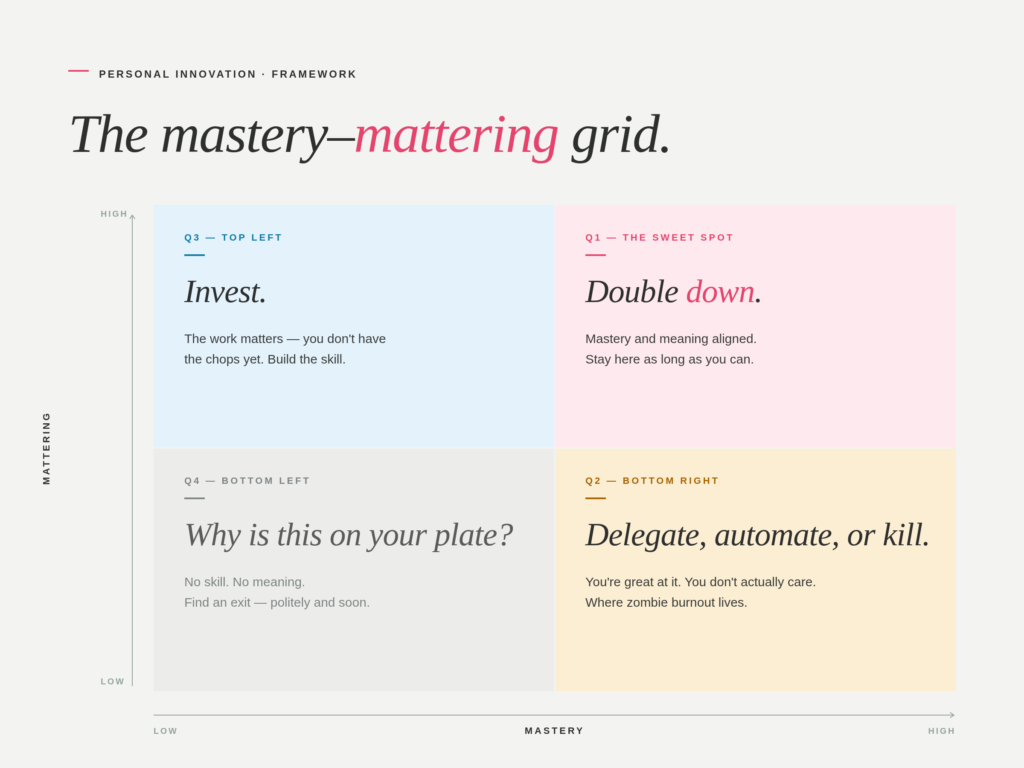
- High mastery + high mattering → double down here.
- High mastery + low mattering → delegate, automate, or kill it.
- Low mastery + high mattering → invest, learn, build the skill.
- Low mastery + low mattering → why is this on your plate at all?
Most of the work that’s quietly burning you out lives in the high-mastery, low-mattering quadrant. It’s the work you’re really good at and don’t actually care about. That quadrant is where your audit will pay you back the fastest.
One Honest Counterpoint
Purpose and meaning, though, are something deeply individual. It’s the Instagram-versus-reality view of the world. And you can just make it up. Researchers like Catherine Bailey have shown that manufactured purpose can backfire. The forced “we’re a family” speech. The contrived mission statement. The performative enthusiasm everyone has to fake. When meaning is performed instead of felt, it accelerates burnout. Bailey’s team calls this “existential labour,” and it’s a real phenomenon.
The Mattering Audit isn’t about manufacturing meaning. It’s about telling the truth about what’s already there. The audit only works if you’ll be honest with yourself: about what lights you up, about what doesn’t, and about what you’ve been pretending. It’s not something you need to share with anyone else. It’s for you.
Becoming the Person You’re Capable Of
The pivot under all of this is small, but it changes the shape of your work. Think about stop chasing “best.” Chase “better than the version of you who started.” That’s the real game of life. The “in-between.” It’s not the medal at the end of a race, it’s not the title on the door, and it’s not the next thing on the list. Just the next mile marker on a road that doesn’t actually have an end.
Michael Gervais also writes about Beethoven in his book. He wrote that: “When Beethoven let go of who he thought he was supposed to be, he became who he was fully capable of becoming.”
That’s the move we should all be aiming for. To stop performing the version of yourself someone else gave you. Start operating from the version of meaning only you can name.
Mastery without any purpose is just a recipe for stress with a fancy title.
Mastery with mattering is excellence. And excellence, as Stulberg reminds us, is your birthright.
Hit reply and tell me which question stung the most. That’s usually the one to start with.
Zombie burnout is a term Brad Stulberg uses in The Way of Excellence for the burnout that comes from doing too much work that doesn’t matter to you — not from doing too much work in general. Unlike traditional burnout, it doesn’t respond to rest. It responds to realignment.
Mastery is developing skill in activities you find worthwhile. Mattering is the sense that what you’re doing has significance — that your contributions are meaningful. Brad Stulberg argues excellence requires both. Most ambitious professionals over-invest in mastery and ignore mattering, producing hollow success.
Three signals. (1) On Sunday nights, you feel static rather than curious about Monday. (2) Someone with your skill set could swap in tomorrow and the work would still feel done — you’re substitutable. (3) You can’t finish “This work matters because…” without corporate jargon. All three together usually means the work has drifted from your values.
Most executive burnout isn’t from doing too much work — it’s from doing too much work that doesn’t matter to the person doing it. Maunz and Glaser’s 2024 longitudinal study found meaning and burnout co-evolve in a feedback loop: eroding meaning causes rising burnout, which further erodes meaning. Rest interrupts the fatigue but doesn’t break the loop.
The Mattering Audit is a 3-question diagnostic developed by Brian Tomlinson based on Brad Stulberg’s mastery + mattering framework. It takes 20 minutes. Questions: (1) The Sunday Test — curious or static about Monday? (2) The Substitution Check — would the work still feel like yours if someone else could do it? (3) The Significance Sentence — can you finish “This work matters because…” without corporate jargon?