

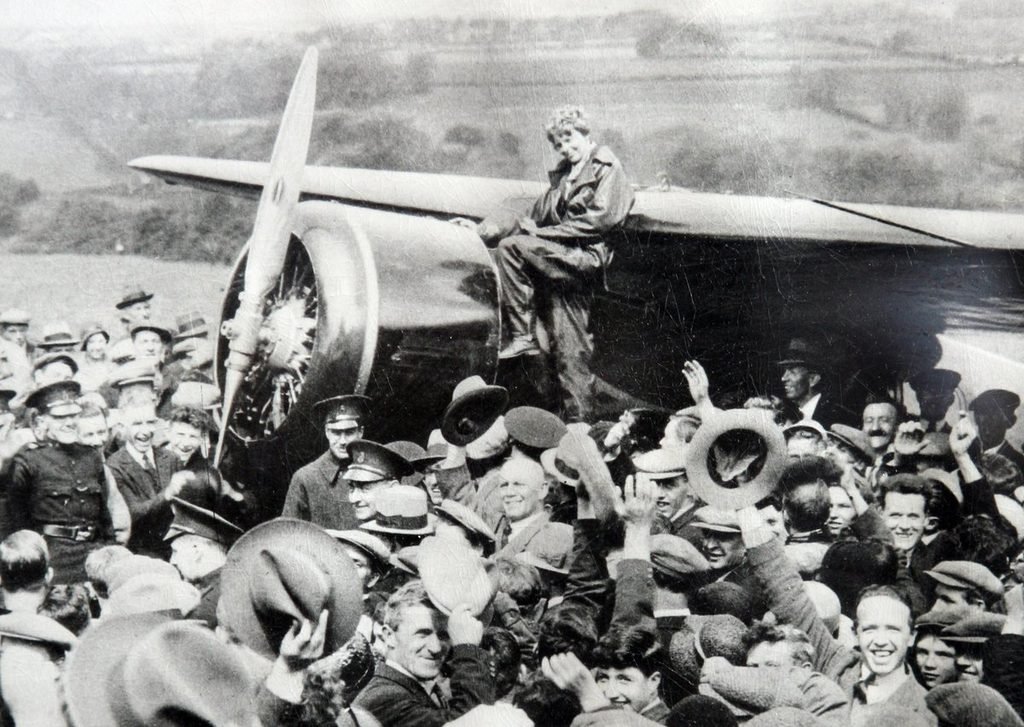
In May 1932, a woman climbed out of a plane in a field in Northern Ireland, and a farmer (who I only assume was bedazzled) asked her how far she had flown.
“From America,” she said.
Amelia Earhart had just become the first woman to fly the Atlantic alone. What we don’t hear enough about is that it was actually her second flight. She had made the crossing four years earlier as a passenger. On that flight, she wasn’t even allowed to touch the controls. Originally, another woman had been offered the seat first and decided the trip was too dangerous. Amelia then essentially said…hold my beer.
At that point, Earhart was already an experienced pilot. She could have simply said no and waited for a better offer. Instead, she said yes and negotiated to keep the logbook so she would have something to do and not be bored out of her mind.
That trip is what got her the resources to try again on her own flight. That seat that she almost turned down is the reason there was a second flight at all.
The experiments nobody puts in the history books
The rest of her working life, though, reads like a list of things that mostly didn’t work out.
Flying was expensive, so she took a job as a clerk at a telephone company. She started a portrait photography business with a friend. She started a trucking business with a different friend.
None of it seems to connect. But she described the thread running through it all as “the something inside me that has always liked to try new things.”
That kind of thing doesn’t show up in history books, which tend to prefer the version where a person knows who they are, knows what they want, and then goes out and becomes exactly that.
Hollywood, all in one.
I know something about that preference myself. I once spent seven years thinking about something I could have tested in the space of two weeks.
Why you can’t reinvent yourself by thinking about it
The way we talk about reinvention follows the same Hollywood script. Figure out who you want to be, then just go be it. Clarity, then movement.
Almost nobody’s life works like that, and there’s actually research that explains why.
Herminia Ibarra spent years studying consultants and investment bankers moving from analytical work into senior, client-facing roles. She published her findings in Administrative Science Quarterly in 1999 and expanded that work into a book called Working Identity. It turns out the people who successfully changed didn’t think their way to that change. They took action first. Side projects, temporary assignments, new surroundings, new people.
She calls the results provisional selves. Provisional, meaning nothing is promised. You’re just trying it on, like that new shirt that caught your eye.
According to her: “We learn by doing, and each new experience is part answer and part question.”
Which means someone who hasn’t done anything hasn’t learned anything. It doesn’t matter how long they’ve been thinking about it.
All the introspection in the world can only search through the experiences you’ve already lived. Ask yourself who you want to become next, and your mind goes looking through every job and every idea you’ve had in the past, and tries to assemble an answer out of that. It might even seem like a good answer.
But the past isn’t the place to build your next self.
The job I could evaluate and the idea I couldn’t
In January 2019, I started a new job at Engel & Völkers. The office was two months old. My son was five months old. I’d spent most of December on my back with pneumonia. I was excited to be on my feet and doing something new.
I was also carrying an idea for this very newsletter you’re reading right now.
I’d come out of a few roles where I was deep into digital transformation work, and I’d been watching how hard the technology change was on people. Colleagues who were great at their jobs, suddenly being asked to do something completely different. Very much like what most of us are experiencing with AI right now. And Engel & Völkers was heading down the road of its own digital transformation, which was a huge part of my role and what I found interesting in the first place.
So I had my idea. I knew the subject. I knew the reader. I’d watched the problem up close for a couple of years, and I even had a name I liked.
I published the first edition in 2025. Nearly seven years later.
A fork in the road sat in front of me that morning. The job was something I could evaluate: a salary, a team, a new market to learn, and a lot of possibility to move up the ladder. The newsletter was something I couldn’t evaluate at all. I had a good reason to write it, but at that point nobody had read anything. There was no evidence it would lead anywhere.
So I went with the one that was more certain, more tangible, more, to my brain at least, safe.
And underneath all of that was a second reason. I told myself that putting my thinking out in public every week wasn’t really for me. After all, I’m an introvert. And of course, what would my new boss and colleagues think?
I ended up staying at E&V for four and a half years. There were real problems to solve, a pandemic in between, and at some point we’d built a team that brought genuine value and was amazing to work with. I wouldn’t give those years back.
But.
The gut feeling was there the whole time. The brand itself was excellent. It just wasn’t mine.
There was no way to learn that from the outside. On paper it was a hell yes, and it would always have been a yes. I had to spend the time and have the experience to find out it was just a costume I was wearing.
Ibarra calls that stretch liminal. The old identity no longer fits, and the new one hasn’t arrived yet. She says it’s destabilizing rather than merely uncomfortable, and on that I have to agree with her wholeheartedly.
One-way doors and two-way doors
We’re taught to think first and act second. It’s what our parents tell us, hopefully to help us avoid doing stupid shit.
So we put a plan in place, and we measure everything. And good planning is absolutely essential when it’s done right. Pixar will run a story through 20 different versions before anyone animates a single frame.
But look at what that is. It’s not reflection. It’s simulation. It’s a way to find out what happens without paying the full price to find out.
Which suggests that running an experiment isn’t the opposite of planning. The experiment is the planning. It’s just that the corporate world leans more toward safety than toward innovation.
Jeff Bezos says that when organizations slow down their decision-making, they lose the ability to experiment. So he divides decisions into two types. One-way doors or two-way doors.
The one-way doors are high-impact, irreversible decisions. You don’t get to come back out. Two-way doors, on the other hand, are low risk, and you can turn around if you want to. You can walk through, test it out, and walk back if it doesn’t work.
Reinventing yourself feels like a one-way door, and that feeling is probably why so many of us stand in front of it for years. We treat everything as if it’s permanent, which ends up killing our speed, our creativity, and our impact.
Two weeks of anything is a two-way door.
What seven years of thinking actually cost
I wish I’d had that perspective at the time, because those years cost me.
“I wish I’d started earlier” is something a lot of people say without giving it much meaning. So let me be specific about what it means here.
It isn’t about what I would have written in that time. It’s about what would have compounded from what I’d written.
The skills I’d have built by now, because writing every week teaches you things that thinking about writing does not. The people who’d have found the work, and the rooms that would have opened because of it.
The lost compounding is the real cost, because that’s the one thing you can’t catch up on. You can work twice as hard. You can’t go back and start earlier.
What I didn’t see at the time, because probably like you, I’m not a fortune teller, is that my ideas would be better now. My thinking would be clearer. Publishing would have become a forcing function years earlier than it did, the way it is for me now. A deadline makes me think, write a sentence, erase it, and go find a better one.
That’s the trap, and I suspect it catches careful people far more often than it catches careless ones. Every one of those weeks would have created new experiences, new failures and new successes, all of which would have shaped who I was becoming.
Instead, I protected myself from finding out.
How to design a two-week identity experiment
Way back in the 1890s, William James wrote that “Action seems to follow feeling, but really action and feeling go together; and by regulating the action, which is under the more direct control of the will, we can indirectly regulate the feeling, which is not.”
In other words, you can’t think your way into feeling ready. Waiting on that feeling is just a polite way of shoulding all over yourself.
You can decide what you’ll do on Sunday. The feeling turns up afterward.
Seven years of saying I should write this newsletter produced nothing. The first Sunday I published marked the start of a body of work.
One of my favorite people on the internet is Anne-Laure Le Cunff. She burned out at Google, and afterward ended up running two experiments at once. Neither was a commitment. She started a newsletter called Ness Labs as a side project while beginning her PhD. That newsletter now reaches more than 100,000 people, and she’s a UKRI-funded researcher at King’s College London.
In her book Tiny Experiments (yes, she became an author as well), she replaces the typical goal with what she calls a PACT (Purposeful, Actionable, Continuous, and Trackable):
I will [action] for [duration].
The distinction underneath it is output against outcome. Her own illustration is a pact to “publish 25 newsletters over the next 25 weeks” rather than a goal to “get 5,000 newsletter subscribers in 25 weeks.”
The approach is very stoic in nature. One of those things is in your hands. The other is hope with a number attached to it.
“Success is showing up, regardless of the end result.”
A few things I keep in mind nowadays, after spending seven years procrastinating.
Curiosity is a low enough bar to start from. “Maybe I’m someone who teaches” is enough. It doesn’t have to be a conviction, and it doesn’t have to be pronounced to the world. Just be curious enough to try something. For example, right now I am looking into progymnasmata and motivational interviewing. Who knows what comes out of those interests.
Naming the duration in advance is what separates this from dabbling. You actually have to try something for a while. Adding a duration stops you quitting after one bad week, and gives you enough trials to trust what you find. You can’t tell whether or not people enjoy your writing by publishing one essay. If you’ve ever tried golf, you’ll know that one day at the driving range doesn’t define how good you will be at actually playing.
The signals worth watching are energy, competence, and pull. Did you have fun, or was it a pain in the ass? Were you any good, and did you get better? What sort of feedback did you get? Did at least one person say that you should keep going?
Action brings about changes you’d never expect.
Remember I told you I’m an introvert? I still am. But the story I built on top of that was wrong. Putting myself out there makes me far more visible than I’d naturally be, and it turns out that’s a good thing.
The experiments I’ve run found a capacity my reasoning would never have approved.
Right now, around 1,200 people read these words every week. Could it be more? Should it be more? My marketing brain says absolutely. Some weeks I feel that pressure. But I don’t stress it. I just get to writing and publish every week.
After all, I’m not trying to be an influencer. I’m trying to build trust and influence.
At some point, we have to remember that the work and the process are what create us. And a lot of that is done in the dark, not necessarily in an Instagram reel.
Earhart’s first Atlantic crossing was as a passenger who wasn’t allowed to touch the controls. She took that flight anyway, and she took notes.
Taking that seat is what got her the plane.
Nobody sits down and plans a career that way, and no advisor would ever hand you that advice. I suspect that if you’d asked her that year who she was going to become, she’d have sat back, thought about it for a while, and answered with something that had very little to do with what happened.
The question isn’t really who you want to be. That question has no answer available today.
It’s what are you going to do. Because that’s what determines your new identity.
To get there, you just need to choose an experiment.
So ask yourself: what are you willing to do for two weeks?
You’ll know more on the other side of that than seven years of thinking will ever tell you.
I’ve run both of those experiments. Only one of them produced the data.
FAQ
Introspection can only search experiences you have already lived. When you ask yourself who to become next, your mind assembles an answer out of your past, which is the one place your next identity has never been. Herminia Ibarra’s research found that people who successfully changed careers acted first and let the doing teach them.
A provisional self is a temporary version of yourself that you test in the real world before committing to it. The term comes from Herminia Ibarra’s 1999 research in Administrative Science Quarterly. Side projects, temporary assignments and new circles are all provisional selves. The word provisional matters: nothing is being promised.
Jeff Bezos sorts decisions into two types. One-way doors are high-impact and irreversible; once you walk through, there is no going back. Two-way doors are low risk and reversible: you can walk through, test it, and walk back out. Most decisions are two-way doors and get treated as one-way doors.
A pact replaces a goal with a commitment to an action for a set duration: “I will [action] for [duration].” It must be Purposeful, Actionable, Continuous and Trackable. The distinction is output versus outcome. Publishing 25 newsletters is a pact. Getting 5,000 subscribers is a goal.
Name a possible self you are curious about rather than committed to. Write it as a pact: “I will [action] for two weeks.” Name the duration in advance so one bad week doesn’t end it. Then watch three signals: energy, competence and pull. Keep it, iterate it, or kill it.