

Andre Agassi won eight Grand Slam titles playing a game he hated every single day.
Not “grew tired of.” Not “had a complicated relationship with.” Literally hated. The first sentence of his memoir, Open, reads: “I play tennis for a living, even though I hate tennis, hate it with a dark and secret passion, and always have.”
That’s a hell lotta hate.
His father, a former Olympic boxer, built a ball machine in the backyard, nicknamed it “the dragon,” and made young Andre hit 2,500 balls a day. That works out to be around a million a year. The theory was that a child who hits a million balls a year becomes unbeatable. The theory worked. The boy became one of the best on earth at a thing that was never his idea.
The unbelievable part of that story is that a person can spend thirty years being world-class at an identity somebody else handed him, and not notice the handwriting isn’t his.
That’s not a tennis story. That’s most people’s careers.
The belief that keeps us stuck is that we need more. More confidence, more skill, more discipline, and then we’ll charge what we’re worth or finally put our work out there. Unfortunately, the “more” rarely arrives. And when it does, it tends to bounce off. The reason it does has nothing to do with your skills. It’s a much deeper and quieter challenge than that. It’s quite simply the fact that you can’t outperform a self-image that you didn’t create yourself.
A few things stand out about why that’s true.
A self-image behaves like a thermostat, not a mirror
We treat our self-image as a description of who we are. But it acts more like a setting that pulls us back.
Maxwell Maltz noticed this in 1960. He was a plastic surgeon, and he kept meeting patients who got the face they’d wanted for years and still felt exactly as they did before. Their nose changed, but the way they felt inside didn’t. He decided that we each carry a self-image that regulates results the way a thermostat regulates a room. Go above the setting, and something cools you down. Drop below it, and something warms you back up.
James Clear, writing about identity-based habits, says that “the real reason you fail to stick with habits is that your self-image gets in the way.” Modern self-concept research says that a stable, coherent sense of self produces stable, consistent behavior, and we drift back toward it under pressure.
This is why the course, the AI workflow, and the new title all fade away after a few weeks. You might assume that you ran out of willpower. More than likely, you ran past your setting, and the setting won. It usually does, because it’s underneath every quiet decision about what’s realistic for someone like you.
A price reverts to its mean. So does a person who never changed the mean.
Most people are running a self-image someone else wrote
The uncomfortable part of this situation is that you mostly didn’t choose the setting.
Here’s what I mean. Let me ask you a question, stay with me here. How do you load a new roll of toilet paper, over the top or tucked under? More than likely, you do it the way you watched a parent do it, and you’ve never thought about it again. My dad loaded it one way. My brothers still load it that way today. I’m the only one who flipped it, and only because I decided his way was a little ridiculous. That’s conditioning. You absorb a default, carry it for life, and never notice that it was handed to you. Now scale that up from toilet paper to what you believe about who you are. The scary part of all this is that most people never once think about these tiny details.
Marshall Rosenberg, who created Nonviolent Communication, said that: “We are not our stories. These stories are self-created fictions that remain intact through habit, group coercion, old conditioning, and lack of self-awareness.” Habit. Group coercion. Old conditioning. That’s a parent, a boss, a coach, a teacher who graded you at fifteen, a performance review from 2019. All of that is a bunch of other people holding the pen and writing the story of your life.
The developmental psychologist Robert Kegan spent a career measuring this. He found that only about a third of adults operate from what he called a self-authoring mind, where you’ve written your own values and can hold other people’s expectations up and judge them. The rest run on a “self” the world assembled for them. Marcia Baxter Magolda tracked graduates and found roughly 2% had reached self-authorship by their senior year, and about 12% a year after that.
Round it off, and the picture you get should scare you. Most capable, intelligent, successful adults are running a self-image that other people wrote, and calling it “just who I am.”
The funny part is that we don’t only inherit the script. We protect it. The psychologist William Swann documented something he called self-verification: people seek out feedback that confirms what they already believe about themselves, even when the belief is unflattering. We would rather be reliably “not a leader” than be confusingly told we might be one. This is also why affirmations slide off. Tell yourself you’re a magnetic founder while your setting says otherwise, and your mind files the gap as a lie and goes looking for proof of the original.
The old story pays a dividend. The dividend is that it feels like home. It feels like it must be true.
Why an unexamined self-image depreciates
For most of history, you could run on a borrowed self-image your whole life and never really have to worry about it. That’s changing, and AI is moving up the due date.
When you lose a role you’re fused to, it doesn’t register as a job change. It registers as a shock to the self. (I’ve been on the wrong end of that call, and I wrote about how to heal after a layoff when it happened.) One of the landmark papers on it is titled, plainly, “Job Loss: Hard Times and Eroded Identity.” Because we build the self out of roles, losing the central one cracks the base. And we tend to pour that base early. A study following adults across midlife found that commitment to an identity you never actually examined peaks around age 36. Right when the career is supposed to be at full speed.
We see that now, with unprecedented job loss. It’s no longer good enough to just be good at your job. More and more, we are going to find that skills are commodities. A self-image you actually own is an asset, and assets are what hold their value when the market turns.
Every year you don’t author your own, you take on a little more identity debt. Layoffs and AI shifts are just the dragons that we’ll need to fight if we want to be the heroes of our own story.
Re-authoring is an accounting change, not a pep talk
Now for the good news. A self-image that was written can be rewritten.
Zig Ziglar said that “Nobody is born a doctor or a lawyer or a salesman, yet those people clearly exist, so somewhere between birth and death, by choice and by training, they become what they wish to become.” I dig that. It means that you, my friend, are in charge. You are the author. It might be slow and on purpose, but you are in charge nevertheless.
The former NFL running back Curtis Martin shocked many people during his Hall of Fame speech. He called himself “a running back who didn’t like to run, and still doesn’t.” He never wanted to play. When the Patriots (Go PATS!) drafted him in 1995, his first honest thought was “I don’t want to play football.” Then someone reframed it for him: maybe the game was just the vehicle for everything he said he wanted to do for other people. He didn’t quit, and he didn’t change the job. He changed the author. Eleven years and a gold jacket later, that choice held firmly.
The research here is genuinely hopeful. Hazel Markus and Paula Nurius described “possible selves,” the future versions of you that you hope for or fear, and found they steer behavior, but only when they’re specific and attached to a real plan. Daphna Oyserman ran a program with struggling middle schoolers. One group got the usual support. The other spent time getting specific about the future person they wanted to become, then mapped the small, concrete steps to get there. Two years later, that second group was doing more homework and earning better grades, and the gains were still holding. The students who worked only on behavior, without touching identity, drifted back to where they started.
A separate study ran the same play with senior executives. Coaching that dug into their values and the kind of person they wanted to be left them far clearer about who they actually were. Change the story underneath, and the behavior follows. Work on the behavior alone, and it snaps back to the old story.
Be clear about the mechanism. Affirmations and reading “The Secret” won’t move it, and visualization won’t either, at least not on its own. The mental-rehearsal studies are clear that picturing works only when you pair it with real practice and real feedback. What moves the setting is authorship plus evidence. You write a truer line, then you go earn proof of it.
Before you decide you already know who you are, sit with one number. The organizational psychologist Tasha Eurich ran a multi-year study and found that 95% of people believe they’re self-aware, while only 10 to 15% actually are. The exercise below takes twenty minutes and tells you which group you’re in.
The Self-Image Audit
It’s four steps. The first three take about twenty minutes. The fourth takes three weeks.
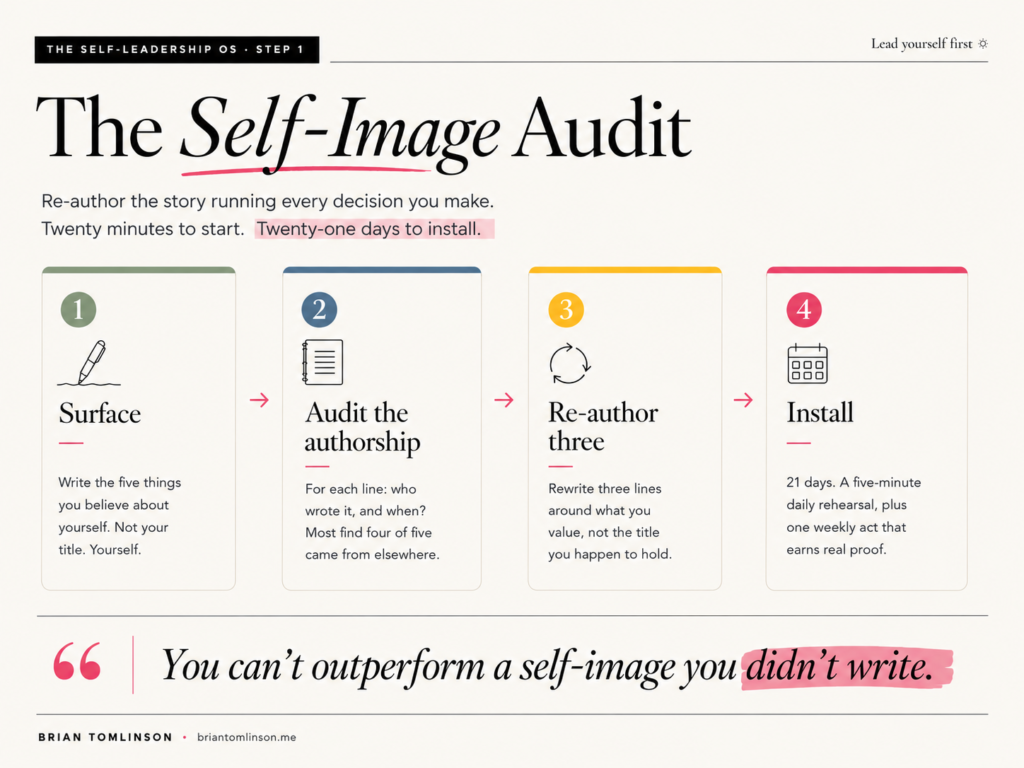
Surface. Write down the five sentences you believe about yourself. Not your job title. The five lines about who you actually are. The professor Robert Yagelski has a line I love: “the self exists in the process of writing; it’s a becoming.” You don’t really know what you believe until you see it on the page, so get it on the page first.
Audit the authorship. Go back to each line and ask three questions. Who wrote it? When did it get written? Does it trace back to a job, a title, or someone’s review of you? Be honest about the origin. Most people find that four of their five came from somebody else.
Re-author three. Pick three of those lines and write them again yourself, anchored in what you actually value instead of the title you happen to hold. So “I’m a project manager” might become “I’m the person who turns a mess into a plan people can follow.” Mark Manson makes the case that your identity is mostly the sum of what you value, so when your values change, who you are changes with them. A line built on a title expires the day the title does, but one built on what you value goes wherever you go.
Install. Give it 21 days. Each morning, spend five minutes rehearsing your new values, and once a week, do one small thing that proves it true. James Clear puts it well that “every action you take is a vote for the type of person you wish to become.” This isn’t about repeating the line until you believe it. You have to take some form of action over the course of those three weeks. You’re stacking up small, real pieces of proof until what you’re doing stops feeling like a stretch and starts to feel like a fact. It’s the same engine behind building a visible body of work, just pointed inward first.
What was always true
Go back to those five sentences. Some are yours. Some were handed to you so long ago you stopped seeing the seams, the way Agassi couldn’t see for thirty years that the racket was never his idea.
What changed for him wasn’t that he stopped hating the work. It’s that he eventually picked up the pen and took charge of his own story. He built a school and found work that aligned with his own values rather than his father’s math. He wrote the back half of his life himself.
This has probably always been true. Your self-image is the one document running every other decision you make, and for most of your life, other people have been editing it without asking. The only real question is whether you ever take the pen back.
So take it back. Lead yourself first.
Because your self-image acts like a thermostat. When your actions run ahead of how you see yourself, you drift back to the old setting. Lasting change requires updating the self-image, not just the behavior.
Most of what you believe about yourself was shaped by parents, bosses, teachers, and past reviews, absorbed without conscious choice. Robert Kegan’s research suggests only about a third of adults operate from a self-authored identity.
Not through affirmations. Through authorship plus evidence: write a truer, values-based statement of who you are, then take small repeated actions that prove it. Identity-based interventions outperform behavior-only ones in the research.
A four-step exercise: (1) Surface the five things you believe about yourself, (2) Audit who actually wrote each one, (3) Re-author three around your values, (4) Install over 21 days with daily rehearsal plus weekly evidence.
Only partly. Mental rehearsal studies show that visualization improves performance when paired with real practice and feedback. On its own, it does little to change a deep self-image.