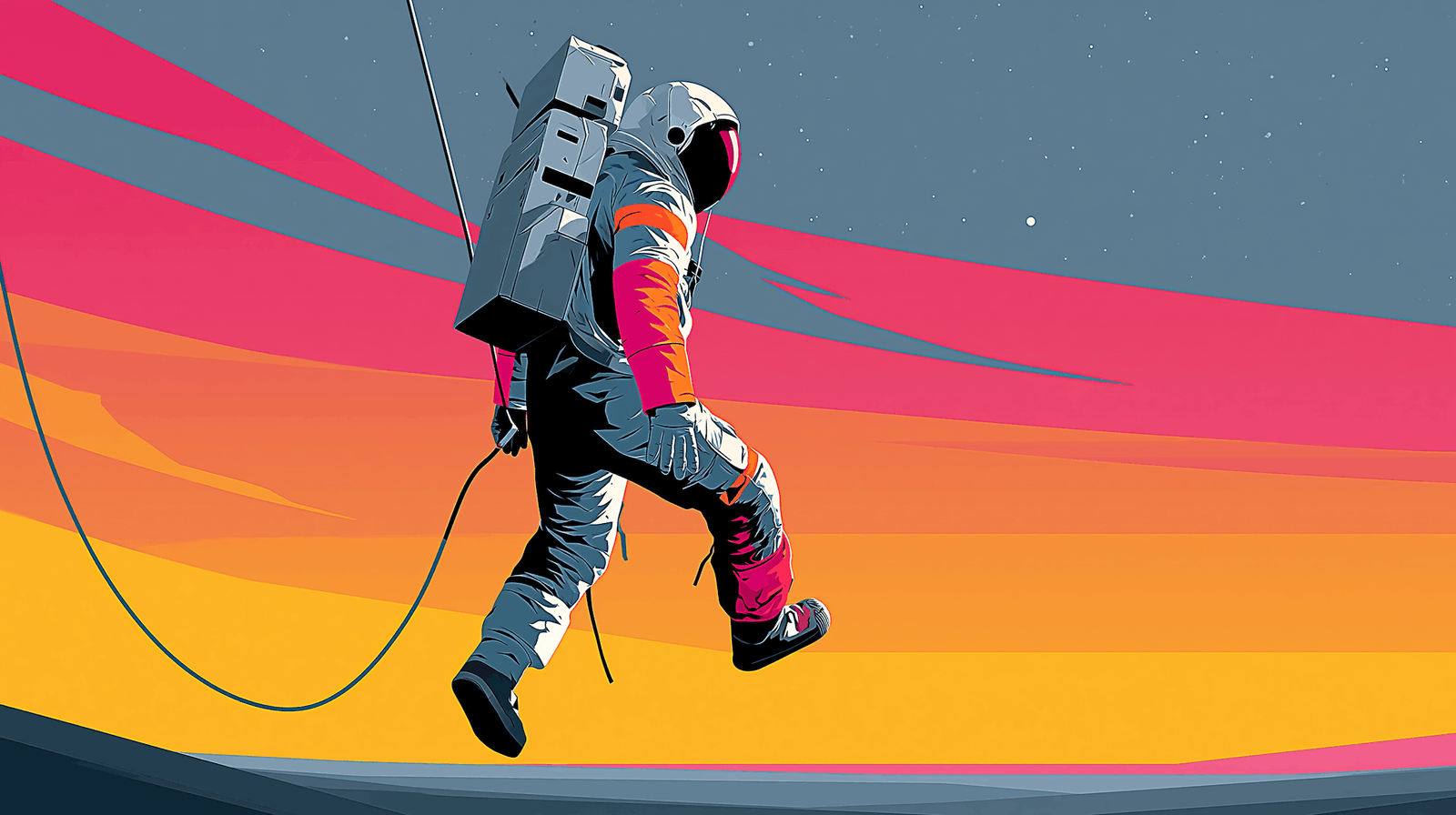
In April 2001, Chris Hadfield was holding onto the side of the International Space Station with one hand, 250 miles above Earth, when he went blind.
He was on a spacewalk, installing a robotic arm, when a drop of cleaning solution drifted off his visor and into his left eye. It turns out that in zero gravity, tears don’t fall. The contamination grew into a ball, rolled across the bridge of his nose, and stung his other eye shut, too.
So now he’s blind, in a spacesuit, in the vacuum of space, with one hand on the only thing between him and the longest fall there is.
His actual thought, in his own words, was: “I thought, well, maybe that’s why we have two eyes, so I kept working.”
He vented the contamination through a valve, waited for his vision to clear, and finished the job. Years later, while giving a TED Talk, he explained what led him to keep working while blind. “The danger,” he said, “is entirely different than the fear.”
I wanted to be an astronaut as a kid. Maybe you did too. I never made it past the dream. But I’ve thought about Mr. Hadfield’s sentence quite a bit, because when I reflect, it explains most of the times I’ve been stuck.
When I played football, I worried about stinking it up in big games. I’ve made mistakes at work and worried that maybe I’d get fired. When I got laid off, I worried about how I would feed my family. In most cases, it’s always fear that’s talking, and the danger that we are facing tends not to be as big.
A few things about how astronauts handle this transfer cleanly to people who will never leave the ground.
Fear and danger are two different problems
Fear is the “feeling” about what’s happening in front of you. It runs hot, loud, and early. Danger is the actual stakes: what can really go wrong, and how bad it really is. We tend to treat the two as one signal. They almost never are.
John Glenn found this out in 1962, becoming the first American to orbit Earth. Mission Control got a warning that his heat shield might be loose, which would mean he would burn up on reentry. He rode the fireball, watching flaming chunks fly past his window, kept his voice level, and flew the capsule down. The transcript catches it: “This is Friendship 7. I think the pack just let go.”
The warning was a faulty sensor. The shield was never loose. The fear was real, and the danger was imaginary, and the only way to tell them apart was to stay methodical long enough to find out.
Most of the things that spike your fear are faulty sensors, too. A “no” you have inflated into a catastrophe. The trick is not to feel less. The trick is to check the reading.
How astronauts turn fear into a procedure
Chapter six of Hadfield’s book is titled, literally, “What’s the Next Thing That Could Kill Me?” (The book is called An Astronaut’s Guide to Life on Earth: What Going to Space Taught Me About Ingenuity, Determination, and Being Prepared for Anything if you’re curious.) That is the working question of his whole profession. You don’t hope nothing goes wrong. You name the next lethal thing and rehearse your response until it becomes automatic.
NASA takes this pretty seriously. To the point where it sounds almost morbid. They run “death sims,” drills that open with Mission Control announcing the astronaut has died, and then everyone works the problem. Hadfield once invited his own wife to sit in on one. Even your worst case becomes a problem you can plan for, which strips away most of its power to scare you. The Navy SEALs say something similar. Brandon Webb writes in Mastering Fear: “You don’t prepare for what will happen. You prepare for the hundred things that could happen but probably never will.”
The part I find most interesting, though, is that this isn’t astronaut folklore. People in lab coats have measured it for decades. In 1996, a team led by Tina Saunders pooled 37 studies on stress inoculation training, covering more than 1,800 people, and found that practicing under controlled, graded stress reliably lowered anxiety and improved performance when the real pressure hit. Or, if you’re into sports, it’s why some coaches make training harder than any game.
Gary Klein turned the same idea into a boardroom tool in Harvard Business Review: assume your project has already failed, then write down every reason why. It works because of a finding from Deborah Mitchell in 1989. Imagining a failure has already happened, rather than that it might, improves your ability to name the real reasons for it by about 30 percent. Your brain searches backward better than it predicts forward. The Stoics understood this 2,000 years ago and called it premeditatio malorum, or the premeditation of evils. Essentially, thinking about all of the ways things could go wrong in order to prepare yourself.
Now I’m not saying that sending a cold email or walking up to talk to a stranger is a spacewalk. The stakes aren’t even close. But your nervous system can’t really tell the difference. It triggers the same alarm whether the threat is the vacuum of space or a polite rejection, which is why a method built for the vacuum still works for real life.
Readiness is manufactured, not something you wait for
We treat readiness like a feeling that arrives on its own, so we wait for it. It doesn’t arrive, and waiting is the most expensive thing you can do with a fear. Readiness is something you prepare for. Webb says it well: “Ready does not mean you’ve removed all uncertainty. All ready means is you’ve suited up and mounted your horse. Now it’s time to ride.”
Neil Armstrong was living proof of this approach. In 1968, testing the contraption astronauts called the Flying Bedstead, his controls failed, and he ejected at roughly 200 feet, a fraction of a second before the machine hit the ground and burned. An hour later, fellow astronaut Alan Bean found him at his desk doing paperwork. As Bean told it in NASA’s history: “I can’t think of another person, let alone another astronaut, who would have just gone back to his office after ejecting a fraction of a second before getting killed.” The near-death experience didn’t get to reorganize his afternoon because he had already rehearsed some version of it in his head.
That’s what composure actually is. We might watch someone stay calm under pressure and tend to think it’s a personality trait, but it’s usually more a function of memory. Mike Massimino, repairing the Hubble telescope with the whole world watching, stripped a critical bolt and froze. He managed through that situation with a thirty-second rule: feel the fear fully inside a set time window, then close the window and go back to the checklist. He scheduled the emotion instead of letting it get loose.
Here is the procedure, scaled down to the basics:
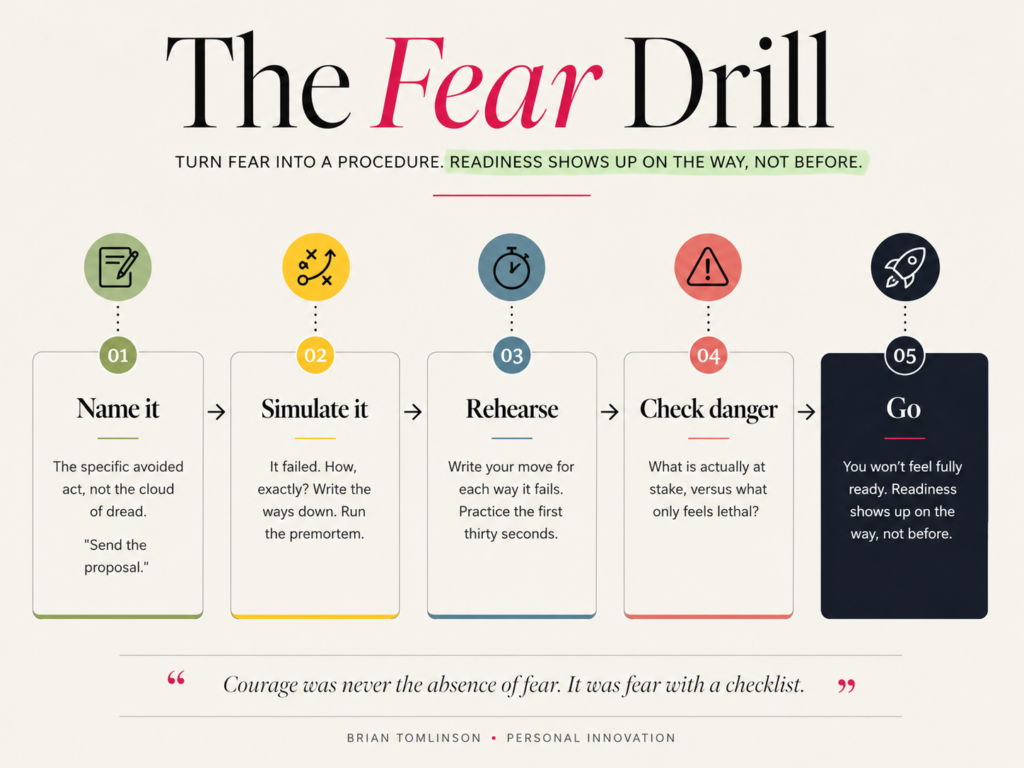
- Name it. The specific avoided act, not the cloud of dread. “Send the proposal.” “Say the number.” “Publish the piece.”
- Simulate it. It failed. How, exactly? Write the ways down.
- Rehearse the response. Write what you’ll do for each one. Practice the first thirty seconds, because that’s where panic wins or loses.
- Check the danger. What is actually at stake, versus what only feels lethal?
- Go. Ready shows up on the way, not before.
It runs the same when you ask someone out on a date, when you ask for the raise you’ve earned, and on the work that makes you visible in a way that feels exposed. Readiness is the output of the drill, the same way a minimum viable system beats a perfect plan you never start.
The drill is the easy part. Knowing what’s worth the fear is the hard part.
Webb’s roadmap ends with a question rather than a technique: do you actually know what matters to you? He tells the story of a man caught in a riptide with a shattered leg, panic pulling him under, until one thought cut through. He had to make it home for his son’s first birthday. His fear didn’t go away. Instead, he gave it a direction.
And here we are. Walking into a world where AI can draft you an email. It can write you a book, and many people even use it as their de facto therapist. But what it can’t do is tell you which fears are worth taking action on. That judgment, the taste for what is actually yours to do, is the human part, and this awareness will become more valuable as the tools get better. AI doesn’t hand you clarity. It amplifies whatever clarity you already brought.
John Boyd, the fighter pilot whose thinking I come back to often, used to give the people he mentored a choice. To be somebody, or to do something. The thing you’re avoiding is that choice. It feels like a question about whether you’re ready. It’s actually a question about whether you’ll move forward.
The part that was always true
Hadfield certainly didn’t feel ready to go blind in space. Nobody could. Hell, I get a bit antsy walking in the dark to the bathroom in the middle of the night. But he had rehearsed the loss of everything so many times that when his sight went, his first thought was a shrug and a joke, and his hands just kept working.
If you take away the spacesuits, this was never really about astronauts. Fear is older than any job, any platform, any tool we’re nervous about today. The people who learn to run a drill on it instead of waiting it out have always had an edge, and they always will.
Courage was never the absence of fear. It was fear with a checklist. You don’t wait to feel ready. You run the drill, and ready comes to meet you.
Astronauts don’t try to feel fearless. They separate fear (the feeling) from danger (the actual stakes), then rehearse the failure in advance until their response becomes automatic. NASA even runs “death sims” that drill the worst case. The method is a procedure, not a personality trait, and it scales down to everyday risks.
Fear is the emotional signal about what might happen. It runs early, loud, and often inaccurately. Danger is the actual stakes: what can really go wrong and how bad it would be. Most avoidance comes from letting fear impersonate danger. The fix is to check the real downside instead of reacting to the feeling.
A premortem, popularized by decision researcher Gary Klein in Harvard Business Review, is a planning exercise where you assume your project has already failed and write down every reason why. Research by Deborah Mitchell (1989) found that imagining a failure as already happened improves your ability to identify its real causes by about 30 percent.
Stress inoculation training is practiced under controlled, graded stress, so real pressure feels familiar. A 1996 meta-analysis by Tina Saunders and colleagues pooled 37 studies covering more than 1,800 people and found it reliably lowered anxiety and improved performance under stress. It’s the civilian version of what astronauts do in simulators.
Stop waiting to feel ready, because readiness is manufactured, not awaited. Run a five-step drill: name the specific avoided action, simulate how it fails, rehearse your response, check the real danger versus what only feels lethal, then go. Readiness shows up on the way, not before you start.