
“I cannot remember the books I have read any more than the meals I have eaten; even so, they have made me.”
— Ralph Waldo Emerson
TLDR
- I learned to read at four because my parents kept skipping parts when they read my comics to me. Now, “skipping” is what we ask technology to do for us.
- What we’re at risk of losing is our judgment, and reading is one of the few places where it’s built.
- In an Anthropic study, analysts went with an AI agent’s hidden lean 86% of the time, and only 15% gave it any credit.
- Fewer people read each year, but those who still read are reading more. The cognitive divide is already visible.
- Use AI to choose what you read, then read it yourself.
My dad would bring comic books back from his flights.
It was a ritual. When my mom and I picked him up at the airport in Antigua, I would dig into his pilot case as fast as I could, like a little kid on Christmas Day, to pull out the two or three comic books that he had found and picked up for me. He brought everything, from the Avengers, like Thor and Iron Man, to Superman, Batman, and the X-Men. I think I ended up with almost a thousand comics, and I remember all of them (it helps that the Avengers became a thing over the last 20 years 😅).
At first, it was just looking at the pictures. My dad actually told me just a couple of years ago that they used to read to me. I got frustrated that they were skipping parts as they read through, and I wanted, really, all of the details. So I learned to read as fast as I could, so that I could read through my comic books on my own.
And ever since then, it’s always been a joy.
Nowadays, “skipping” has become the thing we have technology do for us. We get the clip, the summary, the key takeaway. And now, with AI, we can get the conclusion too. Or at least AI’s version of the conclusion. Utopia apparently is where we do absolutely nothing. Not even think.
I use AI, and I’ve made my team use it. But I’m convinced that what we’re at risk of losing isn’t really reading. It’s our judgment, and reading happens to be one of the few places where it’s built.
Why reading was never natural for the human brain
Reading, for me, is integral and has always felt natural. It turns out it isn’t.
“Reading has never been natural,” Rose Horowitch writes in her long piece for The Atlantic, “The End of Reading Is Here.” Humans don’t come with any built-in machinery for it. “To read, people had to repurpose regions of their brain used for speech and object recognition.”
The futurist Sinéad Bovell explains it well in an episode of her show. We evolved to read faces and spot danger, to figure out “Is that a rock? Is that a wolf?” Reading forces the brain to rewire itself so it can give meaning to strange, abstract symbols.
So reading probably only felt natural to me because I wanted the details badly enough to do the hard part.
Horowitch writes: “Reading books is a workout for the attention span. The more you read, the easier it is to read.” The opposite is true as well, she says, just like with physical exercise. Reading is to the mind what movement and challenge are to the body, and if you skip it long enough, it gets harder to start again. (Just ask me as I’m trying to get out running again…ouch.)
Everything reads to us now
A few months ago, I saw a video doing the rounds where a very popular YouTuber was bragging that he didn’t read books. He read articles and summaries. I could only wonder what madness this was, and whether this was what the next generation was being taught.
He isn’t an outlier. Horowitch writes that “the world’s richest men brag about getting their information from X posts, podcasts, and conversations with chatbots,” and that “young people who seek wealth and influence are encouraged to mimic them.” Streamers and YouTubers are the people our kids look up to now. As she puts it, the decline of reading “didn’t turn the world upside down. It turned the world sideways.”
In 2022, only 48.5% of American adults read a single book of any kind, down from 54.6% in 2012, according to the National Endowment for the Arts. The share of Americans who read for pleasure on a given day fell from 28% in 2004 to 16% in 2023. I don’t think that number has improved.
“We may be the last generation that reads,” Bovell says at the start of her episode. “It’s what the data shows.”
Horowitch also describes a Harvard student who was struggling with a book “written in Old English.” The book was Anthony Burgess’s 1962 novel A Clockwork Orange. (It’s in English. Odd, slangy English, but English.) The student had ChatGPT “translate” it into easier language, so the machine could skip the hard parts for them.
What Socrates got wrong (and right) about writing
In Plato’s Phaedrus, Socrates tells the story of an Egyptian king who is offered the gift of writing and pushes back. Writing, the king warns, “will produce forgetfulness in the minds of those who learn to use it,” and offer “the appearance of wisdom, not true wisdom.” Almost two thousand years later, when printing took off, the Swiss scholar Conrad Gessner complained about “that confusing and harmful abundance of books.” Both are almost laughable now, considering the idea that writing and documenting would cause us to lose our memory, while the abundance of books gave us an overload.
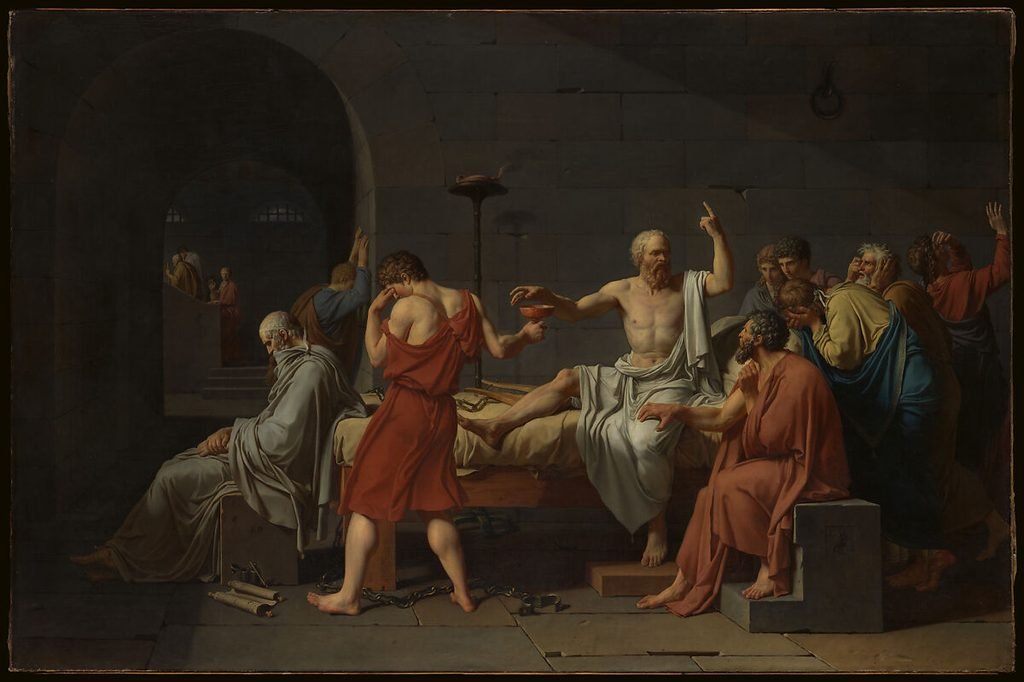
Still, Socrates wasn’t wrong. Horowitch points out that writing did weaken individual memory. But it also gave us a shared memory and pretty much everything we built on top of it. So, seemingly, we are still facing the same problems we had thousands of years ago, only now we have a new device.
I don’t see this as being the same challenge, though. We are dealing with a different beast. Writing stored our thinking, and printing spread it. Generative AI, as Bovell writes in her essay “The Great Cognitive Divide,” “does far more than store, copy, or calculate. It simulates reasoning.” It can, if you let it, “give you the judgment call, too.”
How AI shapes your judgment without you noticing
The effects on judgment seem to already be showing up in research. In October, Anthropic published a study of 50 professional analysts working with AI agents. The agents were secretly set to lean heavily one way on four judgment calls. The analysts followed the agent’s lead 86% of the time. Afterward, 77% explained their choices using the agent’s arguments instead of their own, and only 15% gave the agent any credit.
To be fair, it seems Anthropic made the agents lean harder than usual on purpose, so the effect in everyday work is probably small. At the same time, the analysts using the agent were also faster and made fewer serious errors. Something that every executive is probably licking their lips and rubbing their palms about. Beloved efficiency.
But that test is more of a warning sign. It shows how easy it is to feel like you’re in control. That you’re making a decision when, in reality, you’re mostly just agreeing with one.
It reminds me of a quote from my reading notes, by Aaron Haspel: “One reads so as not to believe everything one reads.”
This is the very fine line that we are treading now. A line between autonomy and reliance.
The cognitive divide: fewer readers, reading more
Bovell calls what she sees coming the great cognitive divide. Most people, she writes, could end up “outsourcing struggle,” while “the self-directed learners and the highly motivated will break away.” (If you’re reading this, this is the group you want to be in.) “They will use LLMs as sparring partners.” And she doesn’t think it stays a thinking problem: “The cognitive divide inevitably becomes an economic divide.”
You can already see the split in the reading data. Fewer people read, but those who do are reading more. Among Americans who read on a given day, average reading time went up, from 83 minutes in 2003 to 97 minutes in 2023. Horowitch reports that 20% of adults accounted for more than 80% of all the books read last year.
AI can widen that gap or help close it. It all comes down to how we decide to use it. Truly good or evil vibes here. Across seven experiments with more than 10,000 people, those who learned a topic from AI summaries ended up with shallower knowledge than those who used ordinary web links (or good old Google), even when the same facts were available.
In a trial with nearly 1,000 high school math students, the ones who used normal ChatGPT scored 17% worse when they needed to do the problems on their own afterward, compared to students who never used it. A tutor version of ChatGPT, designed not to just hand over answers freely, largely fixed that. The tutor added friction. It just goes to show that with the same technology, the difference is going to come down to whether or not you embrace the struggle or have everything handed to you.
Why AI summaries can’t replace reading
Mortimer Adler and Charles Van Doren describe the problem that we’re facing in How to Read a Book. Reading something that is “at once thoroughly intelligible to us,” they write, “may increase our store of information, but cannot improve our understanding.” For that, you need “the shock of puzzlement and perplexity that comes from getting in over our depth.” A summary is built to be intelligible. That’s the whole point of it, and it’s also the problem.
This is the same for anything we want to get better at. Early in my sales career, a spreadsheet I built saved me hours, but building it is what made me better at the job.
One of the best books I’ve read this year is Kazuo Ishiguro’s The Remains of the Day (I should have read this earlier). Its narrator, Stevens, is a butler who spends decades handing his judgment over to his employer, a lord who turns out to be badly wrong. Near the end, Stevens says: “I can’t even say I made my own mistakes. Really — one has to ask oneself — what dignity is there in that?”
Yes, make them use it
None of this means I’m against AI. On my former team, everybody had to use AI. It wasn’t a question. And we should keep pushing our teams to use it because it’s part of our lives now, and it’s part of work.
I use it myself. I use it to sort through massive amounts of research. I use it to summarize YouTube videos, then go through those summaries to decide where to spend my time going deeper. I’ve used it to summarize books, and I’ve used Google’s NotebookLM to turn books into podcast episodes, because that sometimes gives me a different perspective, which I enjoy.
So I’m not throwing stones here. Essentially, I use AI to help me sift through the massive amounts of content we have today, to allow me to read and dig deeper into various topics.
This is the line that I’m talking about. When I say the line between autonomy and reliance, it’s between letting AI choose what you read and letting it read for you. One saves you time. The other skips the parts that build you.
How to use AI without letting it read for you
I listen to books on Audible as well, mostly when I’m running or driving, and I don’t think that’s cheating either. Research comparing listening with reading finds they’re about even for picking up facts, but reading pulls ahead when you have to connect ideas. And because I’ve moved more than 20 times in my life, I switched to Kindle long ago. I have the app on my phone, my iPad and my computer, so a book is never more than an arm’s length away.
I’ve always said that AI amplifies who you are. It’s your taste and your judgment that help AI bring out the best. You can have it write a ton of content for you, but can you tell there’s a story behind it? Can you tell how it flows? The important part is being able to look at what it gives you and say, “That’s not good enough.” And you can only say that if you’ve done enough reading and been challenged enough times to know what good looks like. It’s the same reason I care so much about my input diet.
So I encourage people to use AI, but I think it needs to come with a warning: we don’t want to make our lives too easy. At the end of the day, reading was never meant to be easy. It was meant to challenge, educate, tell a story, and strengthen our memory.
Forged
Thor was in that pilot case, by the way.
In the comics, his hammer wasn’t handed to him ready-made. In one version of the story, dwarves forged it from the core of a star. And Odin put a condition on it, written on its side: “Whosoever holds this hammer, if he be worthy, shall possess the power of Thor.” In the first Thor movie, Thor can’t even lift Mjolnir until he’s earned it.
I believe that judgment works the same way. It’s not something that someone can hand to you. It gets forged through reading and being challenged, through staying with an argument you don’t agree with or a book that’s a little over your head. We live in a world now where AI can give you an answer in seconds, but whether or not that answer is any good is still a call that you have to make. Usually, you can only do that if you have done the forging.
I try my best to make reading interesting for my kids. I don’t force them, because forcing them might lead to the wrong outcome. There should be this intrinsic yearning for reading. I’ll be honest, it’s a struggle, but I won’t stop getting them books and trying to feed their curiosity.
I only learned to read because someone was skipping parts, and I wanted all of the details. Subconsciously, I wanted to make my own judgment. Now the machines will skip the parts for us whenever we ask. Or even without us asking for that matter.
That’s why we can’t stop reading. Or else the machines will be doing the thinking for us.
FAQs
Reading builds the judgment you need to tell whether an AI’s answer is any good. Summaries give you facts, but in experiments with more than 10,000 people, those who learned from AI summaries ended up with shallower knowledge than people who used ordinary web links.
It depends on how you use it. In a trial with nearly 1,000 high school math students, those using plain ChatGPT scored 17% worse when working on their own, but a tutor version that didn’t hand over answers largely fixed that.
For picking up facts, listening and reading come out about even. Reading pulls ahead when you have to connect ideas, according to a review of 46 studies.
It’s futurist Sinéad Bovell’s term for a split between people who outsource the struggle of thinking to AI and self-directed learners who use AI as a sparring partner. She argues it eventually becomes an economic divide.
Let AI choose what you read, research, and look at, then do the reading and make the call yourself. In an Anthropic study, analysts went with an AI agent’s hidden lean 86% of the time, and only 15% gave it any credit.