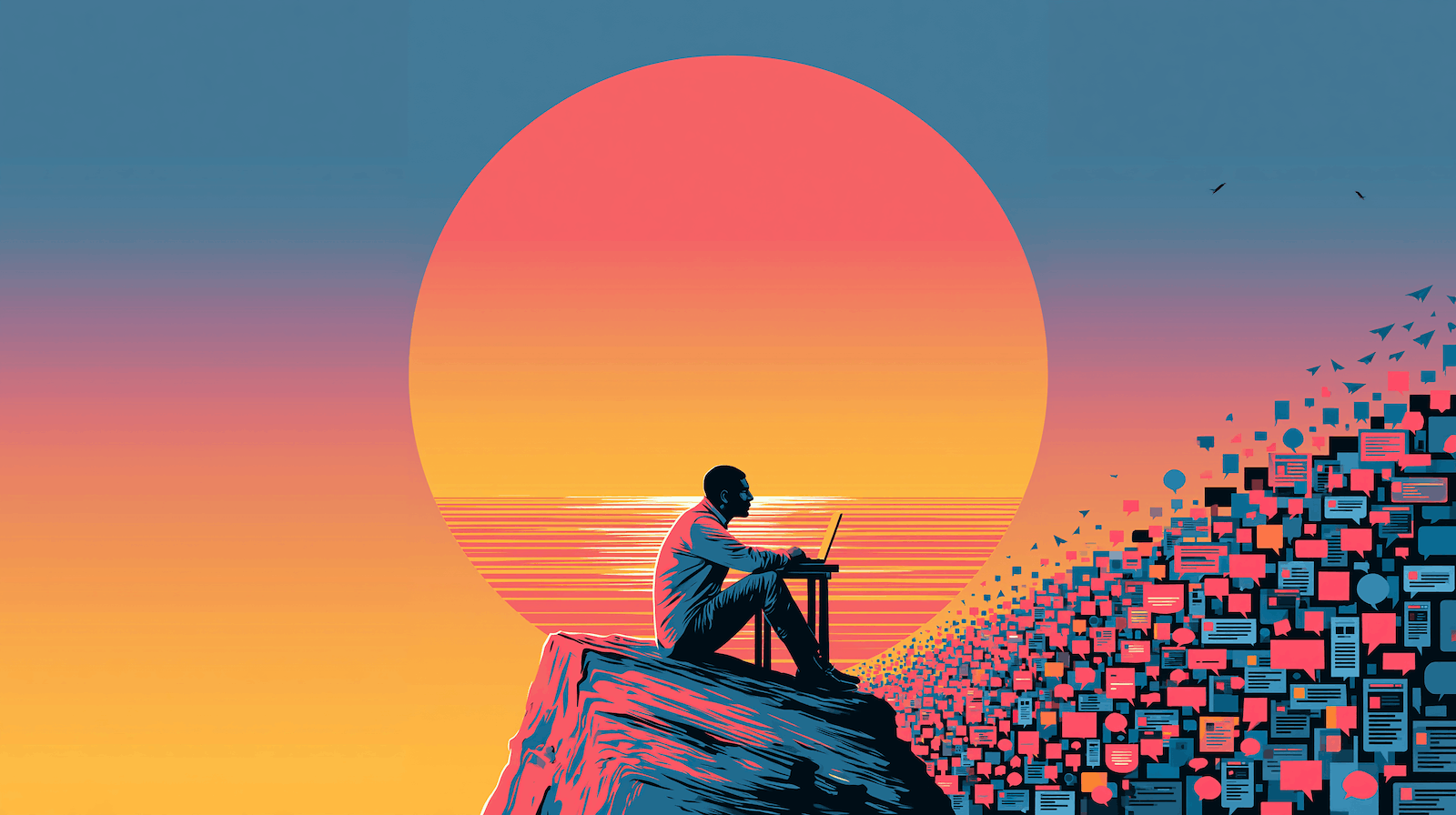
I’m tired of AI too. Every day, a new model pops up, a new update, another new thing that I’m apparently supposed to learn and understand before lunchtime. If your job isn’t primarily about AI, you’re actually now doing two jobs at the same time:
The work itself that you’re supposed to be doing and simply trying to keep up with a fire hose of change that never shuts off.
I work in marketing and communications for a living, so I use these tools all day, every day now. But recently I’ve felt as if I hit a wall. Exhaustion. An overflow of content, invading my life. Some of it I love, but much of it, if I’m honest, I can do without.
So I did something that felt a little bit crazy to me. I walked into a bookstore and bought three physical fiction novels. Actual paper books with prose forged by someone’s amazing imagination. A Booker Prize-winning novel that I’ve been meaning to read for a decade (Remains of the Day). Another brand new, highly acclaimed novel that just dropped (Japanese Gothic, loving it so far) and the other just looked cool (a new spin in the James Bond world — Quantum of Menace).
I haven’t bought fiction on paper in probably more than 10 years, and that’s mainly because I read everything on Kindle, something that came about after having moved over twenty times in my life.
But as I was standing at the register holding those books, it occurred to me that it wasn’t that I had too many AI tools. It was that I couldn’t remember the last time I’d finished a thought without something new arriving to interrupt it, and I was quite simply looking for a way out.
It turns out that I’m not alone in feeling like this. In March 2026, CNN ran a piece about what it called “AI brain fry,” which seems a bit extreme at first. But it’s essentially a low-grade mental exhaustion of living inside an always-updating machine. And that’s pretty much the feeling that many of us are dealing with.
If you think about it, given the fact that most of the development of Claude (by Anthropic) is actually done by Claude, who never gets tired, never sleeps, etc., we’re living in a world where things are not determined by how many hours a software developer needs for rest anymore.
This is a real pain, but I think that the diagnosis might be wrong because it’s not that we need an AI detox. It’s more that we need an input diet.
The fry is real. The diagnosis is wrong.
When we feel overwhelmed by AI, it’s easy for us to want to blame the tools. There are too many of them. They change too quickly. We need a better app, a cleaner workflow, or maybe just a weekend without screens.
But all of that points to a deeper problem, and that’s not the number of tools we have. It’s that almost no one has a system for deciding what deserves their attention.
This isn’t something new. We had already gone over that precipice of how much information we as humans can actually handle. Now it’s just a problem that AI has amplified.
I’ve written about this before: If you walk into AI scattered, it’s going to amplify the chaos. If you walk in clear-minded, it’s going to amplify the clarity. It just works with whatever is already there.
And for many of us, what’s already there is noise.
Luckily, research seems to be catching up. In 2025, Microsoft Research surveyed 319 knowledge workers about generative AI and critical thinking. Now, you could say that they found that AI makes people lazy, but it’s a much more subtle effect than that: the more confident people felt about the AI’s output, the less effort they invested in their own thinking.
Essentially, people shifted their mental workload. Instead of doing the task, they spent more time checking, judging, and verifying what the machine had produced. What used to tire you out from doing the work now tires you out from having to review the work.
At the very least, we should now appreciate what the work of the editor at a magazine or newspaper is like.
Now, every answer that comes back is something you need to review and assess. Every new suggestion, of which there tend to be many, becomes another branch in the decision tree that you need to figure out. Let’s not get into every new tool that pops up in your Instagram feed promising to save you more time while quietly asking you to learn a new interface, maybe new vocabulary, and a new special way of working. Promises, promises, promises.
But all of that new set of judgments comes at a cost. The real danger is that we become really efficient at looking at and processing other people’s ideas, while at the same time losing our ability to hear our own.
Abundance always has a price
In 1971, the economist Herbert Simon wrote that a wealth of information creates a poverty of attention. 1971 was well before my time, which means it was certainly before the smartphone, social media, or the infinite feeds that we dive into every day now. It was before a machine could generate an unlimited amount of plausible new text in a matter of seconds.
In 2011, a little bit more in my time now, the neuroscientist Daniel Levitin, in his book The Organized Mind, estimated that Americans were already consuming five times as much information each day as they had in 1986. He argued that the brain could process the information but struggled to separate the trivial from the important. It turns out that the problem is not just that there is too much to read or consume. The problem is that everything looks essentially the same.
A genuinely important message might appear right beside a promotional notification. The email that you get from your child’s school pops up right next to the latest sale from your supermarket. A difficult question that you are turning over in your mind is interrupted by some AI-generated answer before you’ve even had time to let it sink in.
All of this abundance was always going to cost us our attention. ChatGPT and its friends have simply made that abundance infinite.
Every switch leaves something behind
Much of our work today is built around moving from one task to another. Maybe you move between Slack or Teams, your project management tool, a WhatsApp message, and then your email, all within the space of five minutes. When all of this happens, a part of your mind always remains attached to the task that you were doing before. You start with your first task, and then you arrive at the second one with less of yourself available.
The management researcher Sophie Leroy calls this “attention residue.”
Leroy studied people switching between work tasks, not people using AI, so the comparison shouldn’t be overstated. There’s something that we can certainly take away from her research, and that’s that every ping leaves residue. Every quick look at your messages leaves even more residue.
Every moment that you spend jumping between your agents, your feeds, newsletters, chats, emails, dashboards, and, God forbid, somebody might call you on the telephone, leaves a small part of your attention somewhere else.
It’s not that AI even invented switching. We were doing that pretty well before 2022. The number of things worth switching to has increased tenfold (probably more), so the tool hunt rarely fixes the problem. An app can’t protect an attention system that doesn’t have boundaries.
Why detoxes fail
So when our instincts kick in, the first response that comes up is withdrawal. Delete all the apps. Turn on airplane mode. Go outside. Take a walk.
Buy three paperback novels.
And there’s actually nothing wrong with all of those things. My instinct is certainly going in that direction, toward pages, fresh air, sand beneath my toes, and anything that doesn’t have a changelog.
The issue I see with that, though, is that a detox is a crash diet. It’s dramatic, temporary, and is usually built around willpower. And much like trying to avoid soft-serve ice cream in Denmark, you white-knuckle a silent weekend. You feel clear for a day, then you get back to the same LinkedIn feed on Monday because nothing has structurally changed. That dopamine ice cream is calling your name.
This gets even harder with AI because it’s no longer something that you can avoid. It has become a part of the work itself. You can’t abstain your way out of technology that’s integrated into your job. There’s no turning off email or getting rid of Word and Excel. That means the answer is not necessarily a smaller digital life (as helpful as that might be), but a better-designed attention system.
From less to architecture
Levitin doesn’t argue that we need to take in less information. He argues that we need better systems for organizing it. It’s simply a change in perspective. The fix isn’t abstinence; it’s architecture. (It’s the same reason I keep arguing that systems beat goals.)
Thich Nhat Hanh wrote that before we can make deep changes in our lives, we need to examine our diet and our way of consuming.
He wasn’t only talking about food (though I doubt he ever had soft-serve ice cream and Danish hot dogs). He was talking about everything we allow into our minds.
That tiny word “diet” really matters. A detox is something you survive. A diet is something that you run with. One is a heroic weekend that you’ll probably never do again. The other is a quiet structure that eventually becomes a habit and how you live if you do it right.
I’ve personally been running a media diet for almost 20 years. The first thing for me was that I stopped watching the news back in 2010. I decided to stop letting the news decide what deserved my attention. It’s not that I stopped caring about the world, but that I stopped outsourcing my emotional state to a “feed”.
The seven-day input diet
I’ve thought extensively about how I would approach that today versus how I went cold turkey with the news.
I’d say that you don’t need another app to do this. You need one week and a willingness to look honestly at all the crap that you are consuming.
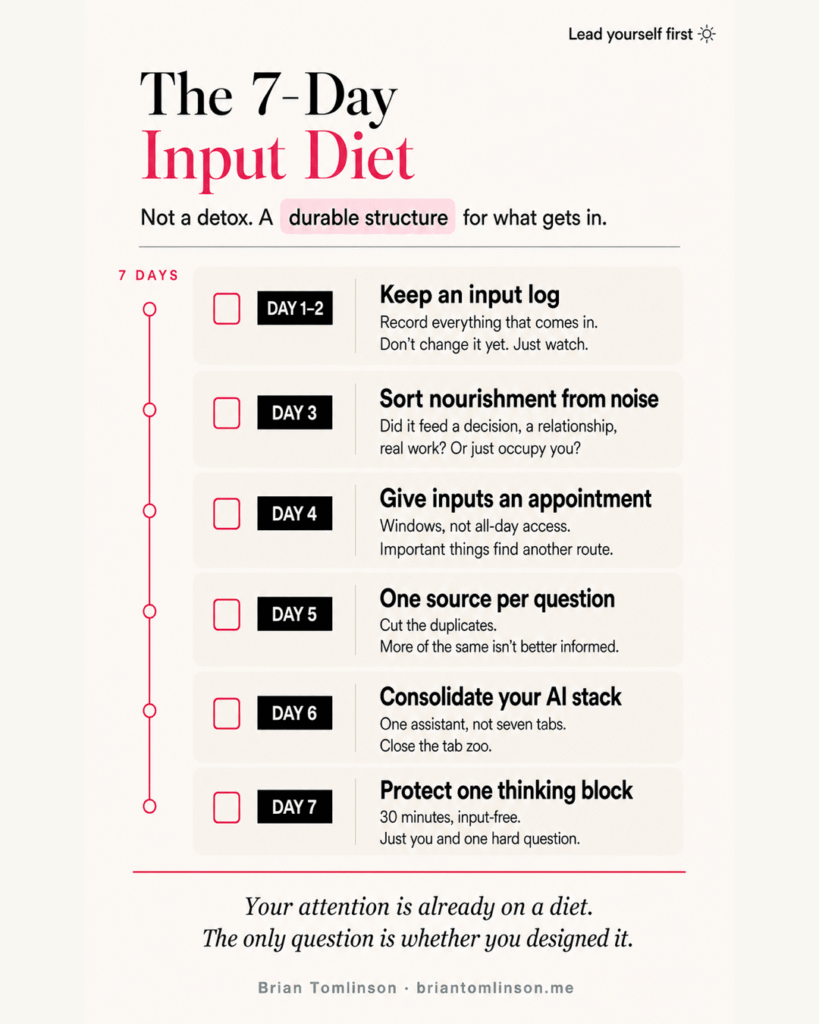
Day 1 and 2: Keep an input log
For two days, record everything that comes in your social media feeds, newsletters, notifications, and the apps they come from: Slack messages, meetings, podcasts, videos. Everything that you work on with AI.
Just try to make a good record of everything that’s coming in. Don’t try to cut anything yet. The most surprising thing that might surface isn’t just exactly how much volume you’re consuming, but how little you consciously know what you’re consuming.
Day 3: Sort nourishment from noise
Now it’s time to start reviewing your list and asking an important question for each one. Does this help me make a better decision? Does it deepen a relationship or do meaningful work? Does it matter to me, or does it simply occupy my time? Remember, not everything needs to be educational or productive — entertainment and the things that make you feel alive matter as well. But there’s a difference between making a conscious choice to be entertained and being captured by whatever new notification hits you.
Today, sorting things out is the skill that we’re working on.
Day 4: Give inputs an appointment
Now we’re starting to try to be a little more strategic. All of your inputs shouldn’t have all-day access to you. Try to give them windows; check email at certain times during the day instead of every few minutes. Try to group your messages. Turn off notifications that you don’t need and that don’t justify interrupting your thoughts. When things are really important, they will find a way to you. For something to be noise, it needs to have constant access. Don’t give in to it.
Day 5: Choose one source per question
Now that we have things sorted, we’ll make sure we have all questions answered and find a single trusted source for each one. You probably don’t need four newsletters covering the same topic or five summaries of the same article from three different people. Duplicate information just gives you more information without you being better informed. And more notifications simply make you more anxious.
Day 6: Consolidate your AI stack
Try to find one favorite assistant that can do 80 or 90% of the work that you do with AI. Then you can close the rest of the tabs and open them when you really need them. Well, all those open tabs quickly become a zoo, and they’re not making you sharper. They’re making you switch all the time. Once you have your context, you can have one system run it, and if need be, every other system should run off that same context as well. That saves you having to brief each one every time. (It’s the whole idea behind building a personal AI operating system.) Experiments are cool, but don’t confuse experimentation with progress.
Day 7: Protect one thinking block
One of the biggest mistakes I see people making is actually not having any time to think. Protect one thirty-minute thinking block. One time with no people, no feed, no inbox, no assistant. Just you doing what we were meant to do. What decisions need to be made? What topics might you be avoiding? Is what you believe really what you believe, or just someone else’s conditioning of you? The whole reason that we are working on getting rid of the noise is not for you to feel more productive, but to give you more room for thought. (It’s the same reason boredom is worth protecting.)
Feed the amplifier
Think back to those three novels on the bookstore counter. My buying them doesn’t fix my relationship with technology. Paper is not the answer, and going analog is not a long-term strategy. It’s just that for the first time in a long time, I decided what got into my world. There’s nothing to do with a feed and everything to do with me just picking up a singular creation and consuming it on my own time.
That’s the whole idea: building a structure for your inputs. Whatever is amplified is what you actually want to be amplified. Something that you consciously chose, not what the system puts in front of you. What we all want is a clear mind that knows what matters and makes you formidable.
You can’t control how loud AI becomes, but you can decide what you feed it.
Your attention is already on a diet. The only question is whether you designed it.
Frequently asked questions
It’s the low-grade mental exhaustion of living inside always-updating AI tools. CNN named it in March 2026. It isn’t a medical diagnosis, just a useful label for a real feeling: too much coming in, and too little room to think.
Usually not. A detox is a crash diet. It’s dramatic, temporary, and built on willpower, so it rarely lasts past Monday. And you can’t really abstain from AI when it’s stitched into your job. A durable input diet beats a detox.
It’s a repeatable structure for deciding what gets into your day, through which channel, and when. Not necessarily less information, but a system for organizing it so your attention goes to what actually matters.
Start with two days of simply logging every input: feeds, newsletters, notifications, meetings, and AI outputs. Don’t cut anything yet. Then sort each one as nourishment or noise, give your inputs set windows instead of all-day access, cut to one trusted source per question, consolidate your AI tools, and protect one input-free block to think.
It can shift how you think. In a 2025 Microsoft Research survey of 319 knowledge workers, the more people trusted the AI’s output, the less effort they put into their own thinking, spending more time verifying the machine than reasoning for themselves. The effect depends on how you use it, not on the tool itself.
Digital minimalism, Cal Newport’s idea, is mostly about reducing smartphone and social media use. An input diet is about designing what gets in across everything, including AI, which you can’t simply quit. It’s architecture, not abstinence.