

I had a conversation a few weeks ago with a senior leader who told me that his calendar no longer belonged to him.
For a bit of context, he’s one of the sharpest people I know. He’s not someone who lacks discipline or struggles with priorities, at least not in the way the word is usually used. But he was having eight hours of meetings on most days. The odd thirty-minute window between calls that he’d use to eat lunch or answer messages on Teams (Slack.) Thinking time, real thinking time, was basically gone.
Now that’s just a shitty situation, whether you’re in leadership or otherwise. We seem to live and work in a world where no one actually has time to do work. The irony of this is not lost on me. But I digress…back to the convo.
The obvious takeaway was that he needed better time blocking. Get strict with the calendar. Protect focus time. Maybe try a “no meeting Wednesday.” We’ve all heard this advice. It’s not wrong. Actually, I’d always recommend it. I’ve always had blocks on at least two days of the week just for work and thinking. And when I was at Staffbase, we were lucky enough to have a no-meeting Friday. But as we spoke more, a different picture emerged of what was really happening.
It turns out that it was very likely that every meeting on his calendar was there because a decision hadn’t been made. Not necessarily by him, not by anyone. Someone hadn’t decided who owned a project, so now there was a weekly sync to manage the ambiguity. Someone hadn’t decided on the project’s priorities for this quarter, so every request came in with equal urgency. Someone hadn’t decided the right escalation path, so decisions that should have lived two levels down kept floating up to his desk. You can probably spot a pattern here, right?
Turns out that he wasn’t time-poor. It was more that he was decision-poor. And his calendar was taking a beating for this indecision.
Why Meeting Overload Is Really a Decision Problem
Once you see this pattern, it’s hard to unsee it.
The calendar isn’t where this starts. It’s where it ends up — a downstream record of how clearly priorities have been decided upstream. When important decisions are made, meeting invites are naturally filtered. You know what you own, so anything outside that boundary has nowhere to land. When those decisions are still floating, though, everything seems to require your presence, because your presence becomes the closest thing to a decision that everyone can agree on.
The DDI Global Leadership Forecast, the largest leadership study of its kind, surveying over 15,000 leaders across 50 countries, found that nearly 60% of leaders report feeling “used up at the end of the workday.” That’s the “I need a drink” vibe after work for sure. The issue is that that’s a burnout marker. But here’s the real kicker: the same study found that leaders who spend more time managing and coordinating rather than actually doing consequential work are 32% less engaged, more burned out, and twice as likely to leave within 12 months. The culprit isn’t the number of hours. It’s the quality of what’s filling them. Any middle manager knows how much admin gets winged at them. Turns out that’s the stuff that tears you down.
What this means is that you can work the same number of hours as your colleague and still feel completely depleted if your hours are absorbed by coordination that leads nowhere. Or you can work fewer hours and feel genuinely energized, if your hours are spent on decisions that actually move the needle.
Bain’s research on meetings shows that managers spend 50% or more of their time in meetings, and two-thirds of those meetings end before participants can make the important decisions they were apparently called to make. Two-thirds! The meeting that consumed your afternoon, the one that ran over and still ended without a decision, probably belonged to that two-thirds. This doesn’t mean the meeting was run badly, but rather that whoever was supposed to make the decision probably didn’t even know they were supposed to.
Paul Graham wrote about this back in 2009, and the observation has aged remarkably well. “A single meeting can blow a whole afternoon,” he wrote, “by breaking it into two pieces each too small to do anything hard in.” He was writing about programmers and makers. But the same dynamic plays out at the executive level, just at a different altitude. When your day is sliced into hour-long windows, you’re always just a meeting away from losing the cognitive runway required to do anything genuinely complex — busy but not building anything, even when the calendar looks full.
The time-blocking instinct makes sense. Block out the time, protect the space, and the creative work will happen. And it does work, temporarily. Then the meeting requests start coming in again, each one with a plausible case for why you need to join, and slowly those time blocks erode. This doesn’t happen because of a lack of discipline, but because the upstream problem hasn’t changed. When priorities are unclear, every invitation feels legitimate. And that’s when we default to yes. Because in our world of work, saying no usually requires a clear reason. But there’s not much of a reason when there is no clarity around what you should say no to.
Greg McKeown captures the mechanism in Essentialism: “When we don’t purposefully and deliberately choose where to focus our energies and time, other people — our bosses, our colleagues, our clients, and even our families — will choose for us.” Peter Drucker, whom McKeown quotes, put it more simply: “If you don’t prioritize your life, someone else will.” That’s not motivational phrasing. It’s a description of a mechanism. When the priorities are left undecided, the calendar becomes a democracy, and every request gets a vote.
This is what decision-poverty looks like in practice. It’s not paralysis, and it’s not avoidance in any obvious sense. It’s a slow drift away from decisions and toward presence — meetings that coordinate rather than resolve, conversations that align rather than commit. The leader who fills her days with eight hours of meetings isn’t being unproductive, in her own mind. She is responsive, she shows up for everyone who needs her, she stays available — all of which, in most organizations, passes for exceptional leadership.
The trouble is, she’s also slowly running herself down to nothing.
Why Time Blocking Can’t Fix Decision Poverty
The move my colleague and I landed on wasn’t a calendar redesign. It was upstream from that.
We named the problem correctly first. Then we looked at the decisions he hadn’t actually made — not incomplete tasks, but genuine choices that were still floating in the organization without a clear owner or resolution. It took about an hour. The list wasn’t long. Five or six major decisions, some of them months old, each generating its own gravity field of meetings, check-ins, and “alignment” calls.
Once we could see them as floating decisions rather than “ongoing discussions,” the path forward became more obvious. Not easy. Obvious. Naming the upstream cause always does that.
Eisenhower apparently kept a similar filter in place throughout his presidency. Ryan Holiday wrote about it in Stillness Is the Key: “Much that was happening in the world or on the job, Eisenhower found, was urgent but not important. Meanwhile, most of what was truly important was not remotely time-sensitive.” That distinction, urgent versus important, only becomes navigable when the important decisions have already been made. Once they have, the urgent stuff either fits inside the decision or it doesn’t. If it doesn’t, it stops being your problem.
Reclaiming your calendar requires making better decisions earlier. Not better habits.
The Decision-Poverty Audit
This is the framework I walked through with my colleague. You can run it in an afternoon.
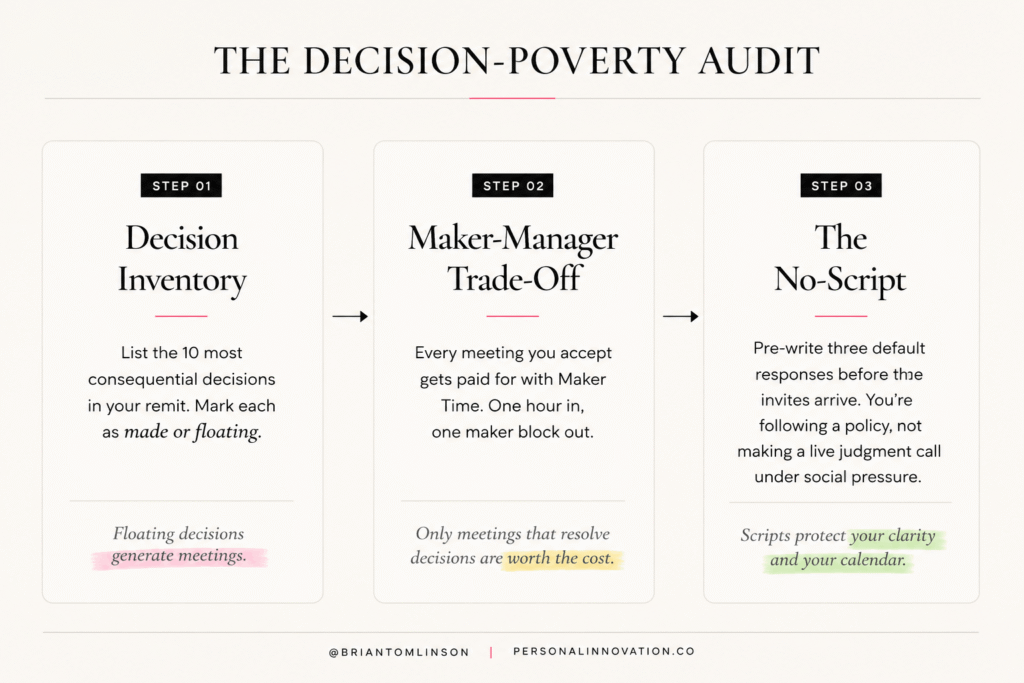
Step 1: The Decision Inventory
Take a piece of paper — or open a doc, whatever works for you — and write down the 10 most consequential decisions in your remit this quarter. Not projects, not tasks, not things you’re currently “working on.” Decisions. The kind where, once you’ve actually committed to a direction, five other things on your plate either get answered or get handed to someone else, because they were really just waiting on this one thing.
When you have your list, mark each one as either made or floating. A floating decision is one that’s come up in conversation, maybe many times, but where no one has formally committed to a direction that the organization is actually executing from. These are the ones doing the most damage, because a floating decision doesn’t just sit there quietly. It pulls people into rooms. Every meeting that ends without a conclusion is probably downstream of one.
If you’re honest about the list, you’ll find two or three “priorities” that have been floating around for months. Those are the ones that you need to get knocked out. Make them your priority. Put them in writing, attach a clear owner, and circulate them. You don’t need to solve every implication that follows. You just need to make the call, so the thing stops generating meetings.
Step 2: The Maker-Manager Trade-Off
Here’s a simple rule that you want to live by. Every meeting you accept gets paid for with Maker Time. This only works if you treat it as a structural rule rather than just a nice idea. An hour in means an hour out somewhere else. If accepting a meeting would cost you your last focused block of the day, that meeting isn’t free — it just looks free because you don’t see the cost.
For anyone doing complex cognitive work, a meeting doesn’t just take time — it changes the mode you’re working in. Two separate one-hour focused blocks are not the same as a single two-hour block, even though the math tells you they should be. The first hour, you’re warming up. The second hour, you’re actually inside the work. Split that in half with a meeting, and you never fully get there. (Asana did a survey a couple of years ago that basically confirms this.)
In practice, this means looking at your calendar not just as a schedule but as a set of trades. Some trades are obviously worth making — a conversation that resolves a floating decision is worth whatever maker time it costs, because it stops generating more meetings down the road. A status update that could have been an email is not. The rule makes you do that accounting out loud, before you hit accept.
Step 3: The No-Script
Daniel Kahneman, who spent his career as one of the great researchers into how humans make decisions, had a rule he used when someone asked him something on the phone. He would tell them, “My rule is I never say yes on the phone. I’ll email you later after I think about it more.” When asked how often he later responded with a yes, “rarely,” he said.
What Kahneman understood is something most of us haven’t built into our own systems yet. The problem with a default-yes isn’t that we actually want to say yes to everything. It’s that yes is the easy answer in the moment, because it avoids friction right now and defers the cost to later. Having a system helps fix this — you have a policy that decides in advance what belongs on your calendar, so you’re not making that judgment call live and on the spot, under social pressure.
What you’re going to do is write three default responses that you can share when the next calendar invites come in.
Something like: “I’m not the right person for this one — [Name] has the decision rights here.”
Or: “This feels like it wants to be a document rather than a meeting. Let me send my thoughts by [date], and we can reconnect if something’s still unresolved.”
Or: “My focus blocks are full this week. Can you send a summary of the output, and I’ll catch up from there?”
The exact wording doesn’t matter much. What matters is having something ready before the moment arrives — you’re following a system you already designed, not making a live judgment call under social pressure. The leaders people tend to respect most aren’t the ones who show up for everything. They’re the ones who already know what deserves their time.
Two Weeks Later
My friend sent me a message a couple of weeks after our conversation. He had decided to do the decision inventory. He found four floating decisions, made a call on three of them, and delegated the other one with clear ownership. He had managed to get out of a number of recurring meetings because his system had already made the decision in advance.
He said it felt like a negotiation he’d finally stopped losing (with himself.)
That’s what reclaiming the decisions does. The calendar doesn’t fix itself through willpower or better scheduling tools. It reflects whatever clarity exists upstream. Get the decisions made, get the priorities anchored, get the no-scripts written before the invites arrive — and the calendar stops being a thing that happens to you.
You’re not time-poor. You never were. You were decision-poor.
Now you know what to do about it.
Decision poverty is a leadership condition in which calendar overload and meeting bloat are caused not by poor time management, but by an accumulation of unmade decisions upstream. When priorities, ownership, and escalation paths remain unclear, meetings multiply as substitutes for decisions. Leaders become decision-poor — not time-poor.
Research from Bain & Company shows that two-thirds of meetings end before participants can make the important decisions they were called to make. The DDI Global Leadership Forecast found that 60% of leaders feel “used up” at the end of every workday. The underlying cause, according to McKinsey and Bain, is unclear decision rights — not poor scheduling habits.
The maker-manager schedule distinction was introduced by Paul Graham in a 2009 essay. Managers operate in one-hour calendar blocks; makers need half-day or longer uninterrupted windows to do complex cognitive work. A single meeting placed in the middle of a maker’s day can eliminate effective focus time by splitting the remaining day into fragments too short for deep work.
The most effective approach is to audit floating decisions — strategic choices that remain unresolved and are generating recurring meetings as a substitute. The Decision-Poverty Audit involves three steps: (1) listing the 10 most consequential decisions in your remit and identifying which are still floating, (2) applying a maker-manager trade-off rule (one meeting in = one maker block out), and (3) pre-writing three default responses (a “no-script”) to filter incoming meeting invitations.
A floating decision is a choice that has been discussed repeatedly in meetings but where no one has formally committed to a direction the organization is executing from. Floating decisions act as meeting magnets — each one generates multiple syncs, check-ins, and “alignment” calls until it is formally resolved with a clear owner and a written direction.