

The short version: people follow whoever makes them feel understood. The best argument often loses.
In this article:
- Why a farmer wasn’t confused when she said a billionaire “gets us,” and what that means for every room where someone gets picked
- How much 49 field experiments say campaign ads changed U.S. general election votes (less than you’d guess), and the 1966 line that explains it
- The explanation I hear most often in Germany for the AfD’s rise, and why it doesn’t hold up
- The one emotion that predicted AfD support across nearly 15,000 Germans (and the one that didn’t)
- What people tapping out “Happy Birthday” on a table show about why the smartest person in the room keeps losing it
In November 2024, I was in Aarhus for the Boye & Company conference. I’ve been going every year since around 2015.
I got in around 10 pm on the train and checked into my hotel. Before I fell asleep, I flicked on the news to see how voting was going in the U.S. It was still only around 6 pm EST, and the final polls hadn’t even closed yet. But he was so far ahead that I could already see the writing on the wall: Donald Trump was going to be president again.
I shook my head a bit in disbelief and went to sleep. When I woke up, the first thing I did was turn the TV back on, and there it was, confirmed. Then I headed out for an early run with a group from the conference. Life had carried on.
Two days later, I was back home in Hamburg. It was around 11:30 pm, and as I was going to bed, I pulled up a New York Times piece by Shawn McCreesh. (Don’t judge me for reading in bed.) It ended up being one of the more memorable articles that I’ve read.
The piece was about how Donald Trump had managed to win the election by connecting with so many Americans. I remember nodding along as I read it because, for me, as a marketer and communicator, it made total sense.
One line stuck with me more than the rest. A hay and beef cattle farmer in Smithton, Pennsylvania, told McCreesh: “He gets us… He just knows where we’re coming from.”
McCreesh called it a head-spinning assessment, and he had a point. How could a man with a silver spoon and a golden triplex above Fifth Avenue understand anything about this woman’s life?
And yet she wasn’t the only one saying it. McCreesh heard it constantly, in the most unlikely of places.
Why people follow whoever makes them feel understood
It’s a strange thing to hear a farmer say about a billionaire. But I don’t think she was confused.
McCreesh put it well: “People saw in him whatever they wanted to see. And they believed that, after so many years, they knew him, and that he knew them, too.”
Robert Cialdini calls this “unity.” In the newest edition of his book Influence, he explains that the strongest “we” relationships “are not those that allow people to say, ‘Oh, that person is like us.’ They are the ones that allow people to say, ‘Oh, that person is one of us.’”
Trump is nothing like her, but she decided he’s one of hers.
Earlier this year, I wrote about why stories beat credentials. Researchers at UC Irvine found that agreeing on values mattered more than twice as much as credentials when people decided which expert to trust, which is pretty much the farmer’s logic.
In my notes on that article, I wrote something I still believe. People vote because they’re fed up. Because they want to be taken care of. And once they feel that, a lot of them can put aside the things that someone says.
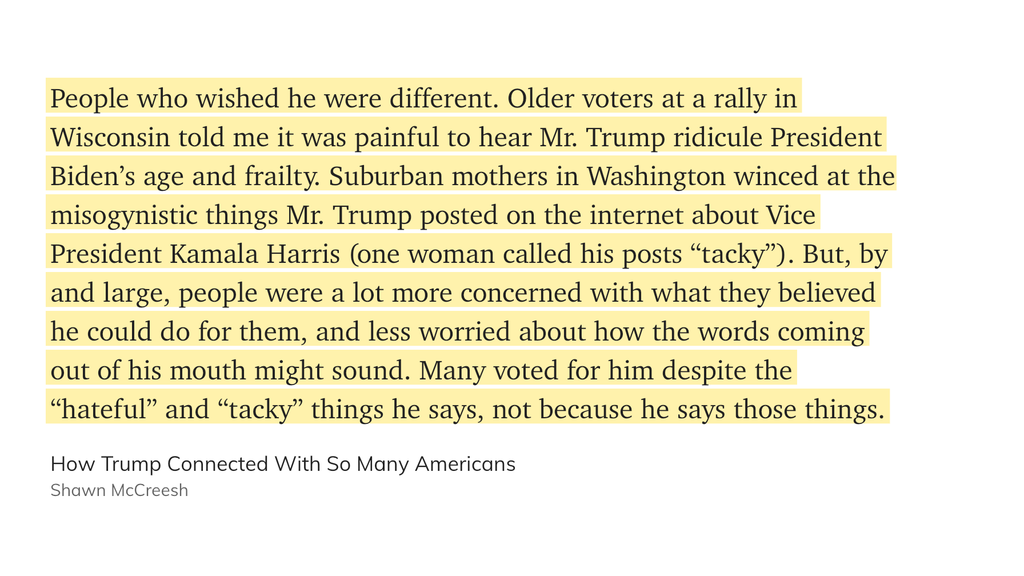
McCreesh saw the same thing at rally after rally. Plenty of voters winced at what came out of Trump’s mouth. But, as he put it, “Many voted for him despite the ‘hateful’ and ‘tacky’ things he says, not because he says those things.”
And that doesn’t only happen in politics. It happens in every room where one person gets chosen over another. Whether that might be a job candidate, a vendor, a new manager, or the leader everyone decides to follow.
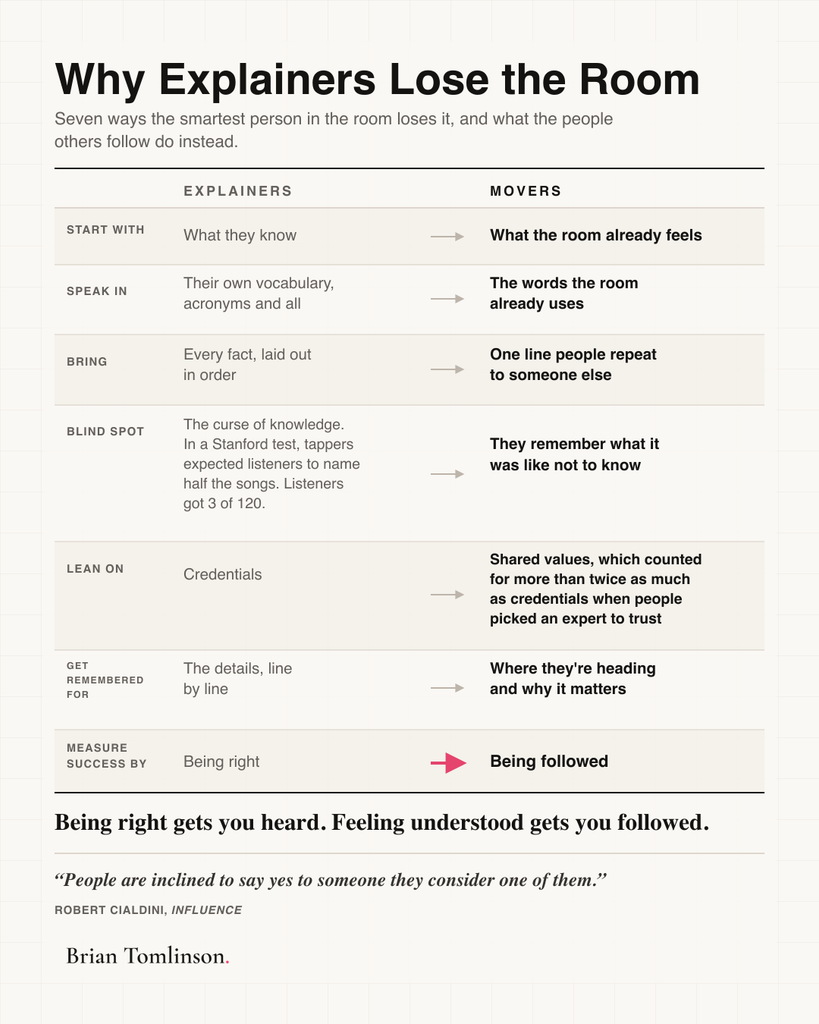
I’ve come to think of it as the difference between explainers and movers.
Explainers believe that if they lay out all of the facts clearly enough, people will come around.
Movers are the ones people actually follow. And the people who like to explain usually aren’t the ones who get anyone to move.
Does political persuasion actually change votes?
The easy version of this essay would say that Trump won because he’s a great communicator. There have been countless articles written about exactly that. But I believe that there might be something else at play.
In 2018, the political scientists Joshua Kalla and David Broockman looked at 49 field experiments on campaign contact and advertising. Their best estimate of how much it all changed people’s choices in a U.S. general election was zero.
They did find exceptions, like when a candidate takes an unusually unpopular position, or when a campaign reaches people months ahead of the vote. But even that early persuasion faded.
Eugene Schwartz, one of the great copywriters of the last century, figured this out back in 1966. In Breakthrough Advertising, he wrote: “Copy cannot create desire for a product.” All it can do is take the hopes, fears, and desires that already exist and point them at something.
That farmer’s frustration was there long before Trump sat down at that big wooden table in a Pennsylvania barn, with hay bales and a John Deere tractor behind him, and talked about seed costs and fertilizer. What he managed to do was make her feel like he’d noticed it too. Trump didn’t create her frustration. Instead, he was just the one who gave it a name.
Why the AfD keeps winning in eastern Germany
I’ve lived in Germany for 15 years now. I love the country, the people and the culture (not so much the language 😅). And the people I know here are so sensitive about the past that it has shaped the culture for decades.
So it’s an odd feeling to watch what’s happening right now.
On September 6, the far-right AfD won the state election in Saxony-Anhalt with 43.8% of the vote. The CDU came second with 17.2%.
The explanation I hear most often is some version of “they’re just better at TikTok.” You can see why people say it. During the 2025 federal campaign, AfD videos pulled more views on TikTok than any other party’s.
But the Otto Brenner Foundation took a close look at the AfD’s digital campaigns in three eastern state elections in 2024 and came away with a different picture. The party was “weit weniger Social-Media-Partei, als häufig kolportiert.” In other words, far less of a social media party than people like to claim. A lot of its own videos were pretty amateur, and many were aimed at older voters, not young ones.
So if it isn’t the videos, what is it?
Where the distrust comes from
This spring, researchers asked why AfD support runs so much higher in the East than in the West. They found the gap was “mainly accounted for by political distrust, alternative political media use, and populist/nativist attitudes.”
This looks like a chain where history builds distrust, alternative media and fan accounts organize it, and the party gives it a name.
When you look at the numbers, they show that East Germans make up about 19% of the population but hold around 12% of the country’s top positions, according to Leipzig University’s Elite Monitor.
For more than three decades, a lot of people in the East have been talked about far more than they’ve been talked to. Usually in a language that doesn’t sound like theirs, by people who don’t sound like their neighbors.
So I don’t find it all that surprising that a lot of them listen to whoever finally talks to them. And this isn’t a German thing. This, I’m going to take a guess here, holds true in other countries, in companies, and just about everywhere human beings are involved.
Anger vs. fear: what really drives populist support
A team that included sociologists from the Free University of Berlin followed nearly 15,000 Germans over several years through the country’s long-running Socio-Economic Panel. They wanted to know which emotions predicted support for the AfD.
Their answer: “Generalized anger increases support for the AfD, even when controlled for any specific worry, whereas generalized fear does not predict AfD-support.”
That distinction matters a lot more than one might imagine. Fear says something bad might happen. Anger says someone did this to us.
And once someone did it to you, you’ve got a target, and a target is something you can vote against.
Eric Hoffer wrote the book The True Believer in 1951. He writes that “it is not actual suffering but the taste of better things which excites people to revolt.” And, in the line most people remember: “Mass movements can rise and spread without belief in a God, but never without belief in a devil.”
Which brings me back to McCreesh. At one rally in Charlotte, he turned his chair around so he could watch the crowd instead of the stage. When Trump started shouting about “child rapists” and “bloodthirsty predators,” McCreesh could see eyes bulge and faces contort. Nobody was looking at their phone.
By the end of the campaign, he wrote, the messaging had become so dehumanizing that “he wasn’t even showing actual human beings anymore.”
I want to hold onto that for Part 2 of this article, because naming someone’s anger is one thing, but turning a whole group of people into the devil is something else.
The curse of knowledge: why experts lose the room
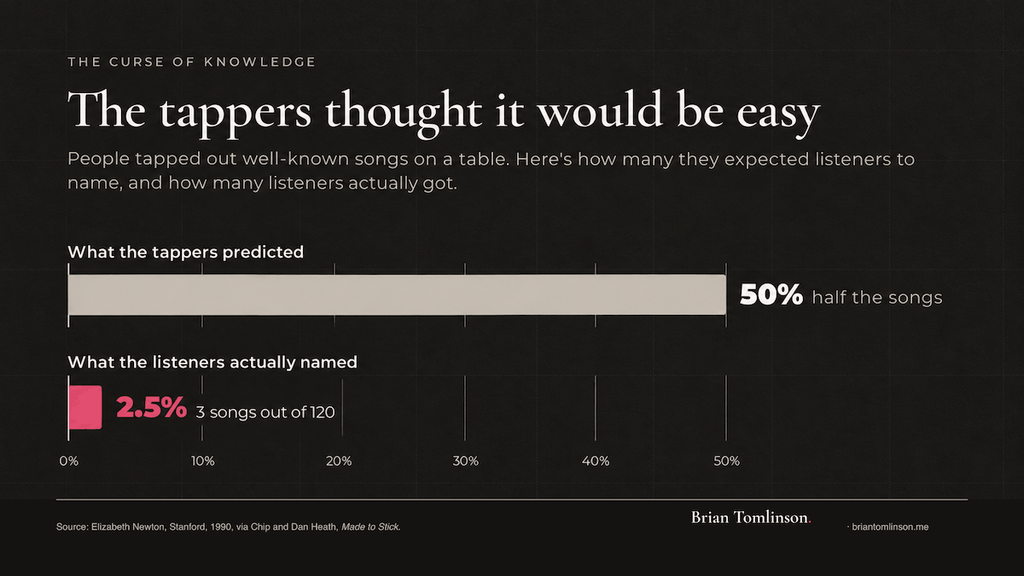
In 1990, a Stanford graduate student named Elizabeth Newton ran a simple experiment. One group tapped out the rhythm of well-known songs, like “Happy Birthday,” on a table. Another group had to guess the song.
As Chip and Dan Heath tell it in Made to Stick, the tappers predicted that listeners would get about half of them. Out of 120 songs, the listeners got three.
In their heads, the tappers could hear the whole melody, but the listeners could only hear knocking.
The Heaths call it the curse of knowledge. Once we know something, it’s really hard to imagine what it was like not to know it.
Donald Miller tells a story in Building a StoryBrand 2.0 that I think of every time I see a politician on television. Years ago, he was asked to come to the headquarters of a presidential favorite. The candidate had been governor of a large state, had over a hundred million dollars behind his campaign, and was shrinking in the polls month after month.
His team explained that their man wasn’t “a sound bite kind of guy.” He was a scholar. He’d written books about his policy ideas, and he believed in nuance.
Miller told them: “You are doing everything to prepare this man to be president and nothing to get him elected.”
I think a lot of us have been that candidate. Twenty years of real judgment, and we lose the room to someone with one good line and a lot less to back it up. Peter Drucker has one of my favorite quotes on communication, a line I’ve leaned on before: “It is the recipient who communicates.”
I’ve written before about why facts on their own don’t change minds. That article was about the listener, and how we dig in when a fact threatens who we think we are.
The tappers and the scholar candidate are explainers. They have the curse of knowledge. They knew the whole song by heart, so they couldn’t hear that everyone else was only getting the knocking.
The movers seem to work the other way around, starting with what the room already feels and the words it already uses, and only then getting to their point.
This makes them much more relatable. They make people feel as if they “get them.”
What persuasive leaders do differently
For one thing, they’re funny. Looking back at the 2016 campaign, three anthropologists argued that Trump’s primary success “was in part due to its value as comedic entertainment.” Trump said the same thing to Joe Rogan: “You need at least the attitude of a comedian when you’re doing this business.”
To me, this is exactly what Donald Miller means about having a sentence or two that works, and that people can connect to you.
They’re also heard for direction, not detail. Back in 2016, Salena Zito wrote in The Atlantic that “the press takes him literally, but not seriously; his supporters take him seriously, but not literally.”
That line should be taken seriously (pun intended). When researchers showed people Trump’s tweets questioning U.S. elections, his supporters’ trust in elections went down, and more of them believed elections were rigged. In other words, “not literally” still comes with consequences.
Edward Bernays, propaganda and the ethics of persuasion
In 1928, Edward Bernays, the man most people credit with inventing public relations, wrote the book Propaganda. In the first chapter, he writes: “We are governed, our minds molded, our tastes formed, our ideas suggested, largely by men we have never heard of.”
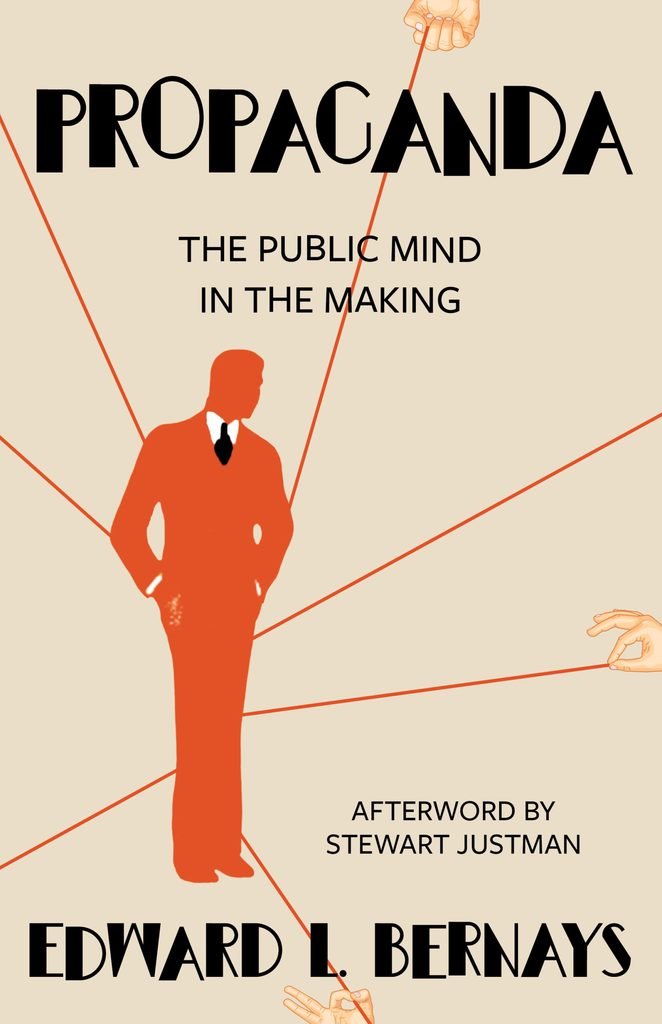
Bernays was fine with that, by the way. He believed an intelligent few should steer public opinion, and he built a whole career doing exactly that.
Then, in his 1965 memoir, he described learning that Joseph Goebbels had been using one of his books, Crystallizing Public Opinion, in the campaign against the Jews of Germany.
“This shocked me,” he wrote, “but I knew any human activity can be used for social purposes or misused for antisocial ones.”
So why is the good side so bad at this?
If Bernays was right and the same tools work for both sides, then the question I keep asking myself is why one side keeps picking them up while the other keeps leaving them on the table.
And the answer can’t be to copy the anger. There’s research on what happens when mainstream parties try that, and it isn’t pretty.
I think the better answer starts somewhere else. Phoenix, Arizona, May 1972, when a farmworker organizer named Dolores Huerta was told that what she wanted to do simply couldn’t be done there.
“No, aquí en Arizona, no se puede.”
That night, she answered them.
We’ll pick up from there next week in Part 2.
Until then, I’d love to know: who was the last person who made you feel like they really got you, and what did they actually say?
FAQs
People rarely follow the person with the best argument. They follow someone they see as one of them. Robert Cialdini calls this unity. Researchers at UC Irvine found that shared values mattered more than twice as much as credentials when people chose which expert to trust. People need to feel understood before an argument can land.
Rarely. Joshua Kalla and David Broockman analyzed 49 field experiments and put the average effect of campaign contact and advertising on U.S. general election choices at zero. The exceptions were unusually unpopular candidate positions and contact made months before the vote, and even that early persuasion faded.
A 2026 study in Frontiers in Sociology found the East–West gap is mainly explained by political distrust, use of alternative political media, and populist or nativist attitudes. Leipzig University’s Elite Monitor shows East Germans are about 19% of the population but hold about 12% of Germany’s top positions.
Anger. Using years of German Socio-Economic Panel data, Nguyen, Salmela and von Scheve found that generalized anger increases support for the AfD even after controlling for specific worries, while generalized fear does not predict it. The difference matters because anger comes with someone to blame.
The curse of knowledge is the difficulty of imagining what it’s like not to know something you already know. In Elizabeth Newton’s 1990 Stanford experiment, people tapping out songs predicted listeners would name half of them. Listeners named 3 of 120. Experts often explain from inside their own heads and lose the room.