
“At the beginning or end of each day, the Stoic sits down with his journal and reviews: what he did, what he thought, what could be improved.”
— Ryan Holiday, The Daily Stoic
I thought I knew what I wanted to say. Then I read the paragraph on my screen and thought, “That makes no sense.”
So I leaned back in my chair and peeped out at the trees blowing in the wind.
This has happened countless times over the past few months. I start an article with an idea and a POV. Then I read the research, write a first draft, and realize the piece is heading somewhere else. Sometimes the original argument survives. Often it changes completely.
I find that what I’ve written helps me realize that the thought I have isn’t finished.
We tend to believe writing begins when thinking ends. My experience keeps showing me the opposite.
The essay was an attempt
The word essay comes from the French verb essayer: to attempt, test, or try. Montaigne called his book Essais. The name described what he was doing on the page, not a container for polished conclusions.
Montaigne first published the work in 1580, expanded it in 1588, and kept revising his copy until his death four years later. The changes he made matter. They are physical evidence that the writing and the thinking moved together. Almost side by side.
In Donald Frame’s translation of the short note he wrote to the reader, Montaigne said, “I am myself the matter of my book.” He put himself inside the subject and used it to examine his own judgment.
That may be the forgotten first life of writing. Before a piece becomes useful to anyone else, it gives the writer somewhere to find out what he actually believes.
Writing catches the mind in the act
Joan Didion put it plainly: “I write entirely to find out what I’m thinking.”
I know the feeling. I’ve written articles that began with an argument I no longer believed by the end. When you reread what you’ve written, the cracks in your argument start to show. A vague idea can live comfortably in your head. Put it into sentences and you see where it contradicts itself, skips a step, or rests on something you don’t believe. It makes you wonder if you even know the point you’re trying to make.
Benjamin Franklin turned that friction into practice. As a young man, he studied essays in The Spectator. He made short notes on each sentence, set them aside, then reconstructed the original. He compared his version with the source and corrected his faults. He also shuffled the notes to work out the argument’s order again.
He learned more than just style. He was learning how thought is arranged.
Shane Parrish argues in Clear Thinking that we need to create space to reason, then deliberately use it. Writing gives that space somewhere to go. A journal offers a smaller version: Ryan Holiday suggests reviewing what helped, what hurt, and what needs work. I have already written about protecting a block with no feed, inbox, or assistant.
One of my mentors, André Chaperon, once wrote that a four-page narrative memo can be harder than a twenty-page presentation. Prose exposes the hierarchy and relationships between ideas. You can’t hide a broken argument between slides, no matter how good your design skills are.
Writing catches thinking in the act of being incomplete.
Then the second job took over
Of course, writing has another job.
It has to earn attention with the opening, keep the promise of the headline, and make the argument easy to follow. It has to work on a small screen. It has to cut whatever wastes the reader’s time.
I recently read an article by Nathan Baugh in which Jack Raines states that a first chapter must hook the reader. The chapters after that have to earn that attention again. He’s right. Nobody owes us another paragraph.
I use hooks. I think about retention. I format for people who skim because, to be fair, most of us do. This is good craft, and good craft is an act of respect.
But in much of the writing advice I see now, the second job has swallowed the first. Then platforms added another audience: the algorithm. We learned to shape the opening for clicks, the paragraphs for retention, and the ending for response.
The mistake that we’re making isn’t learning to write for the reader, but rather deciding that this was all writing was for.
The machine in the middle
AI is the logical endpoint. It helps when it finds research I missed, offers a new angle, or challenges an assumption. Used that way, it helps me rethink.
The trouble starts when I ask it for a finished article. Nine times out of ten, I’m disappointed. The grammar might be clean. The structure might work. But the piece is missing me: my ideas, perspective, and emotional stake.
If I accept it unchanged, I’ve accepted the thinking the machine placed in front of me. AI only exposes whether I did the first job.
Craft is the second act
David Ogilvy’s famous 1982 writing memo is still useful because most of his advice protects the reader’s time: write naturally, use short words and paragraphs, avoid jargon, check your quotations, sleep on important writing, then edit it. And if what you really want is action, he concluded, sometimes you shouldn’t write at all.
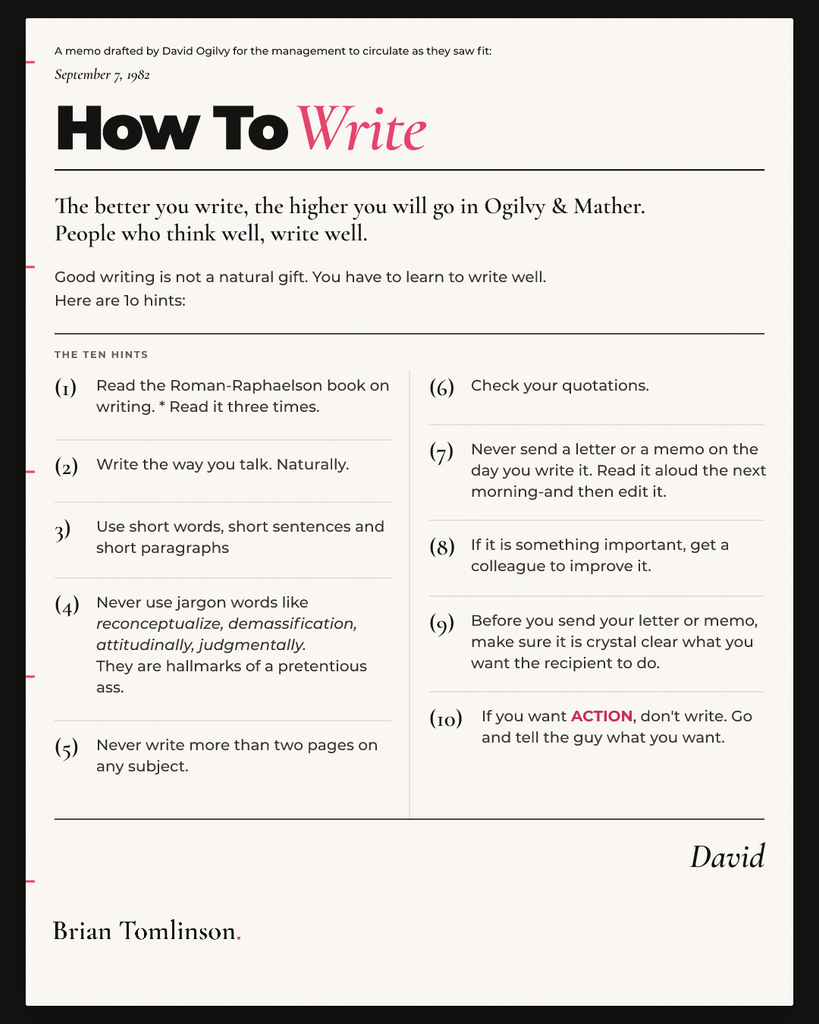
That advice isn’t really about sounding impressive. It’s about clarity, accuracy, revision, and knowing when writing is the wrong medium.
Once the writer knows what he thinks, the reader becomes paramount. Craft spares the reader from having to reproduce the writer’s struggle. The public piece becomes proof of how you think, but only because the writer did the difficult thinking before asking the reader to follow it.
Much competent writing performs this second job beautifully without ever doing the first. That’s why it can be clean, useful, and empty at the same time.
Return to the hand
I loved writing as a kid. I wrote stories and copied pages from books I enjoyed. I even wrote love letters for my friends, although thirty years later, I’m not sure they’d outsource that job to me now.
I think the writing came from reading. I started around four or five, and I loved visiting my grandparents because my grandfather had a shelf of old classics. The Old Man and the Sea. The Count of Monte Cristo. I wanted to get closer to those sentences, so I copied them.
Maybe that old instinct is worth recovering. Take one page you admire and copy it by hand. Handwriting isn’t sacred. Slowing down lets you notice the choices: where the sentence turns, what it leaves out, how one thought makes room for the next.
Serious writing begins not because thinking has ended, but because it hasn’t.
FAQs
Writing can improve thinking because it forces an idea into an explicit sequence. Contradictions, missing evidence, and vague transitions become easier to see on the page. Research on writing-to-learn finds modest benefits, especially in educational settings, so it is best treated as a useful thinking practice rather than a universal law.
An idea can feel complete while it remains in your head. Writing makes you choose an order, define relationships, and commit to specific words. When the sentences do not connect, the gap often belongs to the thought rather than the prose.
Journaling can create a regular space to review what happened, what helped, and what needs work. The direct research on journaling and reasoning quality is thin, however. Its value here is practical: it makes examination visible and gives you something concrete to revisit.
Copywork is the practice of copying strong prose, usually by hand, to study how it works. Benjamin Franklin used a more demanding variation: he made notes on essays, set them aside, reconstructed the originals, and compared his attempt with the source to find his faults.
Use AI to find research, surface objections, and offer alternate angles. Keep the argument, judgment, and final wording in your hands. If you accept a finished draft unchanged, you also accept the machine’s choices about what matters and how the ideas fit together.