

“You can extract a moral from a story, but you can’t extract a story from a moral.” — Chip and Dan Heath, Made to Stick
Communication Moves People, Part 2 of 2
TLDR: a common enemy gets people moving, but it rarely keeps them. The movements that last pick a devil everyone can want gone, and leave room in the “us” for the people on the other side.
In this article:
- What Dolores Huerta kept hearing in Phoenix in 1972, and the three words she answered it with that night
- What 350+ strategies across 108 elections in Western Europe say about copying the other side’s playbook (it doesn’t go the way you’d hope)
- Where the most famous line in Reagan’s Berlin speech came from, and how many drafts left it out
- What happened to the AfD in the polls after 180,000 people marched in Hamburg
- Why Nelson Mandela walked into the Springboks’ dressing room wearing the captain’s number 6
- The devil I picked when I asked a team of writers to get on camera
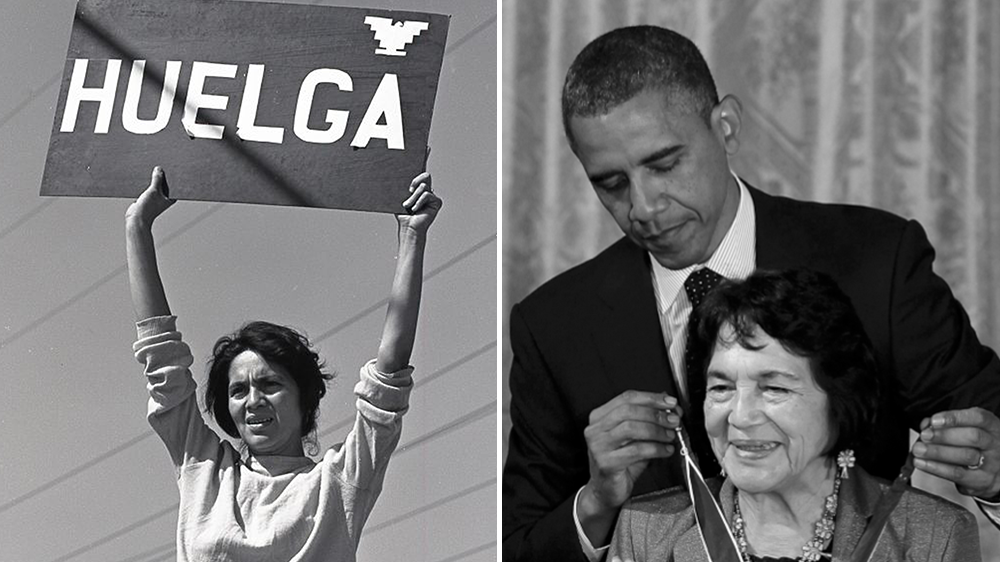
In May 1972, Cesar Chávez was on a water-only fast in Phoenix, Arizona. It would last 25 days.
Arizona had just passed a law that took away farm workers’ right to strike and boycott during the harvest. So Dolores Huerta, who had built the union with him, went to some of the most prominent Latino leaders in the state and asked for their help fighting it.
Their answer was the same, over and over: “No, aquí en Arizona, no se puede.” It can’t be done here in Arizona.
That night, at Santa Rita Hall, she told the room what she’d heard. Then she answered it. “Sí, se puede.”
In her telling, “Everybody stood up, and they started clapping ‘Sí se puede.’”
She could have made the men from that meeting the enemy, and nobody in the hall would have blamed her. She went after the thing they’d said instead.
The devil Dolores Huerta fought that night wasn’t a person. It was a sentence.
Eric Hoffer wrote that a movement can do without a God but never without a devil. Huerta had a devil. It just happened to be “no se puede,” and three words were enough to stand a whole room up against it.
I’ve spent much of my career trusting that good work and clear facts would speak for themselves. Maybe you have too. But Huerta understood something I had to learn much later: people need words that give them a reason to act together.
Where “Yes we can” came from: Dolores Huerta’s “Sí se puede”
Thirty-two years later, in Chicago, David Axelrod was making a Senate ad for an Illinois state senator named Barack Obama, and he wrote “yes we can” into the closing line.
As Axelrod tells it, Obama read it once, got to the end, and asked, “Is that too corny?” Then he turned to Michelle. She slowly shook her head and said, “Not corny.”
Four years later, it became the refrain of the speech he gave on the night he lost the New Hampshire primary.
Funny thing is…Dolores Huerta backed Hillary Clinton that year, and when she was asked about Obama using her slogan, she said, “I think he was using kind of a shortcut.” Four years after that, Obama awarded her the Presidential Medal of Freedom and told the room that “Dolores was very gracious when I told her I had stolen her slogan.”
A good line travels. This one crossed 36 years, two languages and a primary fight on its way to the White House. So I don’t consider “kind of a shortcut” to be an insult. A line that already means something to people is a shortcut, and that’s pretty much the point.
But a shortcut only works if there’s a room at the end of it. In Phoenix, those three words meant something because of who said them. Obama’s campaign built its own rooms behind the line, with volunteer boot camps designed by Marshall Ganz, who had spent 16 years organizing with Huerta and Chávez’s farm workers. The first thing they taught, Ganz said later, was story.
He teaches leaders to tell three stories: a story of self, so others can “get you,” a story of us and a story of now. The first one matters the most, because people follow whoever makes them feel understood, and I don’t think it’s an accident that the “us” comes before the “now.”
Does copying the radical right work for mainstream parties?
There’s a sentence that has been passed around marketing for years. It comes from Blair Warren’s One Sentence Persuasion Course, and Russell Brunson put it near the front of his book Expert Secrets: “People will do anything for those who encourage their dreams, justify their failures, allay their fears, confirm their suspicions, and help them throw rocks at their enemies.”
Most of what makes a mover work is in that sentence, and at the very end of it are the rocks.
So the obvious thing for the side that keeps losing is to start throwing rocks as well. Mainstream parties across Europe have taken this approach for decades, moving toward the radical right’s positions to win those voters back.
Werner Krause, Denis Cohen and Tarik Abou-Chadi examined more than 350 mainstream-party strategies across 108 elections in Western Europe. They found no evidence that it shrinks the radical right. “If anything,” they write, “our results suggest that they lead to more voters defecting to the radical right.”
That teaches us that simply copying the other side’s positions just doesn’t work. Copying someone’s positions isn’t the same as understanding why their message works, and I think the better question to ask is which part of the playbook is worth borrowing at all.
Naming someone’s anger is one thing, but turning a whole group of people into the devil is something else, and that’s where we need to draw the line. You can borrow the clarity: name what people already feel, in their words, in a line they can repeat. What you must not borrow is the contempt. Once the rocks land on a group of people, you might rally your own side, but you’ve made it a lot harder for anyone else to join you.
Who wrote, “Tear down this wall”? The Berlin dinner behind Reagan’s line
Before Ronald Reagan’s visit to Berlin in June 1987, his speechwriter Peter Robinson went there ahead of him. At a dinner with locals, he asked whether people had gotten used to the wall.
One of the guests, Ingeborg Elz, answered: “If this man Gorbachev is serious with his talk of glasnost and perestroika, he can prove it. He can get rid of this wall.”
Robinson took her idea and built the speech around it. The State Department, the National Security Council, Colin Powell and Secretary of State George Shultz all pushed back, and between them they sent in seven alternative drafts. Every one of them left the line out.
When Reagan heard the objections, he said, “Let’s leave it in.” On the way to the wall, he told his deputy chief of staff, “The boys at State are going to kill me, but it’s the right thing to do.”
On June 12, at the Brandenburg Gate, he said, “Mr. Gorbachev, tear down this wall!”
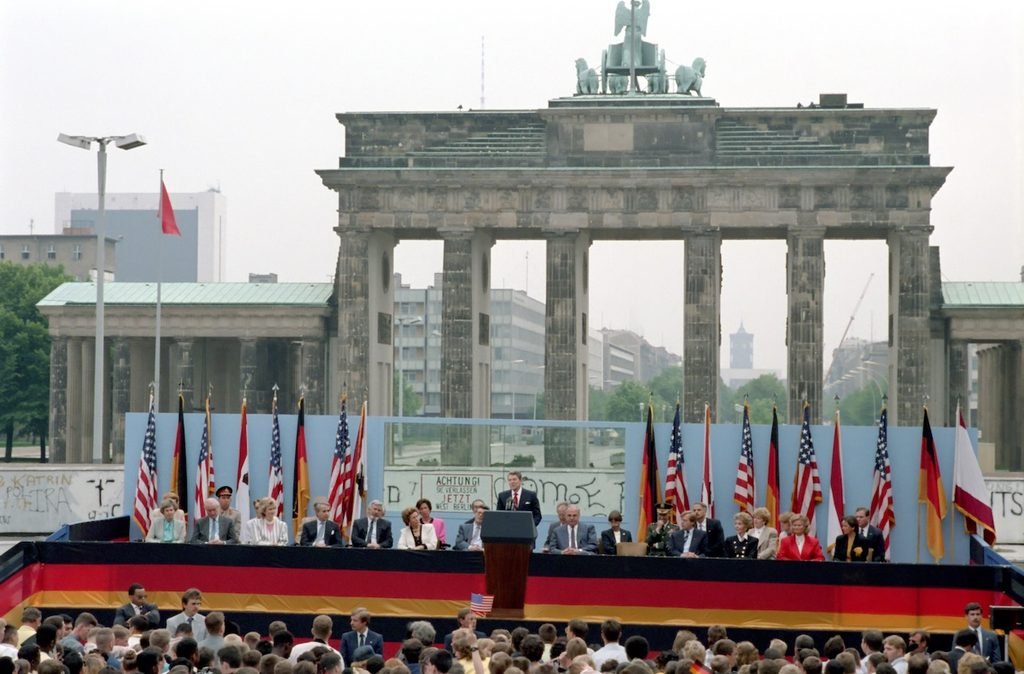
It’s a split you find in most rooms. Explainers believe that if they lay out the facts clearly enough, people will come around. Movers start with what the room already feels and give it words people can repeat. The diplomats had real worries. They thought the line was naive and needlessly provocative, and they answered with seven alternative drafts. In the end, the line most of us still remember started with a woman at a dinner table.
The devil that Reagan picked was a wall, not the East Germans or the Russians as a people, and a wall happened to be the one thing people on both sides of it could want gone.
Hamburg, 2024: who wasn’t in the room?
In January 2024, the newsroom Correctiv reported on a meeting near Potsdam where a “remigration” plan was presented to far-right activists and AfD politicians. Within days, Germany was in the streets.
Here in Hamburg, so many people showed up on January 19 that the march was broken off shortly after it started. The police first counted 50,000. The city later reviewed the aerial photos and put the crowd estimate at 180,000.
The AfD dipped in the polls for a few months. Then it came back, and a year later it was within a point of where it stood before the marches. In September 2026, it won 43.8% of the vote in Saxony-Anhalt (another German state).
That doesn’t mean the marches were a waste. Researchers at Berlin’s WZB found that the AfD lost just under one percentage point in the 2024 European election in the places where people had protested. The marches also built new alliances and brought many people into civic life for the first time. That seems like good progress to me.
But Robert Cialdini makes a point in Influence (the updated edition) that unity built on a common enemy doesn’t work in many situations, “and, when they do, it’s often not for long.” The bonds that last are the ones that feel like family, neighbors and friends, the kind of rooms people already belong to.
A later survey of protesters in Hamburg found that 94 percent were firmly in the camp of the left-of-center parties. That tells us a lot about who showed up, and much less about who the marches persuaded. The question, though, is what story they offered the people who weren’t there.
The marchers knew what they were against. I’m not sure the people who were on the fence, and who tend to be the ones you need most, could see what they were being invited into. You can stand firmly against an idea without giving up on the people you might still win over.
How Mandela used the Springbok jersey to unite South Africa
In 1995, a year after its first free election, South Africa hosted the Rugby World Cup.
In most of black South Africa, the national team, the Springboks, was “reviled as a symbol of racial oppression.” Some of Nelson Mandela’s own cabinet wanted to get rid of the Springbok emblem altogether. He said no.
On June 24, before the final at Ellis Park in Johannesburg, he walked into the team’s dressing room wearing a green Springbok jersey with the number 6 on the back, the number of the team’s captain, Francois Pienaar. The crowd of 65,000 was almost entirely white, and it cheered him as loudly as it cheered the team.
South Africa won in extra time. Afterward, Pienaar said, “We didn’t do it for 60,000 South Africans, but for 43 million South Africans.”
Mandela had spent 27 years in prison. If anyone had a reason to make the people in that stadium the enemy, it was him. His devil was apartheid, and apartheid wasn’t just an idea. People built it, defended it and benefited from it, and he ended up fighting it his entire life. The magical thing he did was invite the people who had cheered for that system’s team into the story.
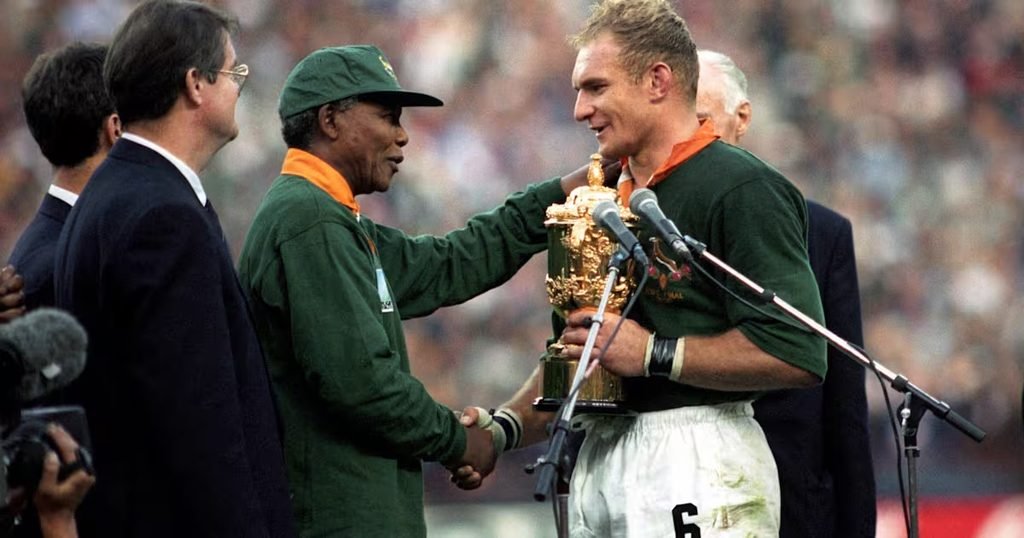
The devil gets people moving, but belonging is what keeps them there, and Mandela made the belonging big enough for the people who had been on the other side.
The quiet ones in the room
Which brings me back to the rest of us, and every room we’ve lost to someone with one good line.
I’ve never really been one for the spotlight. I’ve always preferred to stay in the background and just do the work. A coach once told me that the world needs people like me to also be leaders. But what I saw, again and again, was that being practical, being in the background, and just doing great work wasn’t what lifted you or moved you up through the ranks (unless you already had someone supporting you). I’m an explainer by nature.
When I joined Staffbase, most of our content was built to show up in Google searches. That had worked for years, but it was fading. People were finding and watching content in completely different ways, and LinkedIn pretty much buried any post with a link in it at the time. We had to start working more like a media company, with short videos, a video podcast and our own people on camera.
I remember telling the team that everyone needed to film a video, and I could see the consternation on a lot of the writers’ faces. It went from “I’m not sure,” to filming a few videos and still not being sure, to filming five videos and saying, “Well, this is starting to feel much more natural.”
One of them was in his mid-50s and had grown up in publishing. I remember watching his first video and thinking to myself, “He’s such a natural.” (And the writers, as it turned out, were some of the best people we had on camera.)
Looking back, I think part of why it worked is that I picked the right devil. It was the old-school approach to creating content, not the writers who had been doing it. They were the ones I needed to come with me.
How to pick a better devil without making it a person
So here’s what I’d take into your next room. Start with what people already feel, in their words. Then pick your devil carefully. Make it the problem: the process that eats everyone’s Friday, the way things have always been done, the “no se puede” everyone has gotten used to. Never the team down the hall. And make the “us” big enough for the people you actually need, including the ones who have been doing it the old way.
Before your next change announcement goes out, read it once for three things:
- what you’re fighting
- who might feel blamed
- who needs to feel they belong
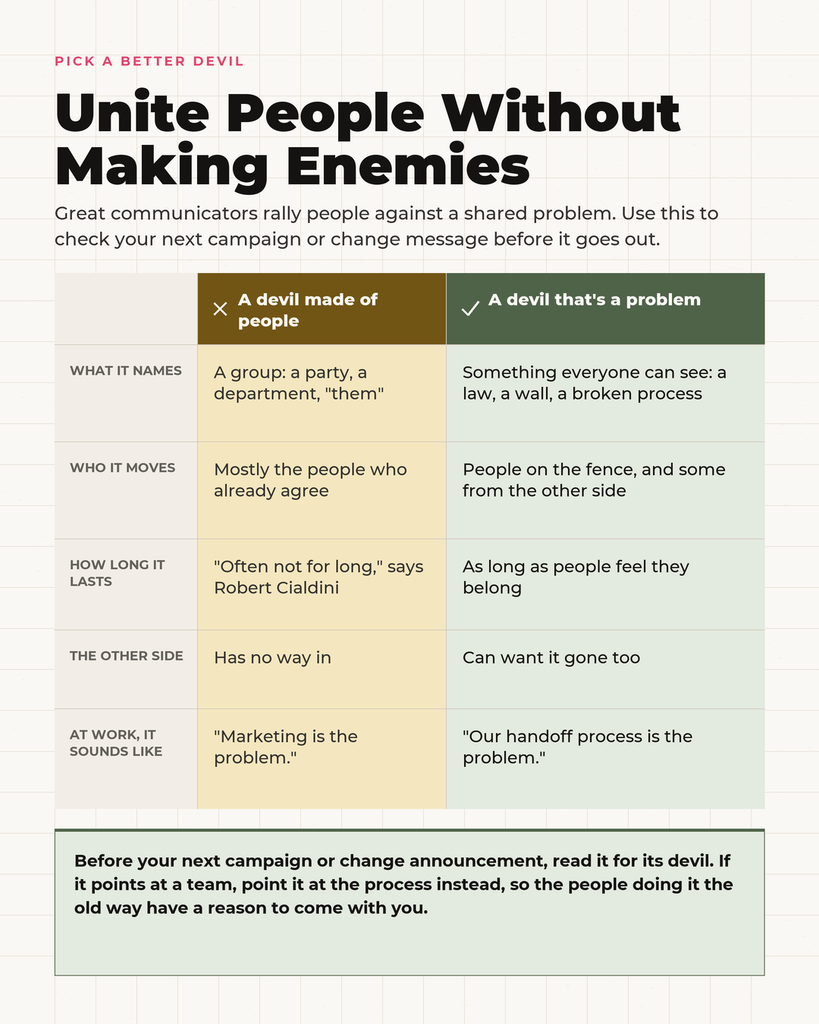
Then rewrite it until you’re fighting the problem and not the people you need beside you.
Communication moves people
When I first got pulled into the Staffbase world, the company had a slogan: “Communication moves people. People move companies.”
It was a belief I already held from my years in comms at big companies. It was simple, clear, and something I could get behind. For a couple of years, that really was the mission.
Today, I’d add one thing to it. It matters a lot where you point people once they start moving, and how big you make the “us” when they get there.
So I’d love to know: what’s the devil in your room right now, and is it a problem or a person?
FAQs
A shared enemy makes groups that disagree see each other as more alike, and it works fast. But Robert Cialdini notes in Influence that unity built on a common enemy often doesn’t work, “and, when they do, it’s often not for long.” Bonds that feel like family, neighbors and friends last longer.
No. Werner Krause, Denis Cohen and Tarik Abou-Chadi studied more than 350 mainstream-party strategies across 108 Western European elections. They found no evidence that moving toward radical-right positions reduces radical-right support. If anything, their results suggest it pushes more voters to defect to the radical right.
Dolores Huerta coined it in Phoenix, Arizona, in May 1972, during Cesar Chávez’s 25-day fast against a law that limited farm workers’ right to strike. When local leaders told her “No, aquí en Arizona, no se puede,” she answered with “Sí, se puede.” Barack Obama later said he had “stolen her slogan.”
Speechwriter Peter Robinson built it from a remark by Ingeborg Elz, a guest at a Berlin dinner, who said Gorbachev “can get rid of this wall.” The State Department and the National Security Council objected and sent seven alternative drafts without the line. Ronald Reagan kept it and delivered it on June 12, 1987.
Marshall Ganz, a Harvard lecturer and longtime farm-worker organizer, teaches leaders to tell three stories: a story of self, so others can “get you”; a story of us, built on shared values; and a story of now, about the urgent challenge. He describes public narrative as leadership that moves others to act on a shared purpose.